
Follow us on social

google cta
J.D. Vance

J.D. Vance is tie-breaker killing War Powers vote

Republicans stopped the process before colleagues could even weigh in on further military force in Venezuela

Reporting | QiOSK
google cta
google cta

Republican senators used a procedural measure to kill a resolution today that would have halted unauthorized hostilities against Venezuela.

Before a vote could take place for S.J. Res. 98, sponsored by Sen. Tim Kaine (D-Va.), Sen. Jim Risch (R-Id.) challenged the resolution’s privileged status in a point of order along the lines that there were no ongoing hostilities with Venezuela.

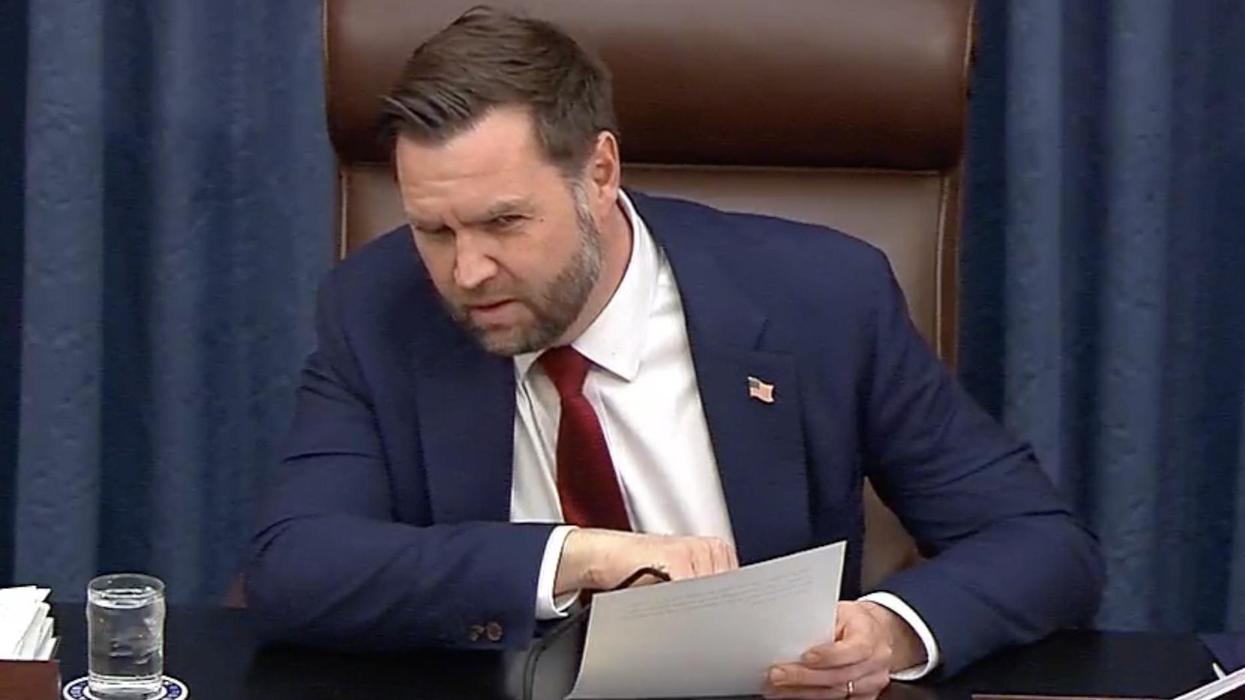
That point of order prompted a vote, which tied 50-50. Vice President J.D. Vance broke that tie and voted for the point of order, thus removing the resolution from immediate consideration on the Senate Floor.

Sens. Todd Young (R-In.) and Josh Hawley (R-Mo.), who voted to advance the resolution last week, also voted for the point of order.

On the Senate floor the day of the vote, Republican leadership asserted that war powers are unnecessary, because there are no ongoing hostilities between the U.S. and Venezuela.

“We have no troops on the ground in Venezuela. We’re not currently conducting military operations there,” Sen. John Thune (R- S.D.) said before the vote.

“The objective of this resolution is to stop something that is not happening,” Sen. Jim Risch (R- Id.) said.

Angered by the procedural move to quash the vote, resolution supporters contended that hostilities with Venezuela have already begun, and that Congress must assert its power to block further unauthorized action.

“Certainly [the senators moving to block the resolution] must think that invasion of a capital is a war, that removing a president is war, or a blockade of a country. So even though the first incursion, the first invasion, may well be over — is the blockade of a country not a war?,” Sen. Rand Paul asked. “Are we not at war when we have a military blockade of a country?’

“An argument that the Venezuela campaign is not imminent hostilities, within the meaning of the War Powers Resolution, is a violation of every reasonable meaning of that term,” Sen. Kaine charged. “To pretend otherwise would weaken the respect that this institution should aspire to.”

The Trump administration previously said it was “not afraid” to put “boots on the ground” in Venezuela if needed. It also said it would have to “run” the country until a transition of power can occur.

Before today’s failed attempt to assert its war powers there were a string of other unsuccessful efforts, which aimed to either stop hostilities against Iran, Venezuela, or attacks on the so-called “narcoterrorist” boats in the Caribbean.

The Senate last passed a War Powers Resolution back in 2020, to bar unauthorized hostilities against Iran; Trump vetoed that resolution.


Top image credit: senate.gov [screenshot]
google cta
Reporting | QiOSK
G7 Summit
Top photo credit: May 21, 2023, Hiroshima, Hiroshima, Japan: (From R to L) Comoros' President Azali Assoumani, World Trade Organization (WTO) Director-General Ngozi Okonjo-Iweala, Australia's Prime Minister Anthony Albanese and India's Prime Minister Narendra Modi at the G7 summit in Hiroshima, Japan. (Credit Image: © POOL via ZUMA Press Wire)

Middle Powers are setting the table so they won't be 'on the menu'

Asia-Pacific

The global order was already fragmenting before Donald Trump returned to the White House. But the upended “rules” of global economic and foreign policies have now reached a point of no return.

What has changed is not direction, but speed. Canadian Prime Minister Mark Carney’s remarks in Davos last month — “Middle powers must act together, because if we’re not at the table, we’re on the menu” — captured the consequences of not acting quickly. And Carney is not alone in those fears.

keep readingShow less
Vice President JD Vance Azerbaijan Armenia
U.S. Vice President JD Vance gets out of a car before boarding Air Force Two upon departure for Azerbaijan, at Zvartnots International Airport in Yerevan, Armenia, February 10, 2026. REUTERS/Kevin Lamarque/Pool

VP Vance’s timely TRIPP to the South Caucasus

Washington Politics

Vice President JD Vance’s regional tour to Armenia and Azerbaijan this week — the highest level visit by an American official to the South Caucasus since Vice President Joe Biden went to Georgia in 2009 — demonstrates that Washington is not ignoring Yerevan and Baku and is taking an active role in their normalization process.

Vance’s stop in Armenia included an announcement that Yerevan has procured $11 million in U.S. defense systems — a first — in particular Shield AI’s V-BAT, an ISR unmanned aircraft system. It was also announced that the second stage of a groundbreaking AI supercomputer project led by Firebird, a U.S.-based AI cloud and infrastructure company, would commence after having secured American licensing for the sale and delivery of an additional 41,000 NVIDIA GB300 graphics processing units.

keep readingShow less
United Nations
Monitors at the United Nations General Assembly hall display the results of a vote on a resolution condemning the annexation of parts of Ukraine by Russia, amid Russia's invasion of Ukraine, at the United Nations Headquarters in New York City, New York, U.S., October 12, 2022. REUTERS/David 'Dee' Delgado||

We're burying the rules based order. But what's next?

Global Crises

In a Davos speech widely praised for its intellectual rigor and willingness to confront established truths, Canadian Prime Minister Mark Carney finally laid the fiction of the “rules-based international order” to rest.

The “rules-based order” — or RBIO — was never a neutral description of the post-World War II system of international law and multilateral institutions. Rather, it was a discourse born out of insecurity over the West’s decline and unwillingness to share power. Aimed at preserving the power structures of the past by shaping the norms and standards of the future, the RBIO was invariably something that needed to be “defended” against those who were accused of opposing it, rather than an inclusive system that governed relations between all states.

keep readingShow less
google cta
Want more of our stories on Google?
Click here to make us a Preferred Source.

LATEST

QIOSK

Newsletter

Subscribe now to our weekly round-up and don't miss a beat with your favorite RS contributors and reporters, as well as staff analysis, opinion, and news promoting a positive, non-partisan vision of U.S. foreign policy.