

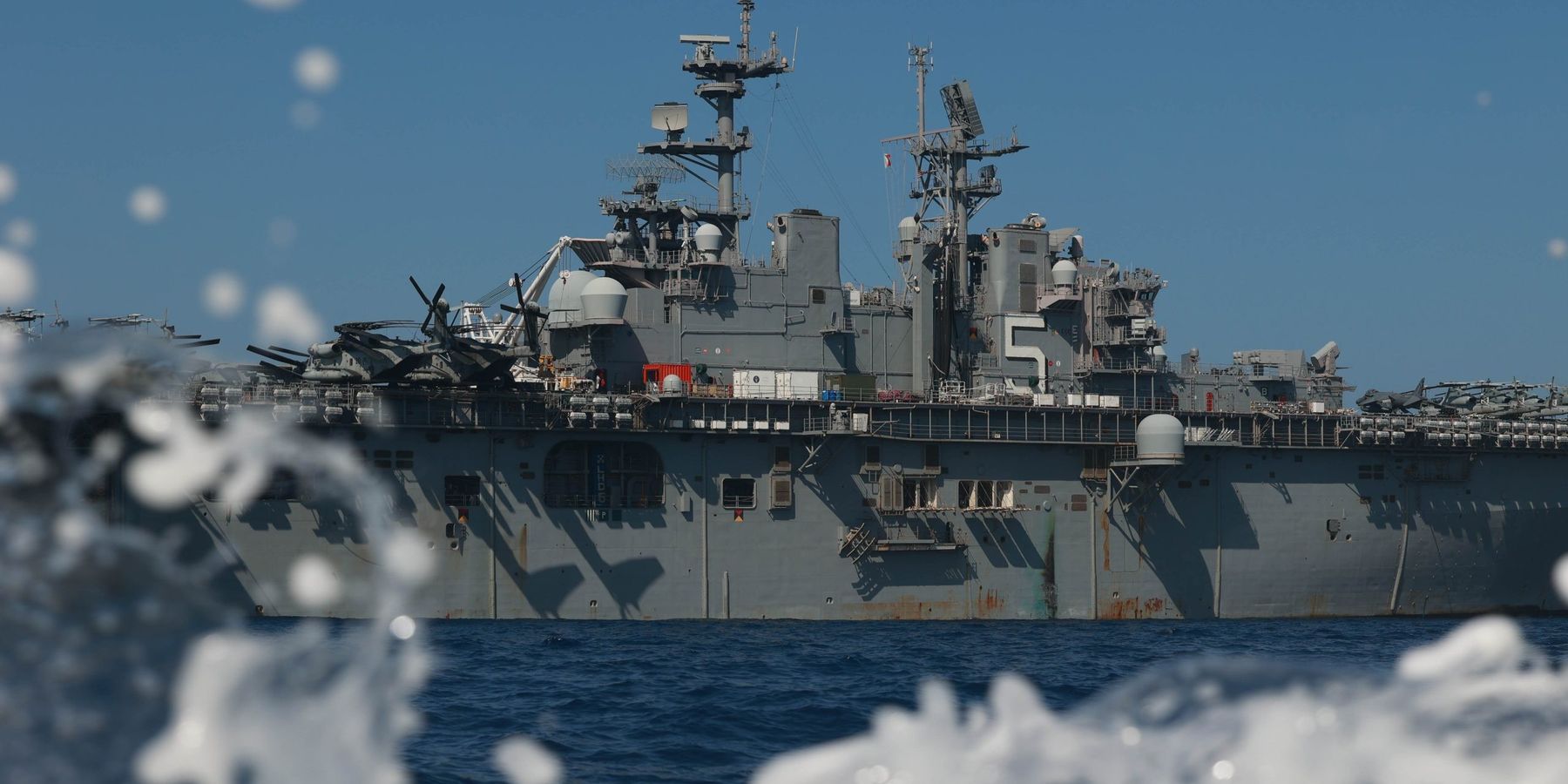
“We're doing the entire world a favor by getting rid of these guys and their ability to strike global shipping,” U.S. Secretary of State Marco Rubio told Face the Nation on March 16 after President Donald Trump announced an extended campaign of U.S. military strikes intended to halt the Iranian-backed Houthis’ attacks on international commerce in the Red Sea.
You’ll have to forgive the rest of the world if it reacts with confusion rather than gratitude. After spending the past month justifiably browbeating European allies for their willingness to free-ride on U.S. military power, the Trump administration is allowing them — and shirking partners elsewhere — to do just that.
Far from a clear signal of resolve, U.S. military strikes in Yemen send a decidedly mixed message about the role Trump and his advisors want the United States to play in the world.
Houthi attacks against commercial shipping passing through the narrow Bab el-Mandeb Strait, purportedly in support of Palestinian militants battling the Israeli Defense Force, started about 16 months ago. Though the group paused operations with the onset of the January 2025 ceasefire between Hamas and Israel, it threatened to resume its operations after Israel cut off humanitarian aid to the Gaza Strip at the beginning of March.
The temporary calm had little effect on international shipping, which has largely avoided the Red Sea passageway — formerly home to some 12% of global trade — since the Houthi campaign began. Most carriers have opted for the longer but safer route around the Cape of Good Hope.
The disruption has had economic costs, but fewer than expected, especially for the United States. The United States does not rely on trade running through the Middle East. With direct ocean access to markets in Asia and Europe and little dependence on Middle Eastern oil, U.S. trade has been resilient to Red Sea disruptions. Shipping rates to and from ports on the U.S. east and west coast have risen since 2023, but less than routes elsewhere, and they remain far below pandemic highs. U.S. energy prices and inflation have not seen long-term increases.
The effects of Houthi attacks have been more significant in Europe which depends heavily on Red Sea shipping routes for trade with Asia and oil and gas coming from the Persian Gulf. Though Europe’s markets have adjusted somewhat to the more expensive shipping route around Africa’s southern tip, the continent has suffered lasting supply chain disruptions and higher energy prices which have interrupted manufacturing in Germany and Belgium, contributed to delays for consumers, and slowed economic growth.
There have been other losers from the two-thirds drop in international shipping through the Bab el-Mandeb precipitated by Houthi attacks, including the countries neighboring the Red Sea whose ports are now quiet. China, also dependent on oil trade through the region, has escaped largely unscathed, reportedly by paying bribes to the Houthis themselves.
Although the costs of Houthi strikes to the United States have been modest and smaller by far than those borne by European allies or partners in the Middle East, Washington has paid the high costs of fighting back, with limited success.
As of January 2025, the U.S. Navy surface fleet has fired 120 SM-2 missiles, 80 SM-6 missiles, 20 Evolved Sea Sparrow Missiles (ESSM) and SM-3 missiles, part of its campaign to intercept Houthi missiles and drones. This amounts to close to $1 billion even before counting the years’ worth of production of air-launched missiles that the U.S. fighter jets have launched at targets inside of Yemen.
In its efforts against the Houthis, the United States has received precious little help from European allies or Middle Eastern partners who stand to gain much more from the return of shipping to Red Sea routes. The United Kingdom offered some support to U.S. air strikes on Houthi targets under President Joe Biden’s administration, and the French Navy often escorts to its own commercial ships in the region. But the European Union has contributed just four frigates to patrol Red Sea waters and countries in the Persian Gulf have been reluctant to meaningfully support U.S. activities.
In the Red Sea, as elsewhere, the world has been mostly content to free-ride off American military power.
Surprisingly, as it starts yet another round of military strikes against the Houthis, the Trump administration seems content to let this free-riding continue. This is a sharp departure from its past warnings to allies and partners.
Since returning to office in January, Trump and his national security team have been clear. The United States will no longer underwrite collective global security. It will not serve as Europe’s primary security guarantor and will not promise protection to allies who do not meet defense spending targets. The administration has sent similar signals to Taiwan and Japan, insisting that both increase military budgets and carry more of the burden for their own defense.
This shift in orientation is commendable and long overdue.
Now, in the Red Sea, the administration is sending allies and partners the opposite message, stepping in to bail them out once again by expending millions — maybe billions — in taxpayer dollars in pursuit of security objectives that — if achieved — will be of greater value to Europe and Arab partners than to the United States. True, freedom of navigation is a core U.S. national interest, one worth using military force to uphold when U.S. economic prosperity is threatened. This is hardly the case in the Red Sea, however.
More importantly, freedom of navigation is a global common good, whose benefits do not accrue to the United States alone. Accordingly, the United States should not be solely responsible for defending freedom of the seas. This should be a shared burden. Washington should demand that all those who stand to benefit from the return of commercial traffic to the Red Sea are willing to put their own ships, personnel, and dollars on the line.
Instead of rescuing them once again, for instance, Trump and his advisors should call on European allies to carry most, if not all, of the burden of defending the contested Red Sea waters, with support from Arab stakeholders. Their willingness to do so would, in fact, be a first real-world test of their stated commitment to do more for their own security.
Critics will argue that neither Europe nor U.S. Arab partners have the capacity to match U.S. military power against the Houthis. This is not a reason for the United States to fill the gap. First, U.S. vital interests and economic security are not at risk in the Red Sea, even if Houthi attacks continue. Second, U.S. military operations have not deterred or degraded the Houthis in a meaningful way and are unlikely to be so going forward, even if Trump expands the target list.
After surviving years of Saudi bombings, the Houthis are confident they can withstand American offensives too. If anything, their willingness to take on American attacks lend them credibility and win them popular support across the region. Whether or not Europe proves able to act effectively against the Houthis without American support, the most likely outcome in the Red Sea is a continuation of the status quo. Washington would still benefit from having Europe take the lead, since it could conserve U.S. military resources.
Trump and his advisors are right to push for defense burden-shifting and to let U.S. national interests, not those of allies, drive the use of U.S. military force. The renewed campaign in the Red Sea, however, is a page out of an old playbook that lets allies off the hook and puts America back in the “global security guarantor” role that Trump has rightly rejected.
In the Red Sea, Trump and his advisors should stick to their mantra. It’s time for the United States to step back and allies to step up.
- Are the Houthis winning in the Red Sea? ›
- An illegal war with Houthis isn't stopping the Red Sea crisis ›
- Does the US military even know why it's bombing Yemen? | Responsible Statecraft ›
- Massie interview: Houthi strikes 'not America First' | Responsible Statecraft ›
- Can Bernie stop billions in new US weapons going to Israel? | Responsible Statecraft ›
- Trump deal with the Houthis: Declare victory and go home? | Responsible Statecraft ›