

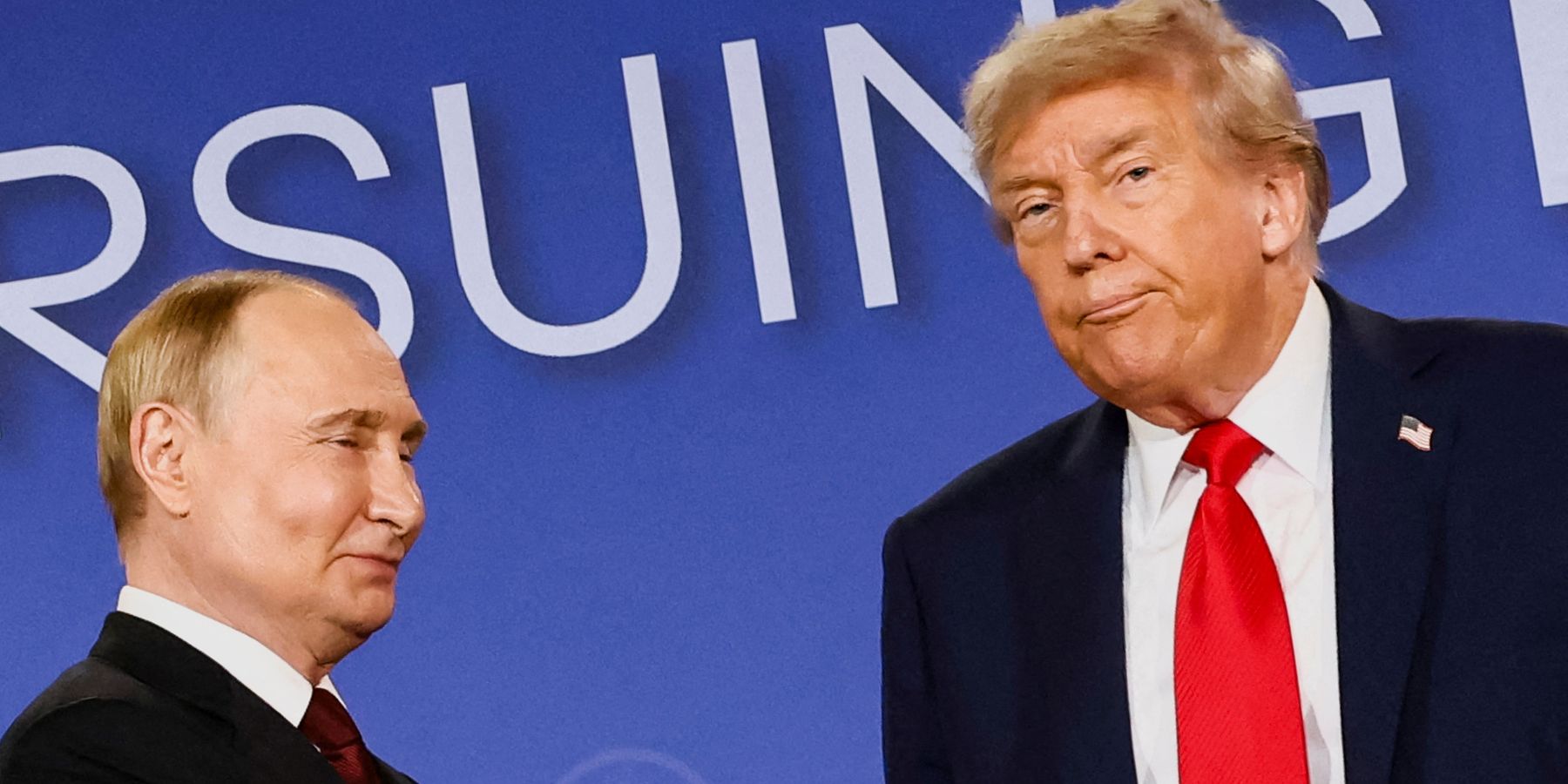
The much anticipated meeting between President Donald Trump and President Putin ended earlier than expected, but the two leaders addressed the press afterwards and appeared amicable while hinting at progress on an "agreement."
But no deal, nor a framework for a deal was announced. They did not take questions afterwards. Trump, who had said earlier that without a ceasefire at the end of the day he might slap Russia with new sanctions, did not go there. If anything they broached the issue of a second meeting. Putin even suggested it could be in Moscow.
"There were many, many points that we agreed on, most of them, I would say, a couple of big ones that we haven't quite gotten there, but we've made some headway. So there's no deal until there's a deal," Trump said in his own statement following the nearly three-hour closed-door meeting that included two members of each delegation in addition to the two leaders (Russian Foreign Minister Sergei Lavrov and aide Yuri Ushakov for the Russian side; Secretary of State Marco Rubio and special envoy Steve Witkoff for the U.S.).
“I will call up NATO in a little while. I will call up, the various people that I think are appropriate and, of course, call up (Ukrainian) President (Volodymyr) Zelensky and tell him about today’s meeting. And so ultimately up to them,” he added, noting "we had real progress today."
For his part, Putin recalled shared history between the U.S. and Russia (World War II) and the shared desire to end the war, noting that he and Trump had open lines of communication after relations of the two governments fell to their "lowest point," and that "it's very important for our countries to turn the page to go back to cooperation." He actually referred to an "agreement" while reiterating his longstanding position of what needed to happen before a peace deal was struck.
"We're convinced that in order to, to make the settlement lasting and long term, we need to eliminate all the primary roots, the primary causes of that conflict, and we've said it multiple times, to consider all legitimate concerns of Russia and to reinstate a just balance of security in Europe and in the world on the whole, and agree with President Trump, as he has said today, that naturally, the security of Ukraine should be ensured as well. Naturally, we are prepared to work on that."
"I would like to hope that the agreement that we've reached together will help us bring closer that goal and will pave the path towards peace in Ukraine. We expect that Kyiv and European capitals will perceive that constructively and that they won't throw a wrench in the works," he said. "They will not make any attempts to use some backroom dealings to conduct provocations to torpedo the nascent progress."
So what to make of it? "While the exact results of the summit remain to be seen, Presidents Trump and Putin each gave some indication that the outline of a framework deal to end the war in Ukraine — and substantially improve US-Russia relations — was reached today," said George Beebe, director of the Quincy Institute's Grand Strategy Program. "The next step will be more consultation between the U.S., Ukraine, and Europe about this framework."
Not everyone agreed. Matt Dimmick, the former Russia director for the Office for the Secretary of Defense in the first Trump administration, told Al Jazeera that Trump’s demeanor appeared “subdued" indicating he wasn't thrilled with the outcome of the 3-on-3 meeting. Another meeting that was reportedly to include a larger group including trade representatives of both governments, never transpired.
“The fact that both of them went up, gave brief statements, talked in vague terms and had really no concrete deliverables to discuss with the press, I think, says everything about this particular sit-down,” Dimmick said, adding that Russia will no doubt report it out as a "win."
“I don’t think there’s any argument that the Russians have won just by showing up and having a red carpet rolled out for them."
Mark Episkopos, senior fellow at the Quincy Institute, disagrees that there was no progress to be seen in the entire affair.
"Contrary to those saying 'no deal,' there is cause to believe that the outlines of a framework deal to end the war in Ukraine and substantially improve US-Russia relations were reached today," Episkopos posted on X. "What remains is additional triangulation between the US and Ukr/EU."
Quincy's Anatol Lieven, director of the Eurasia Program, thought it might have been possible for the Trump administration to take home more than that. "Peace talks to end the war are badly needed, and peace talks are almost invariably a long and difficult process that has to begin somewhere," he said.
"But it was a mistake for Trump to hold a summit without 'sherpas' having reached detailed agreement in advance — that is really not how things are usually done, and for good reason, as it makes it look as if Trump has given Putin an escape from diplomatic isolation from the West without getting anything solid in return."
- On Ukraine war, Euro leaders begin to make concessions — to reality ›
- Trouble in Russian economy means Putin really needs Alaska talks too ›
- Why Trump gets it right on Ukraine peace | Responsible Statecraft ›