

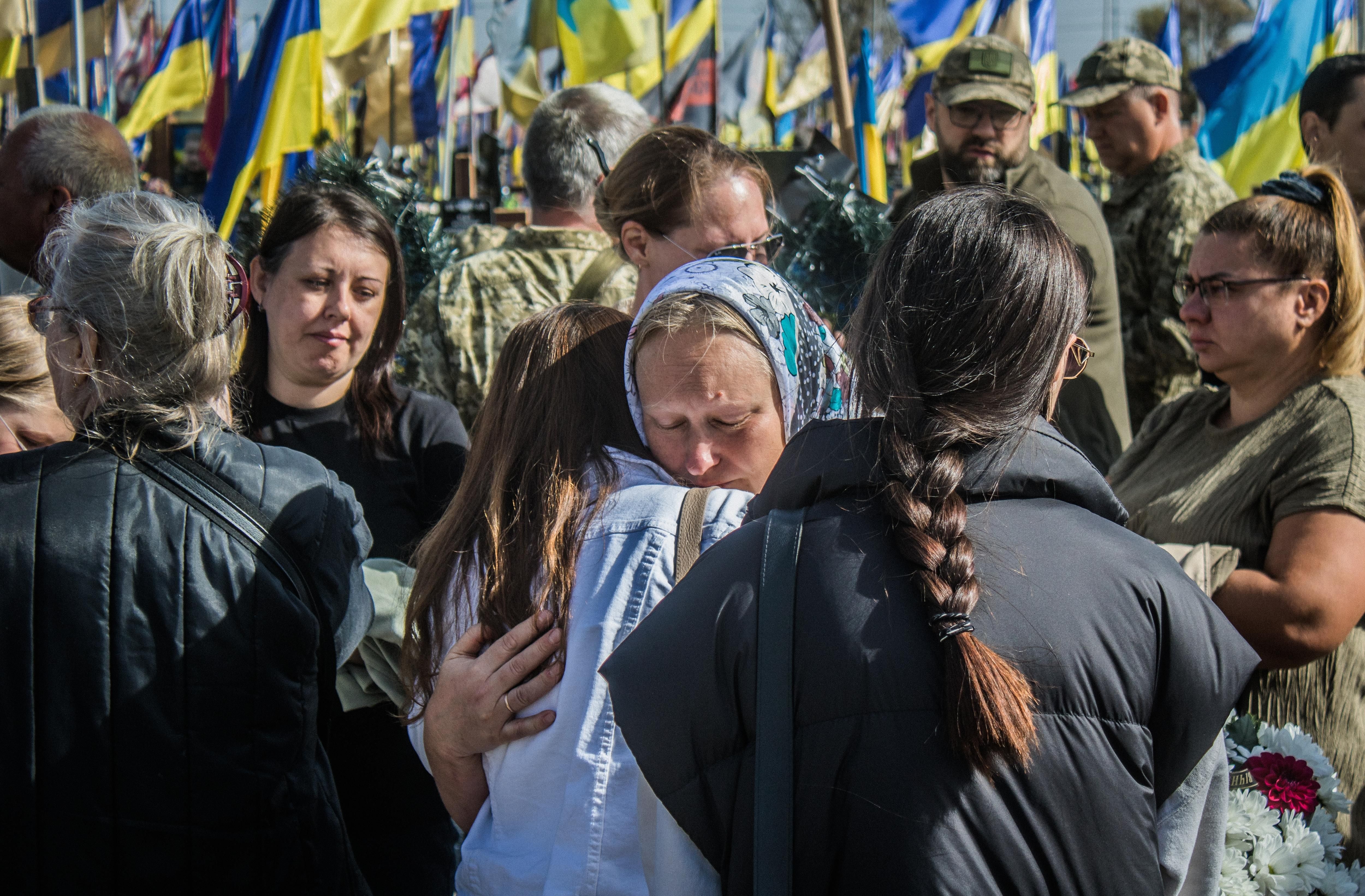
As negotiations accelerate toward a compromise settlement to end the Ukraine war, the voices of the Ukrainians living through the daily horrors have in many ways been suppressed by unending maximalist rhetoric from those far from the frontlines.
The original 28-point working draft that set out an estimation of a compromise between Russian and Ukrainian positions met a harsh response by those who have demanded no less than a complete Ukrainian victory and a decisive Russian defeat throughout this almost four-year-long war.
The draft peace plan has since been revised with input from Kyiv and various European capitals, evolving into several separate documents focused on resolving the war, establishing security guarantees for Ukraine, and outlining an economic recovery plan. Following Sunday’s meeting in Florida between U.S. President Donald Trump and Ukrainian President Volodymyr Zelensky and their respective delegations, both leaders expressed confidence that while some “thorny” issues still remain, peace is now much closer, an assessment shared by the Kremlin.
While any compromise agreement ultimately reached will satisfy neither Russian nor Ukrainian maximalist demands, the foundations for a durable peace may now be on the table and within reach.
Throughout the devastating war and resulting chaos, Ukrainians living along both sides of the frontline have organized communities of informal services to help maintain relative order across the battle-scarred regions. A number of Ukrainians agreed to speak with Responsible Statecraft to share their thoughts on and hopes for a peaceful settlement and the opportunities for Ukraine to secure its future and achieve lasting peace. Pseudonyms have been used to protect the safety of those who agreed to talk with us.
For many Ukrainians who have lost relatives and loved ones, “war is not news headlines—it is everyday life,” says Maria, who lives in frontline northeastern Ukraine, part of which is currently under Russian control.
“The recent change in the U.S. administration and President Trump has sparked hope for a possible resolution of the conflict with Russia and the signing of a peace agreement. The recently published 28-point U.S. peace plan has once again made people talk about the possibility of ending the war,” says Maria who describes herself as an “ordinary woman” living in a frontline region where security is a “key issue.” Facing the daily consequences of war, she hopes for “a ceasefire, silence, and the chance to simply live without constant fear. We want a sustainable, long-term peace — not on paper, but in reality: a peace that saves lives, allows destroyed cities to be rebuilt, and restores a sense of security, dignity, and a future.”
According to a Gallup poll from this past summer, 69% of Ukrainians favored “a negotiated end to the war as soon as possible,” whereas 24% say they “support continuing to fight until victory.” This is a significant shift from 2022, when 73% supported fighting until victory and 22% favored a negotiated resolution as soon as possible.
The most sensitive, unresolved issues concern demands by Ukraine for security guarantees and Russia for Kyiv to cede the remaining territory of the Donbas region under its control. Threading this needle has consumed much of the negotiators’ time and attention over the last several weeks, as ultimately both Moscow and Kyiv need to accept the terms of the agreement.
A December survey by the Kyiv International Institute of Sociology showed that 72% of Ukrainians supported freezing the current front line and providing security guarantees for Ukraine. At the same time, 75% of Ukrainians oppose a proposal to cede the remainder of Donbas to Russia without solid security guarantees.
“Russia should be legally bound to pursue a policy of non-aggression toward Ukraine and Europe, while the United States and Russia should extend their agreements on nuclear non-proliferation and arms control. Ukraine, in turn, reaffirms its status as a non-nuclear state,” says Maria.
Ukrainians’ shared fears are the risk of further escalation of the conflict and the possible unleashing of nuclear weapons. “This prospect is not abstract, it’s a real and deeply personal anxiety for our children, our land, our people, and frightening in a very concrete way—the fear of losing our loved ones, our country dear to our hearts, with its rivers, forests and fields, cities and villages,” Maria says how Ukrainian mothers’ shared common goal is preserving “Ukraine for future generations.”
According to Ivan, who lives in eastern Ukraine under Moscow’s control, the proposals concerning halting further NATO enlargement “are key, as it was the expansion of NATO to the East that became the main trigger for our conflict. Without resolving this issue, it is impossible to resolve others.”
Ivan underscores the importance of the provisions from the original agreement for “promoting understanding and tolerance of different cultures and eliminating racism and prejudice.” He believes the “eliminating racism” phrase must be replaced with “eliminating hatred”, as this “more reflects the situation in the society on both sides of the front line.” He offers the metaphor that “issues of language and religion in Ukraine are abscessing boils, without careful ‘treatment’ of which it is impossible to heal the entire ‘body’ of the state.”
While acknowledging that such a sensitive issue of territorial control will be resolved at the negotiating table, Ivan’s sincere wish is for the voices of those living in territories not controlled by Kyiv to be heard. “Ask them if they want to be ‘liberated’, if they want to return to Ukraine. Most people will answer these questions with an unequivocal ‘no.’ And most of the time, there is no politics in this. People are very tired and brave. And they want peace.”
The proposal that Ukraine hold elections within 100 days of signing the peace agreement, Maria believes, is “necessary,” since trust in the current authorities “remains sensitive.” And holding elections could become “an important step toward renewing public trust.”
For Tatiana, “Ukrainian political elites see that they are being made to pay with Ukrainian lives for a compromise between major powers, yet they do not resist this process.” She offers a grim but accurate assessment of the realities facing ordinary Ukrainians, for whom “this is not true peace but rather a partial transformation into a permanent buffer zone. Still, it represents a halt to the conveyor belt of death, in which people on both sides are killed, and cities are destroyed into lunar landscapes — all for goals that are unclear to anyone and far removed from the daily lives of most Ukrainians.”
“In the end, every side speaks of peace, but means something different by it: the United States seeks a managed exit, the European Union seeks its own security, and Ukraine seeks survival and the right not to be cannon fodder in someone else’s game,” says Tatiana.
For Ivan, the involvement of “representatives of civil society from both sides and experts on specific issues” is critical in addressing the concerns of citizens.
Maxim, who fully supports the 28 points of the Peace Agreement, is deeply committed to peace on his land. He underscores his support for “not only a ceasefire, but also humanitarian issues aimed at protecting and supporting the civilian population on both sides of the conflict.”
Maria agrees with the establishing of “a humanitarian committee to address unresolved issues, including the exchange of prisoners of war and the return of detained civilians.” The underlying concern among all Ukrainians is how the war has divided families; from those living in territories not controlled by the Ukrainian government, to those relocated to western regions where there’s less shelling, and still others who have fled to neighboring countries.
“We need to reunite our families, to have physical access to our loved ones, and to see our husbands, brothers, and fathers return from the frontlines alive and unharmed. We want to focus on rebuilding cities and villages — the restoration of human ties is essential for societal healing,” Maria says.