
Follow us on social

google cta
Donald Trump Marc Fogel

Trump's peace efforts should be a wake-up call for Dems

He's had some dumb ideas too but he's running circles around the left

Analysis | QiOSK
google cta
google cta

In less than 3 weeks, President Trump secured a ceasefire in Gaza, spoke directly to Russian President Vladimir Putin and Ukrainian President Volodomyr Zelensky, and kickstarted diplomacy to end the Ukraine war. At the same time, he has also put forward some idiotic ideas, such as pushing Palestinians out of Gaza and making Canada the 51st state.

But it raises important questions: Why didn't the Biden administration choose to push for an end to the wars in Gaza and Ukraine? Why didn't the majority of the Democrats demand it? Instead, they went down the path of putting Liz Cheney on a pedestal and having Kamala Harris brag about having the most lethal military in the world while Trump positioned himself as a peace candidate — justifiably or not.

Undoubtedly, Trump's plans in Gaza may make matters worse and his diplomacy with Putin may fail. But that isn't the point.

The point is: Why did Trump choose to pursue diplomacy and seek an end to the wars, and why did the Democrats under Biden choose to transform the party into one that embraced war and glorified warmongers like Cheney, while protecting and enabling a genocide?

What happened that caused the party to vilify its own voices for peace — such as Reps. Ilhan Omar (D-Minn.) and Rashida Tlaib (D-Mich.) — while embracing some of the architects of the Iraq war?

And all of this, of course, in complete defiance of where the party base was (throughout the Gaza war, the base supported a ceasefire with 70% majority, for instance).

A profound reckoning is needed within the Democratic Party to save it from slipping into becoming neocon by default.

And with the pace at which Trump is moving, that reckoning needs to come fast. It will, for instance, be a severe mistake if the party positions itself to the right of Trump and reflexively opposes him on every foreign policy issue instead of basing the party's positions on solid principles, such as centering diplomacy, military restraint, and peace. Trump currently speaks more about peace than the Democrats do.

A senior Democratic lawmaker asked me rhetorically last week if I knew anyone who was happy with the foreign policy of Biden and voted for Harris on that basis.

I was happy to hear that the question was being asked. That's a good first step.


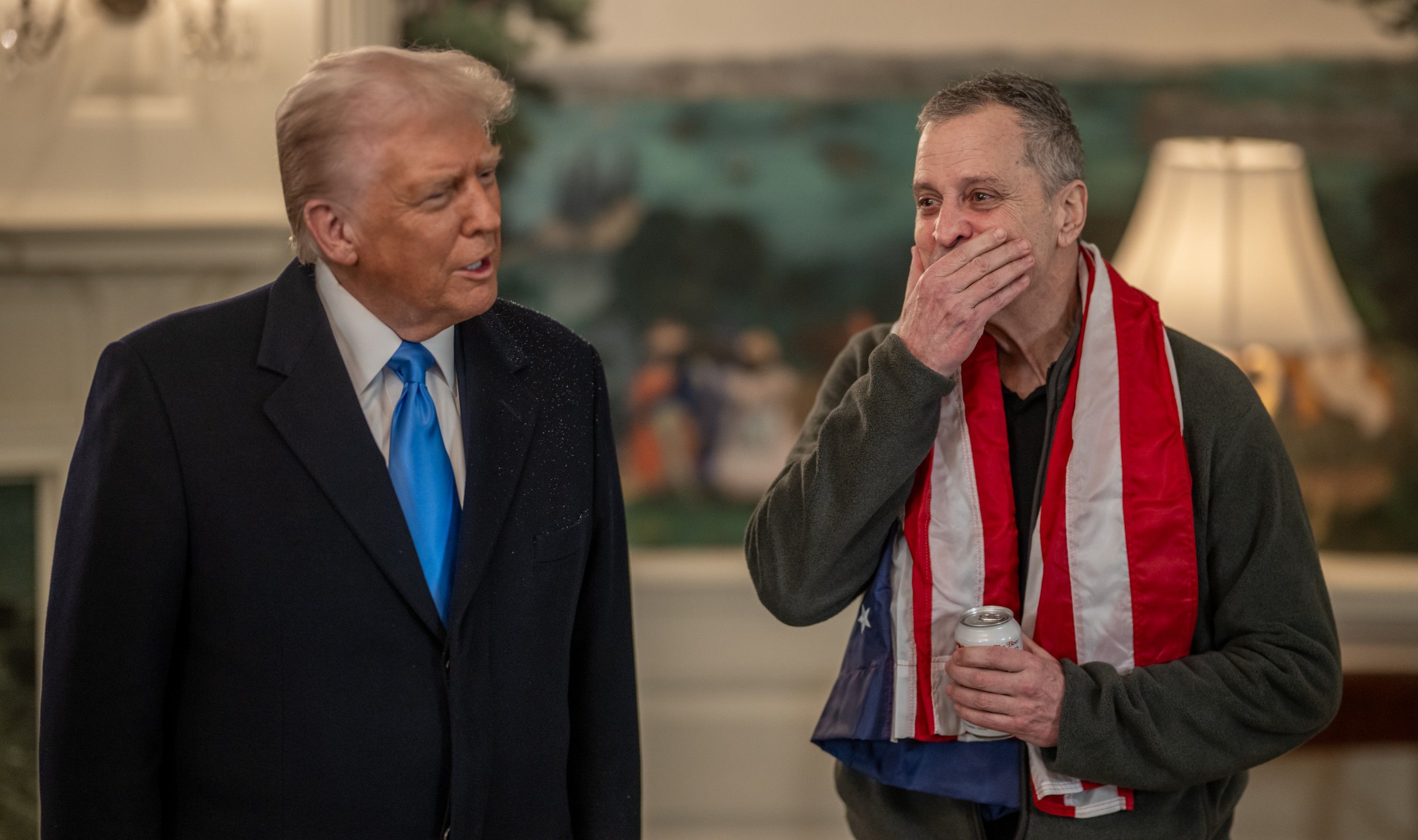
Top image credit: President Donald J. Trump greets Marc Fogel at the White House after his release from a Russian prison, Tuesday, February 11, 2025. (Official White House Photo by Daniel Torok)
google cta
Analysis | QiOSK
'In Trump we trust': Arab states frustrated with stalled Gaza plan
Top image credit: (L to R) Comfort Ero, CEO & President of the International Crisis Group, Moderator, Jose Manuel Albares, Minister of Foreign Affairs, European Union, and Cooperation of Spain, Badr Abdelatty, Foreign Minister of Egypt, Espen Barth Eide, Minister of Foreign Affairs of the Kingdom of Norway, and Manal Radwan, Minister Plenipotentiary, Cabinet of the Minister of Foreign Affairs of Saudi Arabia, take part in a panel discussion during the 23rd edition of the Doha Forum 2025 at the Sheraton Grand Doha Resort & Convention Hotel in Doha, Qatar, on December 6, 2025. (Photo by Noushad Thekkayil/NurPhoto via REUTERS CONNECT

'In Trump we trust': Arab states frustrated with stalled Gaza plan

Middle East

Hamas and Israel are reportedly moving toward negotiating a "phase two" of the U.S.-lead ceasefire but it is clear that so many obstacles are in the way, particularly the news that Israel is already calling the "yellow line" used during the ceasefire to demarcate its remaining military occupation of the Gaza Strip the "new border."

“We have operational control over extensive parts of the Gaza Strip, and we will remain on those defence lines,” said Israeli military chief Lieutenant General Eyal Zamir on Sunday. “The yellow line is a new border line, serving as a forward defensive line for our communities and a line of operational activity.”

keep readingShow less
‘This ain’t gonna work’: How Russia pulled the plug on Assad
Top Image Credit: Syrian President Bashar al-Assad (Harold Escalona / Shutterstock.com)

‘This ain’t gonna work’: How Russia pulled the plug on Assad

Middle East

In early November of last year, the Assad regime had a lot to look forward to. Syrian President Bashar al-Assad had just joined fellow Middle Eastern leaders at a pan-Islamic summit in Saudi Arabia, marking a major step in his return to the international fold. After the event, Turkish President Recep Tayyip Erdogan, who had spent years trying to oust Assad, told reporters that he hoped to meet with the Syrian leader and “put Turkish-Syrian relations back on track.”

Less than a month later, Assad fled the country in a Russian plane as Turkish-backed opposition forces began their final approach to Damascus. Most observers were taken aback by this development. But long-time Middle East analyst Neil Partrick was less surprised. As Partrick details in his new book, “State Failure in the Middle East,” the seemingly resurgent Assad regime had by that point been reduced to a hollowed-out state apparatus, propped up by foreign backers. When those backers pulled out, Assad was left with little choice but to flee.

keep readingShow less
Donald Trump Lee Jae Myung
Top image credit: President Donald Trump is awarded the Grand Order of Mugunghwa by South Korean President Lee Jae Myung during a ceremony at the Gyeongju National Museum, South Korea on Wednesday, October 29, 2025. (Official White House Photo by Daniel Torok)

South Korea isn't crazy about US-led anti-China bloc

Asia-Pacific

In response to what is seen as increased Chinese aggression in Asia, Beijing’s growing military capabilities, and inadequate deterrence, an increasing number of U.S. policymakers and experts now call for Washington to create a grand, U.S.-led coalition of allies to counter and confront China.

Japan, South Korea, the Philippines, and Australia would supposedly form the allied core of such a coalition. And the coalition’s major security function would be to deter a Chinese attack on Taiwan. In this, Tokyo and Seoul would apparently play a particularly prominent role, given their proximity to Taiwan, their own significant military capabilities and housing of major U.S. military bases.

keep readingShow less
google cta
Want more of our stories on Google?
Click here to make us a Preferred Source.

LATEST

QIOSK

Newsletter

Subscribe now to our weekly round-up and don't miss a beat with your favorite RS contributors and reporters, as well as staff analysis, opinion, and news promoting a positive, non-partisan vision of U.S. foreign policy.