

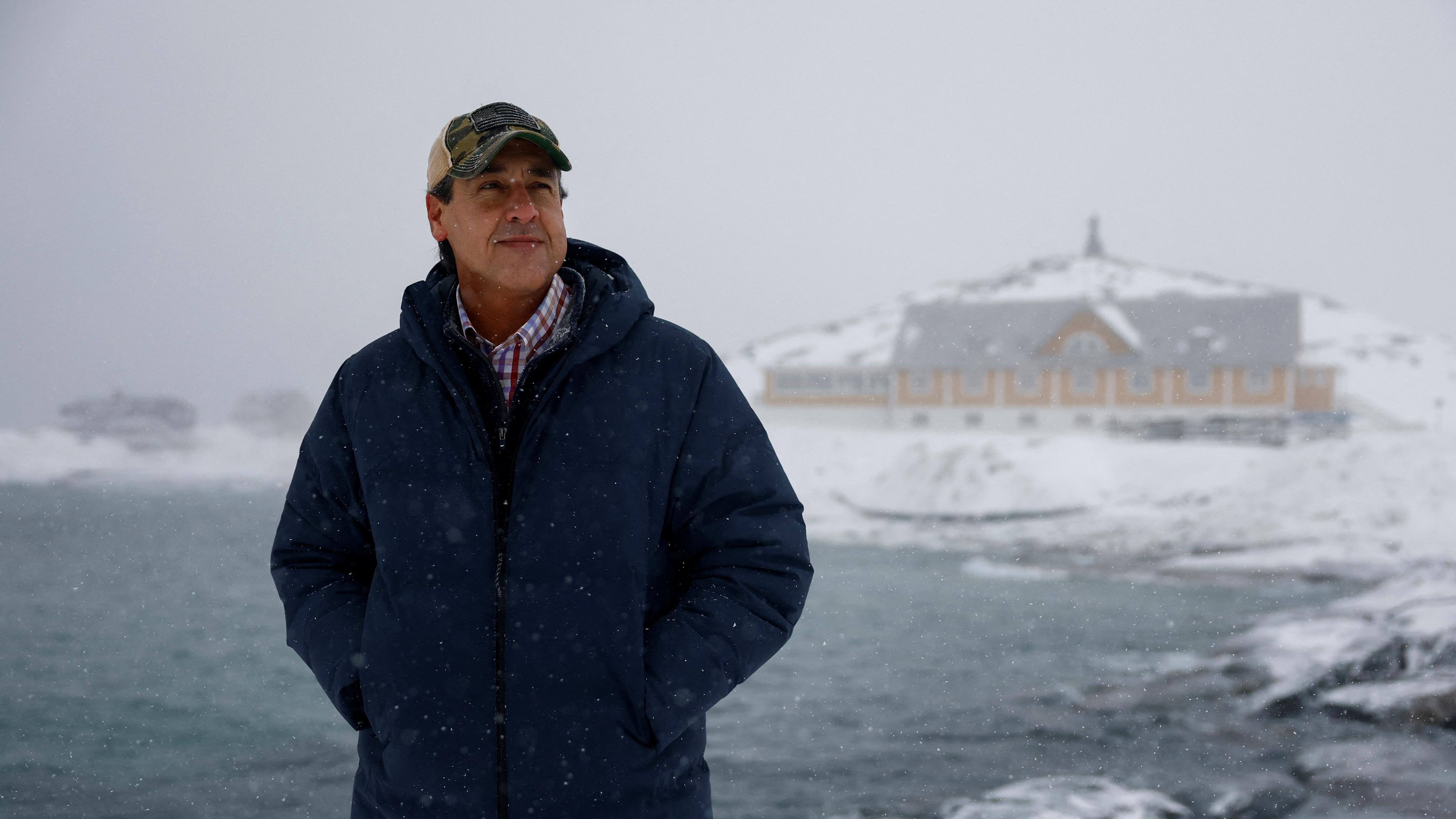
In March of last year, when public outrage prevented Second Lady Usha Vance from attending a dogsled race in Greenland, Thomas Dans took it personally.
“As a sponsor and supporter of this event I encouraged and invited the Second Lady and other senior Administration officials to attend this monumental race,” Dans wrote on X at the time, above a photo of him posing with sled dogs and an American flag. He expressed disappointment at “the negative and hostile reaction — fanned by often false press reports — to the United States supporting Greenland.”
One might conclude from these comments that Dans — a smooth-talking, well-dressed former investor with a passion for the great outdoors — was America’s envoy to Greenland, or at least a U.S. diplomat. But one would be wrong.
Dans is a prototypical example of a notable Trumpian innovation: the MAGA policy entrepreneur. While most administrations prefer to lean on career diplomats with clear roles, President Trump has a penchant for working informally through MAGA-vetted policy influencers. This approach, which sidesteps typical oversight and policy processes, is highly controversial. But it suits Trump, who can use trusted allies to push his personalized, deal-based form of politics. It probably doesn’t hurt that, when it comes to controversial proposals like acquiring Greenland, it also keeps the naysayers at arm’s length.
Dans, who made his career as an investor in 1990s Russia, has embraced his role with gusto. Even before Trump returned to office, Dans organized a trip to Greenland for Donald Trump Jr. and the late conservative media figure Charlie Kirk, in a move that provided an early signal that Trump was serious about his desire to take the island from Denmark. Dans has been a fixture in Greenland policy ever since, through his frequent visits to the island (and the White House) as well as his constant stream of interviews with Greenlandic and foreign media.
Dans declined to comment for this article. Anna Kelly, a White House spokesperson, did not address Dans’ role but told RS that Trump “leads on all foreign policy.”
“He listens to input from a variety of members of his national security team, but ultimately makes the decision he feels is best for the American people,” Kelly said.
Part of Dans’ enthusiasm for his Greenland gig may stem from necessity. After failing to get a job in the early days of the second Trump administration — a roadblock that several sources linked to his involvement with the controversial Project 2025 — Dans had to blaze his own path.
The Greenland portfolio was a perfect fit. Few MAGA stalwarts could truly claim to know their way around the far north, and an establishment figure might hesitate to follow Trump’s instincts on a policy destined to antagonize NATO. But Dans had the background to deal with a complex Arctic issue — and the MAGA bona fides to prove that he wouldn’t back down from Trump’s fight. (Trump seemingly rewarded Dans in December, naming him the chairman of the U.S. Arctic Research Commission, which advises Congress on scientific research in the far north.)
Still, the effort to acquire Greenland, especially through coercive measures, sits uneasily with some of Dans’ other foreign policy opinions.
Dans is, by all accounts, a skeptic of neoconservatives and their efforts to remake the world in America’s image, according to sources who have spoken to him about his views. And he’s popular among many right-wing restrainers, who consider him an intelligent and likable political operator. But he views Greenland as simply too important to America’s interests to avoid contemplating the use of military force. “He's basically a clear anti-interventionist,” said Curt Mills, the executive director of The American Conservative and an acquaintance of Dans’. “But he seems to have a special exception for this.”
This exception can sometimes make Dans sound like an unreconstructed hawk. “The current status quo is untenable, so things need to change, so they will change,” he told the BBC earlier this month. “Bottom line is, everything is on the table.”
The only way out of the cold is through
Dans may be from Texas, but his instincts always drew him further north. He first became involved in the Arctic in 1990, when he visited the Soviet Union as an exchange student at the Moscow Energy Institute.
He returned to Russia in the mid-1990s and launched a career as an investor during the country’s privatization boom. It was during this period that he came to know many prominent Russians, including Kirill Dmitriev, who now leads Russia’s sovereign wealth fund and often acts as an intermediary for U.S.-Russia talks. (Dans told the Financial Times that Dmitriev is “the Kremlin’s ace in the hole.”)
He later developed a relationship with many in the MAGA movement during the first Trump administration. Using these connections and his decades of experience in the former Soviet sphere, he earned a pair of Arctic-related jobs in 2020 and early 2021. His wide travels throughout Eastern Europe and Central Asia, coupled with his passion for fine suits, give him an air of an “international man of mystery,” as one person who works on Greenland told RS.
Given this resume, Dans seemed poised to get a major foreign policy job in the second Trump administration. But politics is a sensitive business, and Dans found himself involved in the messiest Republican saga of the last presidential election: the Heritage Foundation’s Project 2025.
Heritage hoped that, by laying out a series of actionable policy proposals and creating a bank of vetted staffers, it could guarantee for itself a fundamental role in shaping a future Trump administration. Instead, the project turned into an easy target for Democrats, who constantly tied the think tank’s most controversial proposals around Trump’s neck. “I have nothing to do with Project 2025,” Trump said in the final presidential debate of the 2024 election. “This was a group of people that got together, they came up with some ideas, I guess some good, some bad, but it makes no difference. I have nothing to do [with it].”
Many of those who participated in Project 2025 managed to distance themselves from the effort and get a job in the Trump administration. But the Dans twins weren’t so lucky. Paul Dans, who ran the project, became synonymous with its failure. And Thomas, who helped craft the initiative’s proposals on Ukraine, got caught in the middle. “The family was made the scapegoat,” Mills argued.
Paul is now attempting to revive his MAGA stock by running against Sen. Lindsey Graham for the Republican Senate nomination in South Carolina. Thomas, for his part, chose to head north.
The ensuing story has played out a bit like a redemption arc in a Tolstoy novel. Through his self-imposed Arctic exile, Dans has emerged as a new man, having built relationships and expertise that quickly cemented him as MAGA’s most qualified Greenland expert. (It helped that Trump had also asked Dans to develop ties with Greenland at the end of his first term, giving him a foothold in the territory.)
Through his organization, American Daybreak, Dans has acted as a public and private cheerleader for U.S.-Greenland unification. His closest Greenlandic ally is a former bricklayer named Jorgen Boassen, who serves as American Daybreak’s Greenland director. Dans has attempted to elevate Boassen as MAGA’s man in Greenland, introducing him to right-wing influencers like Charlie Kirk (prior to Kirk’s assassination) and Scott Presler, and even bringing the Greenlander on a visit to the White House in January. (Boassen told the New York Times that he communicates with Trump officials through Dans.)
Dans has tried a few different strategies to bolster his case for Greenland joining the U.S. He sometimes frames the issue in historical terms, noting the crucial role that American soldiers (including his grandfather) played in defending the island from the Nazis in World War II. Other times he makes the case that Greenlanders have never really had a say in their political autonomy, all while highlighting the risks to the U.S. of Chinese and Russian influence over the island.
But Dans’ reasoning may be less important than his determination to support the Trump administration. “I do not think Dans is comparable to, say, [Secretary of State Marco] Rubio, who is clearly the originator of the Venezuela policy,” Mills said. “I would basically cast Dans as an ideological entrepreneur ready to fill the void.”
And fill the void he has. Just a year into the second Trump administration, Dans has turned his Arctic exile into an attention-grabbing role in Trump’s policy entourage. “This has probably worked out pretty well for him,” Mills said. “He's kind of the eminence grise in the portfolio.”
An ‘echo-chamber’
Dans is far from the only powerful policy influencer in the world of MAGA. Jared Kushner, who played a more official role in the first Trump administration, has acted as an informal U.S. envoy in the Middle East since his father-in-law returned to office. Mark Savaya, a weed kingpin from Detroit, reportedly used his inroads with MAGA to organize a meeting between Trump and the Iraqi prime minister last year, after which Trump appointed Savaya as his envoy to Iraq.
For Trump, this approach makes a lot of sense. The president is skeptical of “deep state” bureaucrats, preferring to rely on people he personally trusts. These informal channels also create some distance between Trump and his most controversial policies, allowing him to maintain ambiguity as to whether these envoys are really acting on his behalf.
In many ways, Dans is an ideal candidate for this approach. “He's one of the few government officials that is still interested in talking to people like me” and even responding to criticisms, said an Arctic researcher who was granted anonymity in order to protect his professional relationships. Mills called him “cerebral” and “unusually nice” for a person working in a “sharp-elbowed business.” Sumantra Maitra, a right-wing realist who advises the Congressional Greenland Caucus, described Dans as a friend and said “his heart is in the right place.”
But Trump’s policy on Greenland also reveals some serious downsides of the informal envoy approach. One is a profound lack of organization. In a normal policy process, officials from across the State Department and intelligence community would have the opportunity to coordinate on and critique such a consequential proposal. This process is slow-moving, and it lets spoilers slow things down. But it also helps the administration prepare to defend the policy and process its potential repercussions, like, say, the rapidly evolving trade war between the U.S. and Europe that Trump kicked off with a tweet over the weekend.
This points to the more fundamental flaw in this approach: By maintaining a small, informal group of policymakers, Trump’s team has insulated itself from dissenting voices, leaving few checks on more outlandish proposals, like threats to seize the island by force. “There is a lack of external voices which would balance some of the instincts within the administration, which risks being in sort of an echo-chamber,” Maitra said. (Maitra added that he supports deeper U.S. engagement with Greenland but opposes annexation.)
This approach has allowed the administration to ignore the fact that, in both Greenland and the U.S., the idea of taking over Greenland is quite unpopular. "The Congress is not going to accept it,” Maitra argued, noting that many lawmakers want deeper cooperation with Greenland but few want to actually take over the island. “The American people are not going to accept dead Americans and dead Danes over a patch of ice-filled land," he said.
A more traditional policy approach might have surfaced these issues and reminded Trump that he can pursue nearly all of his goals in Greenland without having to take it from Denmark. After all, the Danish government has already pledged to invest $6 billion in Greenland’s security and said it would allow the U.S. to expand its military presence there, according to Pavel Devyatkin, a senior associate at the Arctic Institute and a non-resident fellow at the Quincy Institute, which publishes RS. “It's not [in America’s] interest because there's no military threat from Greenland,” Devyatkin argued.
But none of these ideas seem to have broken through into Trump’s circle of trust. In fact, the administration appears to be doubling down. Last week, Trump’s team signaled the importance of the issue by moving a planned meeting with Danish officials from the State Department to the White House, where Vice President J.D. Vance stepped in to lead the discussions.
The decision to elevate Vance’s role in Greenland drew blowback from European officials, who view the vice president as hostile to their interests, according to the Washington Post. But Dans argued that Vance, after joining his wife on a visit to an American base in Greenland last year, has earned a big role in the policy. Vance is “the one who originally carried the torch” to Greenland, Dans told the Post, adding that the vice president therefore “deserves a share of the honor in whatever happens.”
One can’t help but wonder whether Dans hopes that some of that honor could trickle down to him, too. While Dans may not be the most powerful driver of the Greenland push, he is its most persistent advocate. That simple fact could well be enough to cement his place at the heart of Trump’s most provocative foreign policy initiative — and perhaps even land him a job as an administrator of America’s largest territorial acquisition since the Louisiana Purchase.