

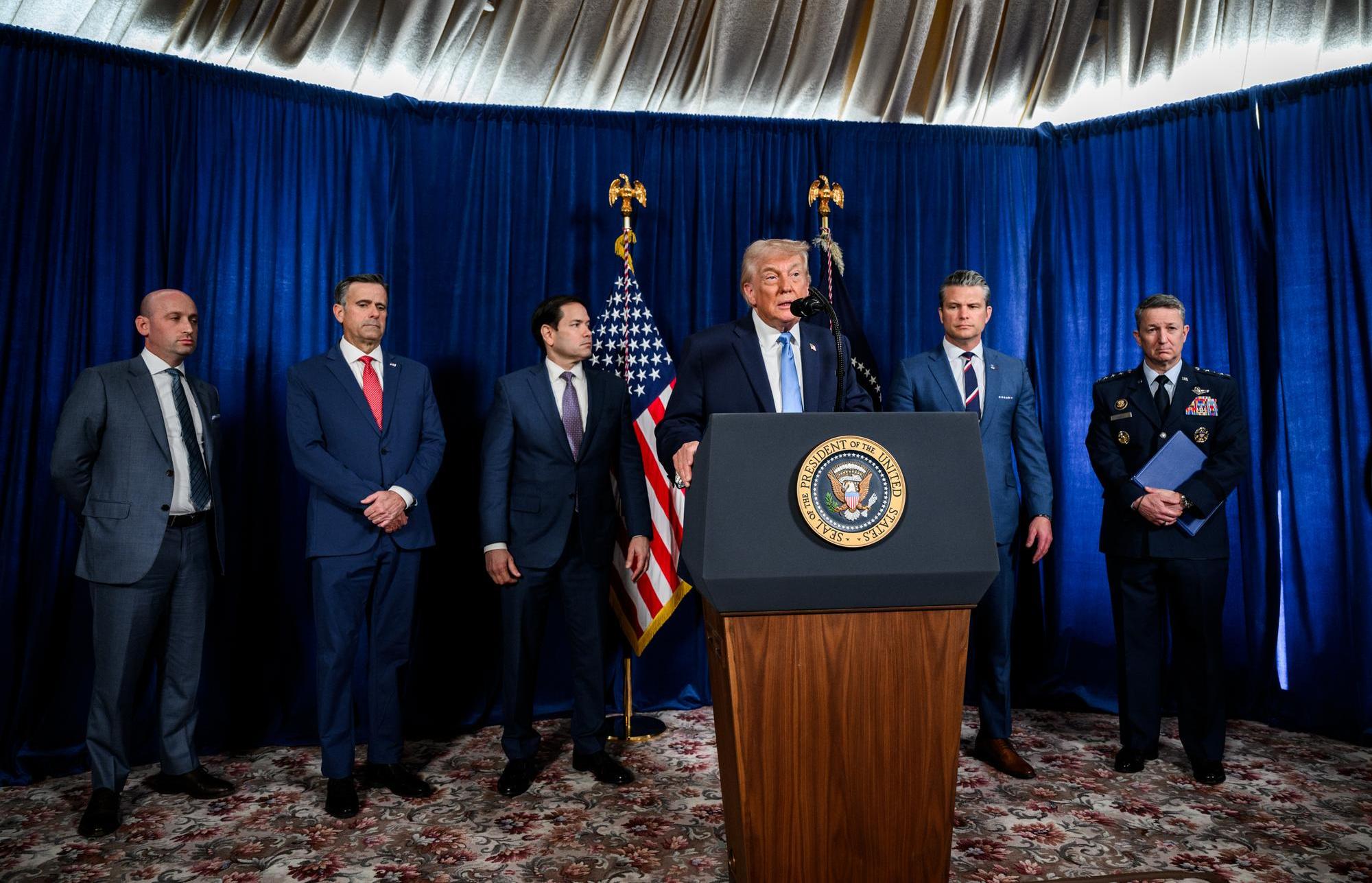
The new year started with a flurry of strategic signals, as on January 3 the Trump administration launched the opening salvos of what appears to be a decisive new campaign to reclaim its influence in Latin America, demarcate its areas of political interests, and create new spheres of military and economic denial vis-à-vis China and Russia.
In its relatively more assertive approach to global competition, the United States has thus far put less premium on demarcating elements of ideological influence and more on what might be perceived as calculated spheres of strategic disruption and denial.
The White House’s relatively succinct 2025 National Security Strategy mentions denial explicitly three times, beginning with, “We will deny non-Hemispheric competitors the ability to position forces or other threatening capabilities, or to own or control strategically vital assets, in our Hemisphere.” Then, the United States “will build a military capable of denying aggression anywhere in the First Island Chain,” while “reinforcing U.S. and allies’ capacity to deny any attempt to seize Taiwan or achieve a balance of forces so unfavorable to us as to make defending that island impossible.” Spheres of strategic denial are now the central organizing principle of the 47th president’s foreign policy.
This strategy reflects a sobering reassessment of U.S. overcommitment abroad shaped by two decades of managing elusive objectives in the Middle East as Beijing quietly accumulated leverage along critical chokepoints — steadily expanding its investments across Latin America and the BRICS, advancing its Polar Silk Road ambitions, deepening civilian and military engagement throughout Africa and Asia, and securing dominance over rare earth mineral processing and supply chains.
Against this backdrop, the Trump administration’s pursuit of Venezuela’s oil resources and even the desire to acquire Greenland signal a far more decisive realignment of American strategic posture. The United States appears increasingly intent on using discrete yet disruptive military action rather than prolonged interventions while restricting its rivals’ access to key regions, resources, technologies, and governance mechanisms. Its modus operandi is to secure advantage without costly military entanglements or the fatigue of colonial or quasi-imperial overreach, all the while challenging the post–World War II international institutional architecture.
Short of overt kinetic confrontation, by exploiting vulnerabilities in technological ecosystems, economic supply chains, outer space infrastructure, and even the normative frameworks that govern international law and diplomacy, the United States is showing that it can rival in influence by diffusing and contesting its competitors’ once-thought unassailable dominance.
Spheres of denial therefore operate by upending the status quo ante or ‘business as usual’ through an obstacle course that challenges China’s and Russia’s security commitments to their presumed allies and partners, narrowing their options for maneuver or foreclosing alternatives altogether and raising the costs of the challengers’ participation.
The denial strategy can prove effective, but it risks breaching faith in the international system itself, already significantly fragmented by global interdependence, and further eroding any residual consensus on international rules, norms, and laws. Bypassing established norms and agreements, sidelining or coercing allies, and weakening multilateral cooperation could make America’s partners less willing to align on defense, intelligence sharing, or economic policy — the very pillars the United States relies upon to project power abroad.
Each maneuver and obstruction carries a subtle diplomatic message from America’s friends and enemies alike: a prendre acte — “I shall take note of this and bring it up against you in the future.”
Political thought has long cautioned against zero-sum obstruction as corrosive to the normative foundations of social order and, if left unchecked, precipitates institutional collapse.
The Thucydidean premise that “might is right” found an echo in Stephen Miller’s recent public statements. In a January 2026 interview with CNN, Miller, the White House deputy chief of staff for policy and homeland security adviser, declared that the world is governed by “strength, by force, by power,” calling these the “iron laws of the world.” Taken to their logical conclusion, as Thucydides observed in the “History of the Peloponnesian War” — “the strong do what they can, and the weak suffer what they must.”
As global competition intensifies, the contours of state-sanctioned influence have become both more diffuse and more contested.
China’s steady rise and expansion of its maritime clout, digital infrastructure footprint, and its investment in critical technologies such as semiconductor manufacturing, artificial intelligence, and satellite networks is an exorbitant challenge to U.S. interests. Here control, or denial of access can shape both economic development and military capacity.
Equally formidable is Europe’s still sizable energy dependence on Russia — with Hungary, Slovakia, France, the Netherlands, and Belgium among the largest importers — as well as its technology reliance on both the United States and China, further limiting the continent's strategic autonomy.
The Arctic region and U.S. overtures to Greenland, too, are an assertion of a sphere of denial to China and Russia, respectively. The region, once an item of curiosity on a transatlantic flight and somewhat peripheral in geopolitical terms, has become a theater for competing claims to vast natural resource deposits, control over prospective shipping lanes, and exclusive economic zones.
The Trump administration’s pursuit of sovereign control over Greenland has become a paradigmatic global security issue, framed as essential to strengthening America’s military posture against intercontinental threats, particularly Russia’s assertion of maritime boundaries and the restoration of its Arctic military facilities, as well as China’s research, military, and commercial ambitions in the region. In a conversation with Fox News host Maria Bartiromo at the 2026 Davos meeting, U.S. Treasury Secretary Scott Bessent reiterated Greenland’s strategic necessity for the Golden Dome shield while warning allies against panic and overreach.
Weakening its rivals by expanding U.S. influence, intensifying competition over regions and resources, and denying them military and technological advantages, will require careful balancing between deterrence and escalation. While this approach — if executed with diligence, humility, and requisite restraint — can yield substantial strategic and material advantages, it also risks entrenching normative paralysis.
- Trump will be sore when Cuba domino refuses to fall ›
- Trump's 'Monroe Doctrine 2.0' completely misreads Latin America ›
- Trump's realist defense strategy with interventionist asterisks | Responsible Statecraft ›