

Three years after the Taliban took control of Afghanistan, many Western countries are unwilling to formally recognize the hardline group as a legitimate government until it ends widely banned practices such as institutionalized oppression of women or extrajudicial detentions and killings of suspected political opponents.
While the West justifiably remains fixated on human rights, the Taliban government remains intransigent and refuses to bend to the demands of the international forces it defeated in August 2021.
Dangling the reward of formal recognition has failed as an effective incentive to modify Taliban behavior, especially as numerous regional countries are already engaging with Kabul. China, Iran, Pakistan, Russia and several Central Asian republics are pursuing transactional, pragmatic policies towards the Taliban to revive the ancient “Silk Road” trade route which is part of China’s “One Road, One Belt” mega-project, and would see Afghanistan become a major logistics point for regional exports, including oil. This approach does not consider the internal affairs of the Taliban significant.
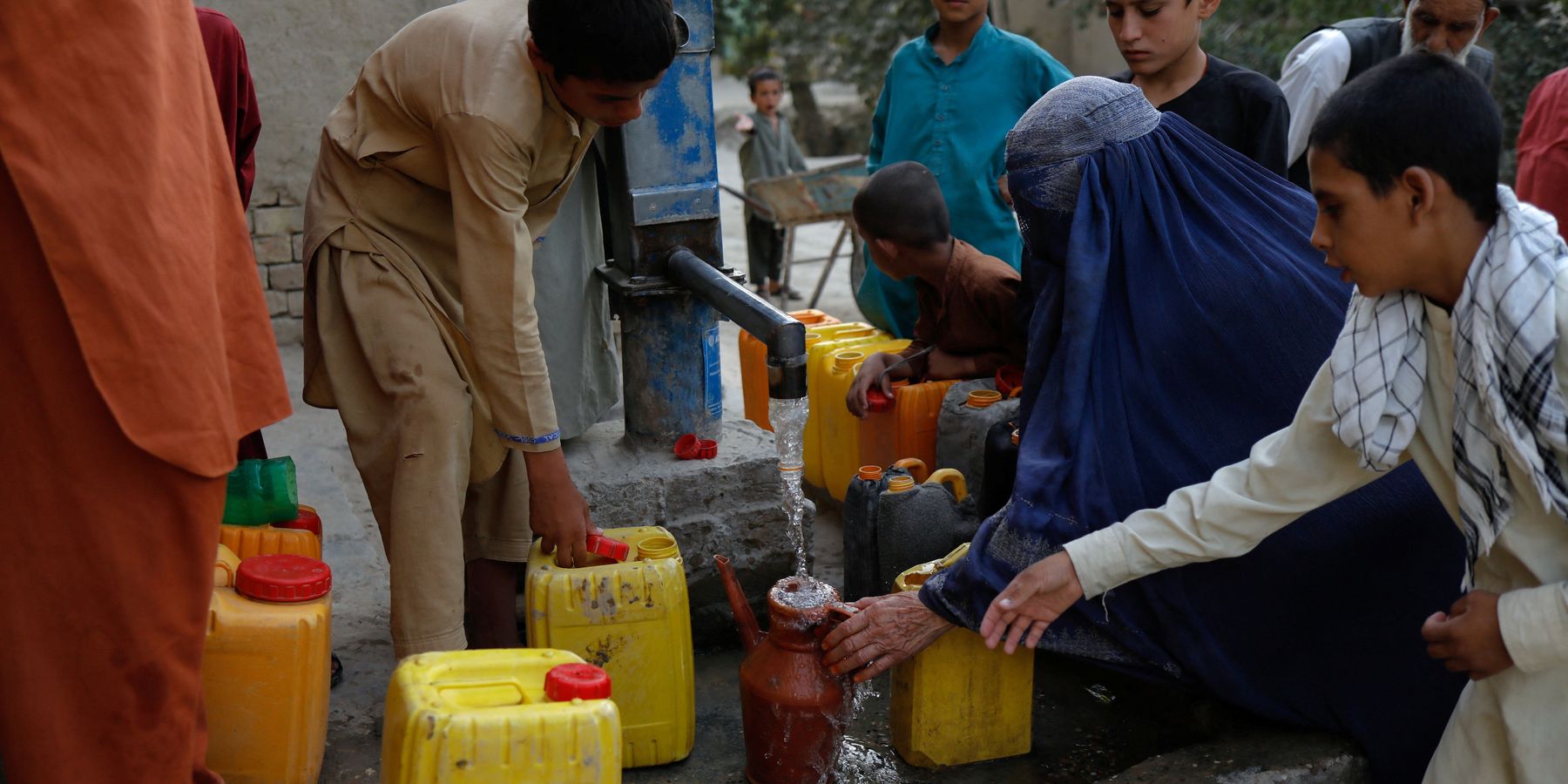
Even with non-Western support, a rapidly worsening water crisis poses a grave and imminent threat to Afghan lives. On-the-ground assessments persuasively argue that the Taliban’s isolation is aggravating the underlying causes of the crisis, which has resulted in food insecurity, hunger, mental health issues and the spread of infectious diseases. Until now, external actors have shown indifference to the problem, but if ignored, the present situation will most likely lead to a broader humanitarian catastrophe. This crisis, a direct threat to Taliban governance, may offer the West greater leverage to address its concerns than previous aid-based policies.
Climate crisis
While Western-dominated international institutions focus on the Taliban’s oppressive policies, there is comparatively little reported in mainstream media about the climate-related pressures facing an Afghan population of over 43 million. Rising temperatures and extreme weather events such as melting glaciers, flash floods, droughts, and earthquakes, have led to the destruction of vital water sources and facilities in Afghanistan.
Nearly four out of every five Afghans now lack access to clean water, while only 27 percent of the rural population enjoy access to sanitation facilities. Afghanistan currently ranks fourth on the list of countries most at risk of a climate change crisis and eighth on the index of countries most vulnerable and least prepared to adapt to climate change.
These pressures would challenge any government, let alone Afghanistan’s current de facto rulers of madrassa-educated guerrilla fighters. They are hardly capable of assessing and managing highly complex geoclimatic factors that impact the economic viability of the entire South Asia region. Although not a unified body — with reports of schisms within the ranks of its leadership — some elements within the Taliban may be aware, if not fearful, of the near-term consequences of their inability to manage the crisis on their own.
Efforts are underway to manage groundwater in the country with at least 300 projects in various provinces set to be implemented this year, according to Afghanistan’s Ministry of Energy and Water. Rehabilitation has begun on six major water projects, including the Pashtun dam, Kamal Khan dam, Turi Bakhshabad dam, and Shah and Arous dam, and construction is set to start on 11 more check dams to store water and release it into springs and canals for irrigation.
But these projects are hardly sufficient to meet the needs of the Afghan people, mostly concentrated in rural areas and living a bare, subsistence-level agrarian lifestyle. Sadly, it is not for lack of water within Afghanistan, as its high mountains and near-alpine conditions provide a surplus. Yet, distribution of that water is severely impaired by outmoded or non-existent delivery systems. Currently, Afghanistan annually uses only 30 percent of available water resources; 70 percent is wasted due to lack of infrastructure, water storage facilities, and inefficient distribution systems.
Rivers run through it
Despite an inability to get water to its own people, Afghanistan is a major source of water to Iran, Pakistan, Tajikistan, Uzbekistan and Turkmenistan. With major population and industrial growth and shrinking rivers, water is a vital concern for them. They understand the threat of water shortages to their economies and political and social stability.
As a result, water disputes have been a significant cause of tensions between Afghanistan and its neighbors. In May 2023, Afghan and Iranian forces clashed after Iran’s president charged the Taliban government with restricting access to water from the Helmand River. The Taliban’s construction of a 285-kilometer canal off the Amu Darya, the Qosh Tepa Canal, could draw off 12 to 15 percent of the water that now flows to Turkmenistan and Uzbekistan. Water wars are not new and may soon come to Central Asia.
An offer they can’t refuse
As a country whose economic viability is dependent on agriculture, an adequate domestic supply of water, reliable irrigation and power are fundamental. The Taliban will need to understand that the sustainability of its grip on power will be in large part contingent upon its ability not just to rule, but also to govern and maintain good relations with its neighbors. Water is key to both. Failure to do so will likely result in a powerful backlash, including regional isolation and even an uprising by people who have nothing left to lose.
This situation presents Western countries with leverage with the Taliban, to both reduce the suffering of the Afghan people and enhance their influence in the larger region which, according to most accounts, they have lost to China and Russia. The West can deploy both advanced water resource management technologies inside Afghanistan and regional diplomacy with its neighbors as tools to move forward on long-stalled objectives. The Taliban may be ideological, but it can also be pragmatic.
To avert the risk of being left out of a new reality in Central Asia, the West must move toward decoupling politics from environmental and humanitarian issues. It must reach an entente of sorts whereby the Taliban would accept desperately needed assistance in exchange for a few “good faith” concessions on human rights issues in particular. These concessions would need to be made quietly and without fanfare, to allow the Taliban to save face.
The Taliban will also need to attract and work with technocrats and with expertise in hydraulics engineering and water resource management, as well as negotiate partnerships with countries that are at the cutting edge of water management technology, such as the Netherlands, the U.S., Australia and Germany.
If the Taliban’s behavior is to be modified, those seeking modification need to use more carrots and fewer sticks.
Some measure of pragmatism
Humanitarian catastrophes routinely require good faith efforts by both local authorities and outside aid agencies, but the situation with the Taliban is anything but routine. The “facts on the ground” demonstrate that the conventional assumption — that humanitarian aid can be used to effect changes in local governance practices — have not worked with the Taliban. Part of this is ideological, and part of this is practical.
While Western nations seek to tie assistance to reforms, other nations, such as China, famously “take no position on internal affairs” and view engagement as transactional in nature. In Afghanistan, that means trade and investment in return for aid.
While this is unfortunate (and some would say immoral), it is clear that the West should be similarly pragmatic in exchange for minor reform. Water resources is one key area where this could bear fruit.