

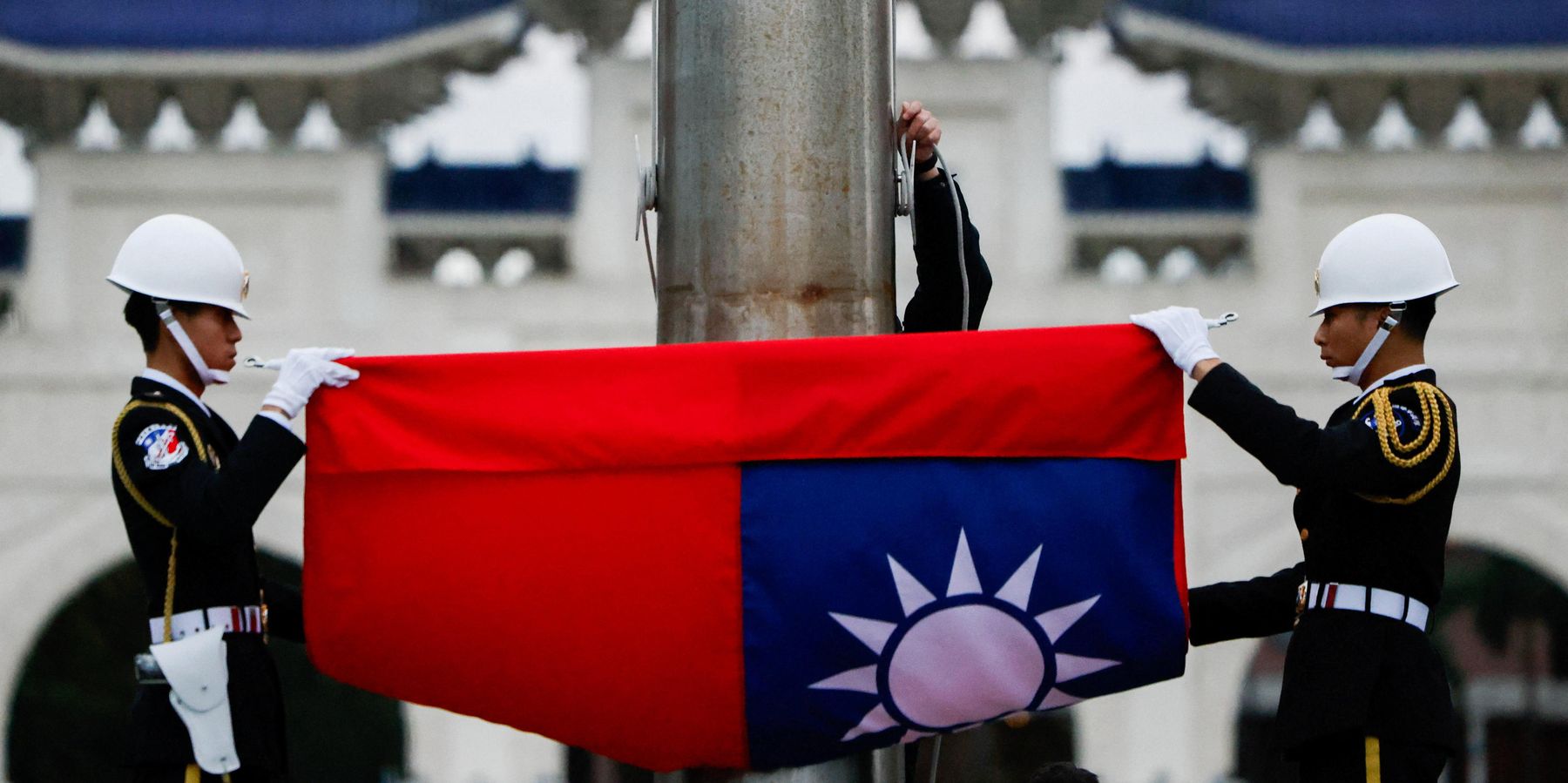
On December 17, while much of the nation was watching President Donald Trump’s primetime “year-in-review” address to the nation, the State Department made a big reveal of its own: the approval of an $11 billion arms package for Taiwan.
According to the announcement, the sale will facilitate “[Taipei's] continuing efforts to modernize its armed forces and to maintain a credible defensive capability.”
The news was widely praised in Washington, by China hawks and supporters of the defense industry alike, for sending a strong deterrent signal to Beijing and a valuable message of U.S. commitment to Taiwan. The Washington Post editorial board, for example, called the sale “a welcome change to Trump’s Taiwan policy” and “an overdue correction after months of policy changes that favored Beijing over Taipei.”
Celebrations are premature, however. As Chinese warships encircled the island this week as part of “Justice Mission 2025,” it seems that Taiwan’s position is more vulnerable than ever after the U.S. arms sale announcement, and Washington is partly to blame.
The problem is not that the Trump administration has continued to sell weapons to Taiwan — it is required to do so under the terms of the Taiwan Relations Act.
The problem is how the Trump administration, and those before it, has chosen to sell weapons to Taiwan — loudly, brashly, and publicly. As the United States looks to shift the burden of the island’s defense to Taiwan itself, it needs a different approach to supporting Taipei, one that is more subtle, emphasizes Taiwan’s indigenous production, and attends assiduously to context.
There are three problems with the December 17 sale, and they all have to do with timing.
For starters, although the U.S. State Department has approved the $11B weapons package, Taiwan’s legislature has blocked the special budget required to pay for it five times. Until Taiwan finds the money, the sale cannot be completed, and production of the promised weapons cannot begin.
As a result of this political fiasco, Taiwan now appears weak, indecisive, and unprepared to support its own defense. That Taiwan’s failure to approve the special budget drags on after the United States greenlit the weapons sale has made an already embarrassing situation worse by calling attention to Taiwan’s domestic divisions and lack of resolve.
Though Taipei bears much of the responsibility, poor U.S. planning is also at fault. The State Department could have averted much of the fallout by holding off on its sale announcement until Taiwanese funding was secured.
But considerations of Taiwan’s domestic politics are not the only reason the timing of the U.S. announcement was puzzling and counterproductive. Coming soon after Trump’s positive meeting with Chinese leader Xi Jinping in Busan and during a trade war truce between the two countries, the size and scope of the U.S. arms sale (for example, it included rocket artillery and long-range ATACMS missiles) took Chinese officials by surprise.
In Beijing, the Trump administration’s move was seen as a provocative reversal and even a betrayal of the U.S. president’s previous stance. Lingering regional tensions caused by Japanese Prime Minister Sanae Takaichi’s confrontational statements on Taiwan in November only exacerbated Beijing’s sensitivity.
In this context, China’s extensive military drills around Taiwan this week were to be expected, even still largely unjustified.
Beyond the just-completed military exercises, there could still be further repercussions on the way for Washington, including economic retaliation or roadblocks to Trump’s planned April visit to Beijing. Progress made in stabilizing the U.S.-China relationship over recent months has almost certainly been dealt a setback.
Regardless of possible future ramifications, Taiwan’s immediate security picture has darkened, as it endured several days of intense military pressure, simulated blockade, and live fire drills just off its coast. In theory, the new weapons promised by the United States should offset any increased military coercion from China. Once again, however, there is a problem of timing.
While U.S. weapons may be sold in principle to Taiwan today (or, in the coming months if they find the financing and after U.S. Congressional approval), they won’t arrive for years, possibly well into the 2030s.
Take for example, the 82 HIMARS included in the most recent sale. Though the United States can produce about 100 HIMARS a year, this total must meet global demand, including rising purchases from Europe and the needs of the U.S. military.
In 2021, Taiwan purchased 11 HIMARS from the United States. They arrived in 2024. In 2023, Taiwan purchased 18 more HIMARS. They have not been delivered but some may be completed in 2026. At this rate, completely filling an order of 82 additional HIMARS will take at least until the end of the decade — a long time to wait for an island under threat today.
The extensive lag time between the sale announcement and weapons arrival creates another problem for Taiwan: a window of vulnerability in which Beijing can exploit Taiwan’s weaknesses and prepare its own countermeasures. Ultimately, China’s near-term actions may negate any defensive value that comes from additional U.S. arms sales to Taiwan over the longer term.
Neither challenges of timing nor Beijing’s probable retribution are reasons to stop selling arms to Taiwan entirely. But they are cause to rethink how Washington plans and executes these arms sales so that they can provide the most support to U.S. interests with the fewest costs to cross-strait stability.
First, U.S. officials should reconsider how much information about arms sales to Taiwan they make public. Members of Congress should still review and approve sales, but the timing and content of public announcements might be altered to exclude information on quantities, total value, or types of weapons.
This would not be without precedent, as the United States has previously kept classified some information on arms sales to clients like Israel and Ukraine even as they have met requirements for transparency and accountability.
More discretion would have several benefits. China’s vast intelligence network would likely learn the details of a given sale before they are made public, but without a high-profile announcement, Beijing might feel less pressure to retaliate against Taiwan or the United States directly. And to the extent information on new arms packages remains private, it would buy Taipei and Washington time.
Second, U.S. policymakers should link U.S. arms sales to Taiwan directly to Taiwan’s approved defense budget, not its planned or promised one. In practice, this would mean that Washington would not approve weapons packages for Taiwan unless necessary funding is already appropriated. This might require the use of smaller and less frequent arms packages, but it would avoid embarrassing liabilities like that at present, where sales are approved before funding exists.
At the same time, the United States future military assistance to Taiwan conditional on Taipei hitting a pre-agreed threshold of defense spending, say 5 percent of GDP.
Another option would be to prioritize efforts to aid Taiwan’s indigenous defense production, rather than selling American weapons. This might be accomplished by incentivizing private investment in Taiwanese companies, facilitating technology sharing, or supporting co-production and joint ventures with U.S. firms. This would have the added benefit of supporting Taiwan’s self-sufficiency and resilience.
Beijing might not welcome these moves, but they should be less antagonistic than direct sales of advanced American military hardware.
Finally, Washington should consider timing more carefully when planning its military assistance to Taiwan. U.S. officials should avoid announcing new initiatives at delicate periods, when tensions are aroused or regional disagreements unresolved. They should also prioritize the health of the U.S.-China relationship above all else, safeguarding mutual understandings over regional security issues generally and Taiwan specifically.
After all, if Washington and Beijing are at odds (or worse at war), no amount of military aid in the world can protect Taiwan from the repercussions.
- Taiwan shouldn't become the thorn we use to provoke China ›
- Takaichi 101: How to torpedo relations with China in a month ›
- Navy: Iran war stockpile woes behind 'pause' on aid to Taiwan ›
- How not to prevent a war over Taiwan | Responsible Statecraft ›