

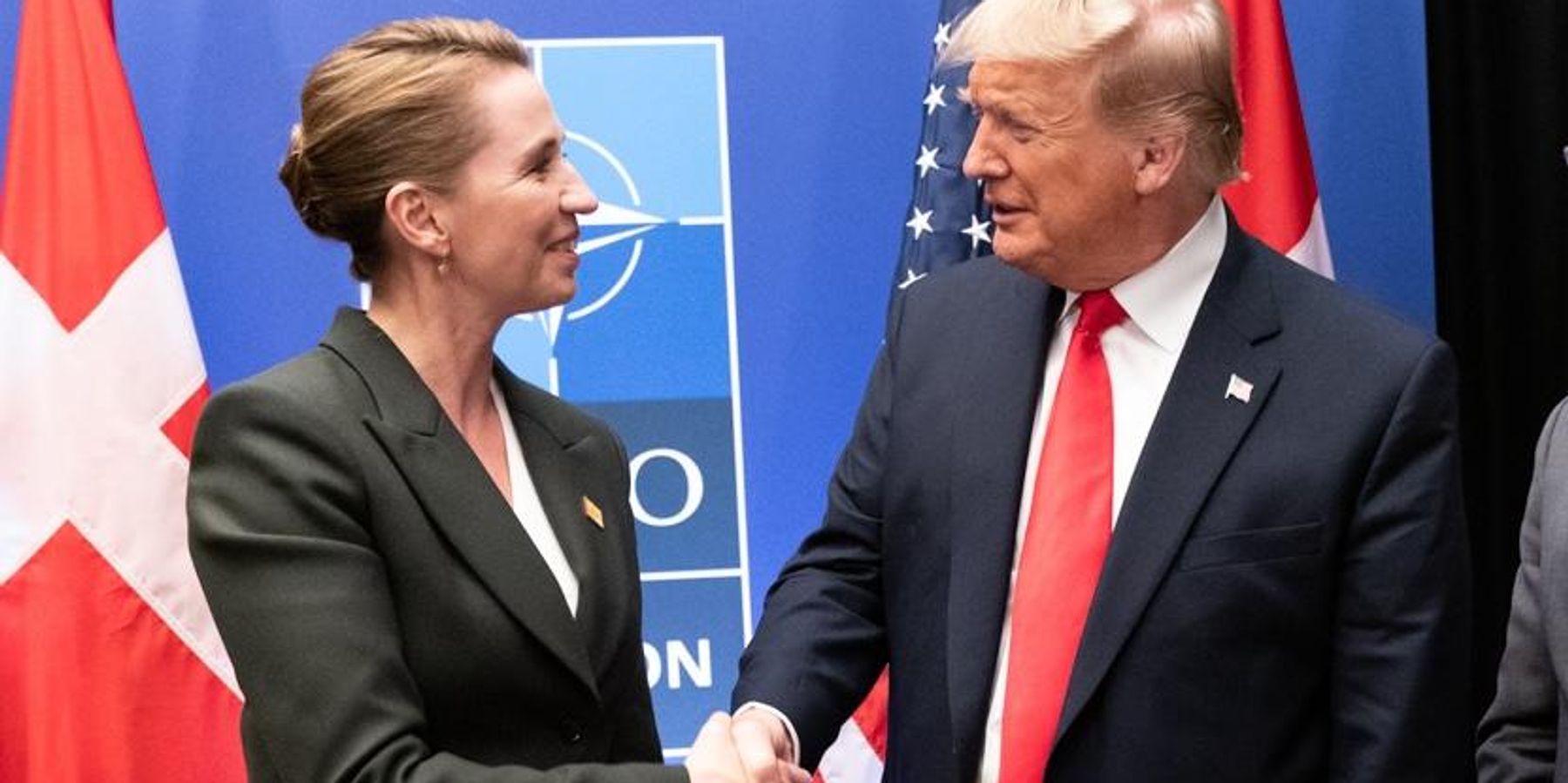
The Trump administration dramatically escalated its campaign to control Greenland in 2025. When President Trump first proposed buying Greenland in 2019, the world largely laughed it off. Now, the laughter has died down, and the mood has shifted from mockery to disbelief and anxiety.
Indeed, following Trump's military strike on Venezuela, analysts now warn that Trump's threats against Greenland should be taken seriously — especially after Katie Miller, wife of Deputy Chief of Staff Stephen Miller, posted a U.S. flag-draped map of Greenland captioned "SOON" just hours after American forces seized Nicolas Maduro.
Trump caused further shockwaves when he said in an Atlantic magazine interview that "We do need Greenland, absolutely. We need it for defense," adding erroneously that the island is "surrounded by Russian and Chinese ships."
Danish Prime Minister Mette Frederiksen responded quite categorically. "I have to say this very directly to the United States," according to an official statement on Sunday. "It makes absolutely no sense to talk about the United States needing to take over Greenland. The U.S. has no right to annex one of the three countries in the Danish Kingdom."
This came after she used her New Year’s address to signal a hardening stance against Washington’s ambitions, declaring, “Never before have we increased our military strength so significantly, so quickly.”
Trump keeps insisting that the U.S. needs Greenland for national security, even threatening to use military force or economic pressure to get it from Denmark. He has also threatened steep tariffs if Denmark doesn’t hand it over, claiming “people really don't even know if Denmark has any legal right to it, but if they do, they should give it up.”
This isn’t the careful diplomacy America used to practice. Trump’s approach has triggered protests from Denmark, and for the first time ever, Denmark’s intelligence service is labeling America a possible security threat.
Trump has appointed Louisiana Governor Jeff Landry as his special envoy to Greenland. Landry called it an honor to help “make Greenland a part of the U.S.” Denmark’s Foreign Minister Lars Løkke Rasmussen called the appointment “deeply upsetting” and Landry’s comments “completely unacceptable.”
Influence and pressure
The administration is working every angle to influence Greenland. In January 2025, the president-elect’s son, Donald Trump Jr., visited Greenland to shoot video for his podcast. He said he was just a tourist, but many saw it as part of a pressure campaign.
Danish media noticed that a lot of Trump supporters in his videos and photos were actually homeless and “socially disadvantaged” locals who’d been offered free meals and MAGA hats if they’d appear on camera. “They are being bribed, and it is deeply distasteful,” one Nuuk resident said.
Then came Vice President JD Vance’s visit in March. Second Lady Usha Vance planned to attend a dogsled race. U.S. representatives went door-to-door, asking if Greenlanders wanted to meet her. The answer, everywhere: “No, thank you.”
After local businesses and residents backed out from meeting with the Second Lady, the Vances had to limit their visit to the remote Pituffik Space Base, far from the rest of the population. There, Vance accused Denmark of failing to protect both Greenlanders and U.S. troops from “very aggressive incursions from Russia, from China and from other nations.”
Things got uglier in August. Danish media reported that American operatives were running “influence operations” in Greenland, trying to promote secession from Denmark. That prompted Denmark’s foreign ministry to summon the U.S. envoy for a dressing-down. A White House official said, “We think the Danes need to calm down.” U.S. intelligence agencies had reportedly been ordered to step up espionage in Greenland in May.
Meanwhile, the U.S. consulate in Nuuk is hiring interns who speak Danish and Greenlandic to help “communicate U.S. foreign policy priorities to Greenlandic audiences” on social media. Basically, they want Greenlanders to sell U.S. policy to their own communities.
The view from Greenland
Greenlanders aren’t having it. In a January 2025 poll, 85% said they’re against joining the U.S., while 6% were in favor and 9% undecided. Most Greenlanders do want independence from Denmark though, about 84%, but nearly half say only if it doesn’t hurt their quality of life.
The March 2025 parliamentary election in Greenland felt like a direct response to Trump’s rhetoric. The center-right Demokraatit party, which has strongly criticized Trump, won. Its leader, Jens-Frederik Nielsen, called Trump “a threat to our political independence.” According to Danish expert Ulrik Pram Gad, the election results showed that Greenlanders “are pushed away and more reluctant to engage with the U.S.”
After Trump's comments Sunday, Nielsen said in a statement: "When the President of the United States says that 'we need Greenland' and links us to Venezuela and military intervention, it's not just wrong. It's disrespectful."
Is Greenland really a national security issue?
America’s legitimate security and economic interests can be better served through respectful partnership than aggressive acquisition. Thanks to the 1951 Greenland Defense Agreement, the U.S. already has broad military rights there.
This framework gives the U.S. access to Pituffik Space Base (previously Thule), a crucial missile-defense area. But when Trump talks about Greenland, he keeps lumping the whole island together with the base, insisting the only way to keep Pituffik safe is to own the land beneath it.
Crucially, Trump's argument for seizing Greenland shows a misunderstanding of Arctic security. When he says, “Russian and Chinese ships are all over the place” along Greenland’s coast, he’s mixing up different parts of the Arctic. Russia and China do send ships into the Arctic, but those ships are nowhere near Greenland. They’re way out in the Barents and Bering Seas, thousands of miles away.
The U.S. Coast Guard has encountered Chinese and Russian warships, bombers, and coast guard vessels operating together off Alaska’s coast. That’s where American attention would be better applied when it comes to Arctic security, not Greenland.
Taking a step back
Instead of threatening force or coercion, Washington should focus on deals that benefit both sides and respect Greenland’s right to govern itself. That means treating Greenland’s government as a partner, not a prize.
Denmark’s intelligence service points out that America’s unpredictable approach pushes countries to cut deals with China instead. Ironically, Trump’s push to buy Greenland to counter China could backfire, making Beijing seem like a more stable and reasonable partner compared to Washington’s existential threat.
The administration needs to drop the talk of annexation. Instead, it should work within current agreements, support Greenland’s own development goals, and show that America leads by building strong partnerships, not by issuing ultimatums.
If the U.S. wants access to Greenland’s critical minerals, it can get there through honest business deals and joint ventures that let Greenlandic communities benefit. Greenlanders have made their position clear: “Greenland is open for business but not for sale.”
- Why spying on Greenland isn't the problem ›
- 'America First' meets Greenland, Taiwan, and the Panama Canal ›
- Tracking congressional criticism of Trump's attack on Venezuela ›
- Tech billionaires behind Greenland bid want to build 'freedom cities' | Responsible Statecraft ›
- Trump digs in as Europe sends troops to Greenland ›
- On Greenland, Trump wants to be like Polk | Responsible Statecraft ›