

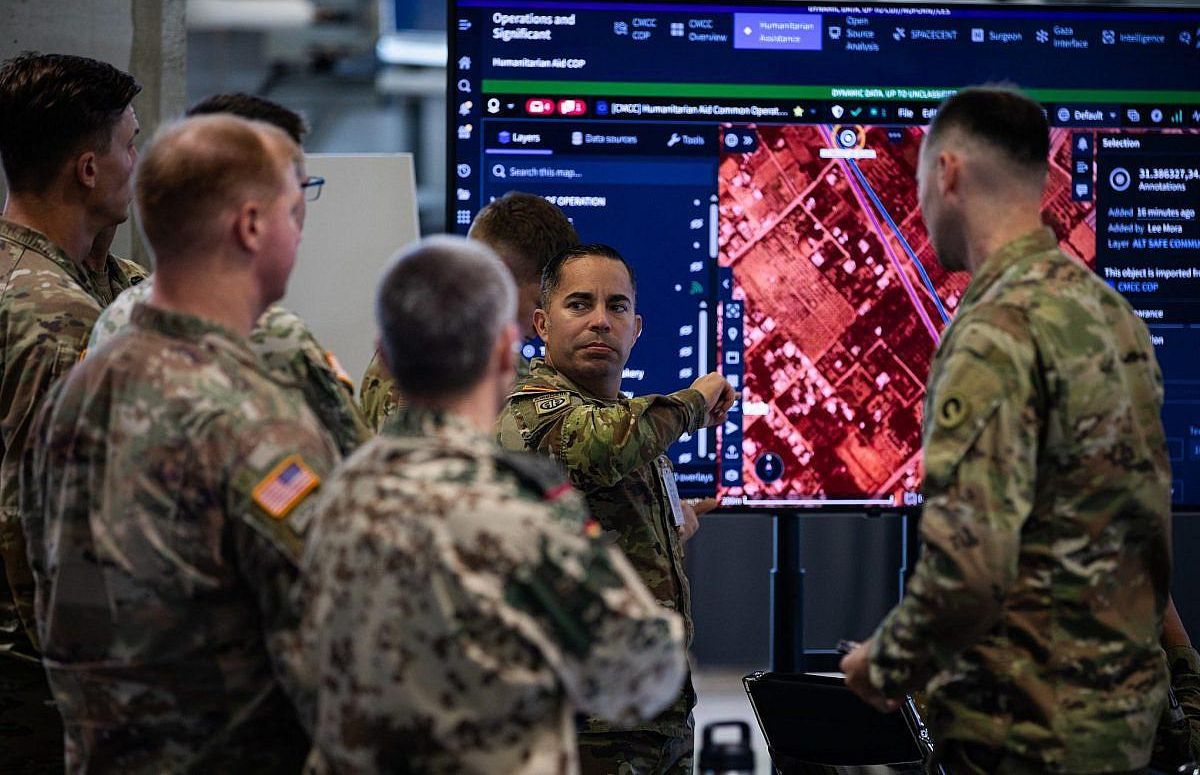
Since mid-October, some 200 U.S. military personnel have been working out of a sprawling warehouse in southern Israel, around 20 kilometers from the northern tip of the Gaza Strip. The Civil-Military Coordination Center (CMCC) was ostensibly set up to facilitate the implementation of President Donald Trump’s 20-point “peace plan” — whose stated aims are to “disarm Hamas,” “rebuild Gaza,” and lay the groundwork for “Palestinian self-determination and statehood” — which last week received the endorsement of the UN Security Council.
Yet while no Palestinian bodies have been involved in the conversations surrounding Gaza’s future, at least two private U.S. surveillance firms have found their way into the White House’s post-war designs for the Strip.
According to a seating chart seen by +972 Magazine, a “Maven Field Service Representative” has been present at the CMCC. Built by the U.S. tech company Palantir, whose logo was visible in presentations given inside the Center, Maven collects and analyses surveillance data taken from warzones to speed-up U.S. military operations, including lethal airstrikes. The platform sucks information from satellites, spy planes, drones, intercepted telecommunications, and the internet, and “packages it into a common, searchable app for commanders and support groups,” according to U.S. defense outlets.
The U.S. military calls Maven its “AI-powered battlefield platform.” It has already been deployed to guide U.S. airstrikes across the Middle East, including in Yemen, Syria, and Iraq. Palantir has marketed its technology as shortening the process of identifying and bombing military targets — what the company’s CTO recently described as “optimizing the kill chain.” Over the summer, Palantir scored a $10 billion contract to update and refine the Maven platform for U.S. armed forces.
Palantir has also worked closely with Israel’s military since January 2024, when the two parties entered into a “strategic partnership” for “war related missions.” The company has been aggressively recruiting employees to staff its Tel Aviv office, which first opened in 2015 and has expanded significantly over the last two years. Justifying its stalwart commitment to Israel in spite of mounting charges of war crimes and genocide, Palantir CEO Alex Karp recently said his company was the first to be “completely anti-woke.”
In addition to Palantir’s Maven, the name of another U.S.-based surveillance firm showed up in recent presentations at the CMCC: Dataminr. The artificial intelligence start-up leverages close ties to social media platforms like X (formerly Twitter) to allow states and corporations to monitor internet users: “Real-time event, threat, and risk intelligence” is how the company advertises its services.
Dataminr got its start in the mid-2010s by offering the FBI access to the entire output of Twitter’s userbase to surveil and alert law enforcement of “criminal and terrorist activities.” Though sold as a tool to monitor violent incidents across major cities in real time, the company offered law enforcement and governments the ability to surveil any social media user’s “past digital activity” and “discover an individual’s interconnectivity and interactions with others on social media.” Twitter referred to Dataminr at the time as an “official partner” and owned a 5 percent stake in the company. The CIA’s venture capital fund, In-Q-Tel, was also an early investor.
In the decade since, Dataminr has worked closely with the U.S. military and law enforcement agencies across the country. During the first Trump administration, Dataminr partnered with local police forces to track Black Lives Matter protests, while under President Joe Biden, the U.S. Marshals used the firm’s services to monitor activists protesting the rollback of abortion protections. And this March, the Los Angeles Police Department used Dataminr to surveil protestors calling for a ceasefire in Gaza and to flag pro-Palestinian speech online.
The presence of Palantir and Dataminr at the CMCC suggests that despite vague mention of Palestinian self-determination in Trump’s plan, Israel’s control over Gaza will remain deeply entrenched — with AI-powered surveillance and weapons systems at the center of post-war security architecture.
For Palestinians on the ground, the first six weeks of the so-called ceasefire offer a window into what’s in store. U.S. military officials at the sprawling CMCC are monitoring Israeli troops in real time. Yet according to Gaza’s Health Ministry, Israeli soldiers have killed more than 340 Palestinians since the agreement took effect on Oct. 10 — some crushed in airstrikes and others shot by Israeli troops for approaching the “Yellow Line,” the fluctuating perimeter of the 58 percent of the Strip still under direct Israeli occupation.
“There isn’t much difference from the period before the ceasefire,” Mohammed Saqr, director of nursing at Nasser Hospital in Khan Younis, told The Guardian earlier this week. “Unfortunately, the bombing is still going on.”
AI-driven surveillance regime
As part of Trump’s plan, the United States will oversee the creation of an International Stabilization Force (ISF) composed of soldiers from various unnamed countries. The use of Palantir’s Maven system and Dataminr’s platforms will provide the United States and the ISF with capabilities comparable to key elements in Israel’s arsenal.
Maven mirrors the AI-assisted targeting systems Israel has relied on to guide airstrikes and operations on the ground across Gaza since the war began. Dataminr’s AI-powered social media scraping tools resemble the platforms Israel’s intelligence agencies have deployed to monitor Palestinian internet users for the last decade. And given the United States’ history of sharing and bolstering Israeli surveillance efforts across the Palestinian territories, it is unlikely the data compiled by Palantir and Dataminr will remain under Washington’s exclusive purview.
In 2013, American whistleblower Edward Snowden released a cache of documents revealing how the NSA transferred raw intelligence to Israeli intelligence units, including “unevaluated and unminimized transcripts, gists, facsimiles, telex, voice, and Digital Network Intelligence metadata and content” regarding Palestinian civilians. Under the first Trump administration, the two intelligence agencies operated “in virtual lock step” across the Middle East, according to the New York Times.
That collaboration has only deepened since October 7, with the United States sharing massive amounts of its own intelligence on Hamas activity in Gaza with Israeli forces — including “drone footage, satellite imagery, communications intercepts and [AI-powered] data analysis.” These intrusive surveillance measures are posed to continue under Trump’s peace plan, as U.S.-manufactured technologies like Maven will scale up the ability of U.S.-backed forces to conduct surveillance and reconnaissance across the Strip.
Beyond facilitating intelligence cooperation, Palantir and Dataminr may also play a role in U.S.-Israeli security coordination in Gaza. Indeed, key among the Trump plan’s recommendations is the mass transfer of Palestinians from the areas of Gaza under Hamas control into compounds inside the Israeli-occupied enclaves, and collaborating with Israeli troops and intelligence agencies to manage them.
These “Alternative Safe Communities” would house approximately 25,000 Gazans, according to reports. Each enclave would be surrounded by patrol roads, fences, surveillance cameras, and military outposts managed by the ISF, which would coordinate with Israeli forces to determine who enters each compound — and once admitted, Israeli officials have proposed, Palestinians should not be able to leave.
Israel is further seeking that entry be contingent upon approval by the Shin Bet (Israel’s internal security agency), and the main criteria will be whether a person or their relatives have ties to Hamas, according to one Israeli official quoted in The Atlantic. But because Hamas has governed Gaza since 2007, hundreds of thousands of Palestinians have ties to the organization by virtue of working in the public sector, whether in healthcare, education, or policing.
Israel has already relied on an AI-assisted surveillance tool called Lavender to identify all known and alleged Hamas affiliates as targets for assassination, including public sector workers like police officers, as previously reported by +972 Magazine. Lavender uses predictive analytics to rank Palestinians’ likelihood of being connected to Hamas and other militant groups, based on an opaque set of criteria. The new plans give Israeli intelligence agencies the incentive to continue amassing this information, and U.S. firms and platforms could further bolster these efforts.
Maven and Dataminr will allow U.S.-managed forces to carry out surveillance on behalf of Israeli authorities, within and beyond internationally controlled compounds. The firms’ products can map connections between civilians and militant groups, compile lists of those to be detained or killed in military operations, and monitor the movement and communications of Palestinians en-masse. The use of similar technologies by Israeli forces over the last two years has turned Gaza into a site of unremitting horror, accentuated by endless aerial bombardment and dragnet surveillance.
A new occupation model
A bullet point in Trump’s plan that has garnered the ire of Israel’s ultra-right-wing government is the vague promise to phase out the Israeli military’s control of the Gaza Strip and facilitate the establishment of a Palestinian state. Yet this should be treated with skepticism, not only because of the absence of any real commitment to achieve Palestinian self-determination, but also because past plans that ostensibly aimed to bolster Palestinian sovereignty have only sharpened Israel’s domination over the occupied territories.
The Oslo Accords of the 1990s enshrined Israeli control of Palestinian telecommunications infrastructure, ensuring Israel’s intelligence units have almost limitless surveillance powers over the West Bank and Gaza. Israel’s “disengagement” from Gaza in 2005 allowed the Israeli military to maintain control via aerial surveillance and a policy of targeted assassinations — what Air Force officials at the time called an “aerially enforced occupation.”
Officials at the CMCC are now hashing out yet another paradigm of Israeli control over Gaza, and this one may outsource the work to U.S. military forces and their partners in the private sector. It is a mutually beneficial relationship: Companies like Palantir and Dataminr are eager to amass data and refine new military technologies with real-world testing. Israel’s military is keen to offload the work of aerial and ground occupation from its run-down and dwindling supply of reservists, all the while maintaining control of broad swaths of the Strip through intelligence sharing and security coordination.
For the last decade, and certainly since October 7, U.S.-based firms like Palantir and Dataminr, alongside Microsoft, Google, and Amazon, have seized on the catastrophe of war as an opportunity for capital investment and growth. Israel’s unchecked power over Gaza converted it into the ideal incubator for an increasingly militarized AI industry. The unprecedented scale of destruction Israel inflicted over the last two years hinged in no small part on the steady supply of weaponry and computing power from the U.S. and its tech titans.
It is clear that this innovative ethos remains despite the ceasefire; U.S. officials describe the CMCC as a “chaotic start-up.” Meanwhile, the military tech industry’s corporate interests — namely, unfettered data extraction and lethal experimentation — will be permanently etched into the region’s political reality.
Palantir and Dataminr did not respond to requests for comment.
This article has been republished with permission from +972 Magazine.
- Report: IDF using Amazon cloud to store intel on 'everyone' in Gaza ›
- Israel using secret AI tech to target Palestinians ›
- Israel's all-seeing eye is the stealthiest cruelty of all in Gaza | Responsible Statecraft ›