

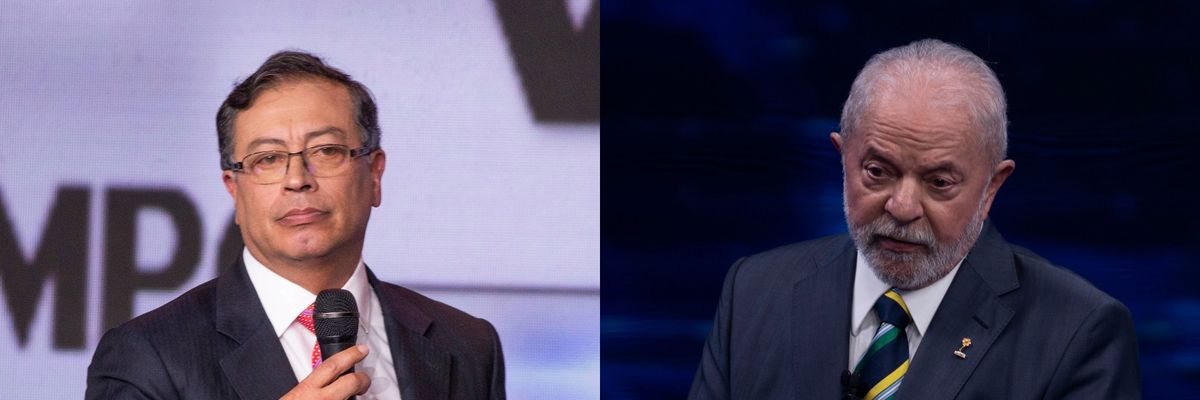
Colombian President Gustavo Petro sent shockwaves through the diplomatic world recently when he accused Israel of carrying out a “genocide” in Gaza.
“The head of the state who carries out this genocide is a criminal against humanity,” Petro wrote on X. “Their allies cannot talk about democracy.”
The comments are remarkable for a leader of Colombia, which has historically stuck with the United States on matters of international affairs. “It was just kind of unimaginable for the Colombian government to take a position like that, that would be so divergent from the U.S.,” said Alex Main, the director of international policy at the Center for Economic and Policy Research.
Petro, who is the country’s first-ever left-wing president, has doubled down on his criticism of Israel in recent weeks. He retweeted a poster depicting a cartoon baby being menaced by Israeli rifles and called Israel’s attack on the Al-Shifa hospital a “war crime,” promised to petition the United Nations to make Palestine a full member state, and threatened to bring Israel before the International Criminal Court.
And Petro is far from alone in Latin America. While most states in the region condemned Hamas’s initial attack, their harsh response to the Israeli offensive in Gaza has only been equalled by that of Arab- and Muslim-majority countries. Belize and Bolivia both cut ties with Israel over the war, and Colombia, Chile, and Honduras have all recalled their ambassadors from Tel Aviv.
Even states that consider themselves neutral on the conflict — like Brazil and Argentina — have issued withering condemnations of Israel’s attacks on civilians in Gaza. “This is not a war,” said Brazilian President Luiz Inacio Lula da Silva. “This is a genocide.”
So why are Latin American leaders so pro-Palestine? Experts who spoke with RS said it mostly comes down to three factors: Latin America’s increasing independence from the U.S.; the rise of left-wing and indigenous movements; and the presence of large Arab diasporas in much of the region.
U.S. pressure ‘doesn’t count as much as it used to’
Brazil's Lula, as he is popularly known, has spent much of his first year back in office carving out an independent path for the country’s foreign policy. The leftist leader led a charge for talks to end the war in Ukraine while helping to bolster the influence of BRICS, a geopolitical grouping meant to offset the G7 that he had helped found in the late 2000s. So when a new round of fighting broke out in Israel-Palestine, there was little doubt that Lula would jump in with a pitch to solve it.
In practice, this meant leading an effort to pass a United Nations Security Council resolution calling for humanitarian pauses to allow much-needed aid into Gaza. But his initiative hit a wall when the U.S. vetoed the resolution. That, combined with growing pressure from his domestic allies as well as the evacuation of Brazilians stuck in Gaza, led Lula to turn up his rhetoric on Israel’s offensive, according to Guilherme Casaroes, a senior researcher at the Brazilian Center of International Relations.
“He's defending the right of Israel to exist, but not the right of Israel to massacre Palestinians in Gaza,” Casaroes argued, adding that Lula views his approach to the conflict as a balancing act aimed at reaching a two-state solution. (The Brazilian leader is not the first to advocate for such a path forward; in fact, Brazil presided over the 1947 U.N. vote in favor of the partition of Mandatory Palestine.)
The episode, experts say, highlights the extent to which American influence has waned in Latin America since the height of the unipolar moment after the first Gulf War.
The U.S. has privately “expressed disappointment with governments that have done things like recall their ambassadors, or referred to genocide or used strong language and so on,” according to Main of CEPR, who has extensive contacts in Latin American governments.
“But that pressure doesn't count as much as it used to,” he argued. “It's a region that's changed enormously in terms of its dependence on the U.S. and the level of influence that the U.S. can have on foreign policy.”
The ‘pink tide’ rolls on
The pro-Palestine stance of many Latin American leaders also stems from the “pink tide” of left-wing and indigenous activists who have taken power in recent years. Left-of-center politicians now hold power in two-thirds of Latin American states, representing more than 90 percent of the region’s population and GDP.
As Main noted, these groups have long been involved in Palestine solidarity campaigns and other indigenous rights movements, especially since Israel had helped to arm many of the region’s most oppressive 20th century governments.
For many activists in the region, the disappointment of the Oslo peace process in the 1990s led them to view the situation in Israel-Palestine as little more than a new form of colonialism, according to Casaroes.
“The Israeli-Palestinian conflict is very often pictured in the back of the minds of Latin American leaders as the conflict between the oppressor, which is Israel, and the oppressed, which are the Palestinians,” he said.
This helps to explain why the Latin American left has been so united on this issue, as opposed to the war in Ukraine, which has pitted progressive leaders like Chile’s Gabriel Boric against traditional leftist stalwarts like Lula and Venezuelan President Nicolas Maduro.
While Boric has largely stood alone in his strong support for Ukraine, he has joined his fellow leftists in excoriating Israel for its conduct in Gaza and even withdrew Chile’s ambassador from Tel Aviv. “These Hamas attacks are without justification, they deserve global condemnation, but the response by Benjamin Netanyahu's government also deserves our clearest condemnation,” Boric argued following a meeting with Biden in Washington earlier this month.
Deep ties to the Arab world
The Arab diaspora in Latin America is also a major force behind pro-Palestine activism. Brazil alone has some 16 million citizens of Arab descent, and Chile has the largest Palestinian population of any country outside of the Middle East.
The phenomenon of Arab migration to the region dates back to the late 1800s, when many Lebanese and Syrian migrants fled to the Americas to escape the death throes of the Ottoman Empire. Palestinians followed in waves after each major war between Israel and Arab states.
This large diaspora has significant political influence across the region, with Arab politicians holding top positions in many governments. Fully 10 percent of Brazil’s parliament had Arab origins as of 2016, according to the Washington Post.
Contrast this with the region’s relatively small Jewish community, which numbered only 500,000 in 2017. As Main noted, Latin American Jews who support Israel also have no equivalent to powerful U.S. Zionist groups like the American Israel Public Affairs Committee (AIPAC), which will reportedly spend $100 million next year to try to push lawmakers advocating for a ceasefire in Gaza out of office.
Of course, there are notable exceptions in the Arab diaspora. El Salvador’s president, Nayib Bukele, is of Palestinian descent but has thrown his full support behind Israel’s campaign in Gaza. But, experts say, most Arabs in the region still favor Palestine over Israel.
A new shift, however, could upset the region’s political balance in the coming years, according to Casaroes. Latin America has an increasingly large evangelical Christian movement whose leaders see the state of Israel as a crucial part of their theology of the “end times.” And survey research suggests that, as a country’s evangelical population grows, so does its support for Israel.
This has already led to political dust-ups in places like Brazil, where former President Jair Bolsonaro has made pro-Israel activism a key part of his efforts to bolster his evangelical support. Bolsonaro sparked a controversy earlier this month when he met with Israel’s ambassador to Brazil, a move that a ruling party official condemned as a “spurious alliance” between the former leader and the foreign diplomat.
- Fears of Iranian influence in Latin America are way overblown ›
- How the Global South is reacting to events in Israel and Gaza today ›
- Weighing the political fallout from Lula's Nazi comment | Responsible Statecraft ›
- With Rubio, Waltz, a harder line on Latin America looms | Responsible Statecraft ›
- Bolivia elections could signal final break with Evo Morales era | Responsible Statecraft ›
- Ex-Trump officials cashing in on Latin American tariff fears | Responsible Statecraft ›
- In Latin America, the road to Trump's heart goes through Israel | Responsible Statecraft ›