

The release of the latest U.S. National Security Strategy (NSS) has triggered a revealing meltdown within Europe’s political and think-tank class. From Berlin to Brussels to Warsaw, the refrain is consistent: a bewildered lament that America seems to be putting its own interests first, no longer willing to play its assigned role as Europe’s uncomplaining security guarantor.
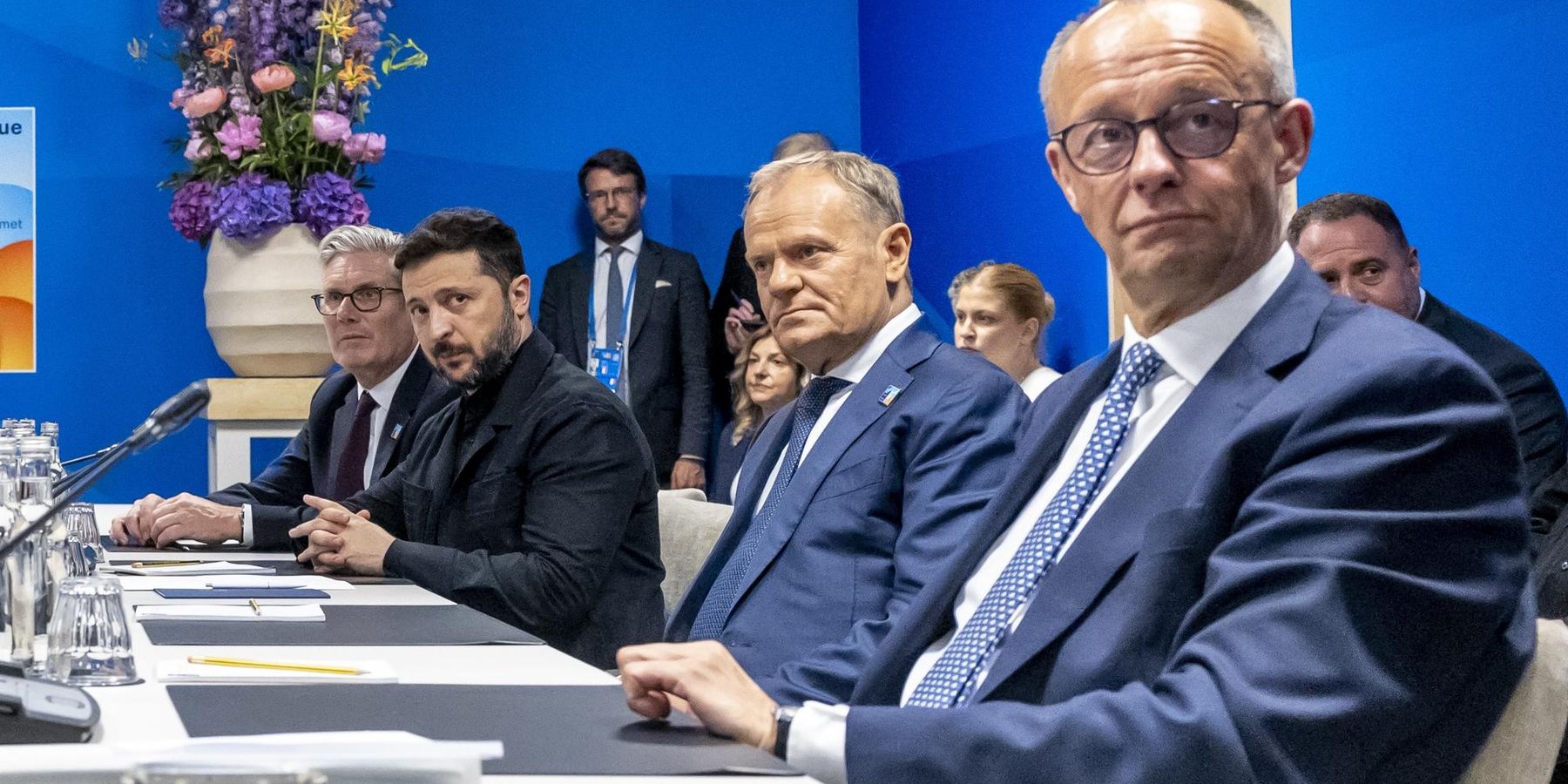
Examine the responses. German Chancellor Friedrich Merz finds the U.S. strategy “unacceptable” and its portrayal of Europe “misplaced.” Polish Prime Minister Donald Tusk, for his part, found it necessary to remind the U.S. that the two allies "face the same enemies." Coming from a Polish leader, this is an unambiguous allusion to Russia, which creates clear tension with the new NSS's emphasis on deescalating relations with Moscow.
EU Council President Antonio Costa, voicing a common EU stance, claims the Union is targeted due to its strength, citing its steadfast support for Ukraine. This assertion, however, ignores the decisive reality: without American arms and intelligence, Kyiv might not have endured against Moscow’s invasion as long as it has.
Next comes the crescendo of think-tank hysteria: the EU is portrayed as a “last bastion of sanity” besieged by a cabal of “Russian warmongers,” “American tech bros,” and “MAGA politicians.” In this narrative, Europe is uniquely virtuous, a pure-hearted victim in a world of predators.
This is not analysis. It is a continent-wide therapy session. It reveals a political establishment confronted with the expiration of its preferred modus operandi: what analyst Almut Rochowanski aptly terms “vicarious primacy.” This can also be defined as a “primacy by proxy” — an illusion of strength stemming from Europe’s role as America’s junior partner. Europeans acted as America’s vice-hegemon, sharing in the moral authority and diplomatic clout of the West while outsourcing the work of actual security, deterrence, and great-power politics to Washington.
For Europe's elites, Donald Trump’s 2016 victory was not a stark warning of the expiration of this bipartisan consensus in Washington, but a transient aberration. Consequently, the response was not a sprint toward strategic autonomy, but a peculiar mix of hoping the American "deep state" would control a wayward president and actively appeasing him. The failure of the E3 — Britain, France, and Germany — to uphold the 2015 Iran nuclear deal that Trump foolishly abandoned in 2018 exemplifies this latter approach.
Biden's 2020 election seemed to validate their hope for a "business as usual" return. Even now, in 2025, mainstream European politicians cling to the idea that a President Rubio, Ted Cruz, or a new Democrat in 2028 will resurrect the neoconservative/liberal interventionist consensus that made their vicarious hegemony so comfortable.
This denial is actively fueled by spoilers within Trump's own party — figures, like former Secretary of State Mike Pompeo, who work to sabotage efforts to end the war in Ukraine.
European politicians, seeking validation, flock to Washington where establishment voices — from International Republican Institute types to anti-Russia pundits like Max Boot, who recently dismissed the European section of the NSS as looking "like it was written by a far-right troll" — tell them precisely what they want to hear: that restrainers like Sen. Rand Paul and Rep. Thomas Massie are merely marginal "isolationists." I heard such ideas firsthand during my time as a European Parliament staffer.
Consequently, Europe’s mainstream made no serious effort to engage with the diverse MAGA world, including its anti-war paleoconservatives and libertarians. They preferred the comfort of their old Atlanticist echo chamber.
Why? Because true strategic autonomy is terrifying to them. It would require what they have consistently failed to do: think seriously about defense, which is first and foremost about the sober assessment of threats, not just more funding for defense contractors. It is also the practice of complex, nuanced diplomacy with adversaries — something the Europeans seem to have unlearned.
Examples abound. European diplomatic initiatives to end the war in Ukraine seem more like attempts to purge Trump’s peace plan from the very provisions that might incentivize Moscow to make a deal. When they do this, a return to a protracted war as a default setting appears to be the preferred option.
Matters are not much better with China. When France’s President Emmanuel Macron attempted an independent overture to Beijing, he returned to Paris only to threaten to impose tariffs — a staggering display of diplomatic incoherence made all the more reckless by the fact that the default American diplomatic and security backstop can no longer be taken for granted.
The new NSS, with its blunt language and clear prioritization of the Western Hemisphere subject to an imperious “Trump Doctrine,” must serve as a brutal wake-up call. From a European perspective, its language — notably the overwrought rhetoric of “civilizational erasure” — feels condescending and alarmist.
Trump’s reference to this in the NSS:
Continental Europe has been losing share of global GDP — down from 25 percent in 1990 to 14 percent today — partly owing to national and transnational regulations that undermine creativity and industriousness. But this economic decline is eclipsed by the real and more stark prospect of civilizational erasure. The larger issues facing Europe include activities of the European Union and other transnational bodies that undermine political liberty and sovereignty, migration policies that are transforming the continent and creating strife, censorship of free speech and suppression of political opposition, cratering birthrates, and loss of national identities and self-confidence. Should present trends continue, the continent will be unrecognizable in 20 years or less.
The irony is profound because the EU has long instrumentalized a similar, patronizing rhetoric of a “civilizing mission” to justify its meddling in Ukraine, Moldova, Georgia, and Armenia.
Furthermore, when figures like Merz crassly frame Israel’s bombing of Iran as “doing the dirty job for all of us,” or when Macron and Finnish President Alexander Stubb cast the conflict with Russia in existential civilizational terms, they traffic in the same logic of supremacy they now condemn. Europe is confronting an unwelcome echo of its own rhetoric.
Yet there is no evidence that Europe’s current leaders will face reality, stop whining about “American betrayal,” and build the real strength that requires credible defense and the diplomatic maturity to engage in real give-and-take with adversaries.
Instead, they keep feeding their delusions of “convergencies with the U.S.” in pushing for Ukraine’s military victory, a policy that defies both battlefield evidence and Trump’s clearly stated strategic priority of stabilizing relations with Moscow.
Should the U.S. proceed despite European objections, some have floated a financial "nuclear option” — dumping U.S. Treasury reserves in British, German and French central banks. This threat, however, is dangerously detached from reality as it appears to be massively underestimating the practical and legal risks for Europe itself.
The absurdity of this financial "nuclear option" mirrors the larger strategic delusion: a belief that Europe can threaten measures that would undermine its own financial stability, all while still clinging to the ghost of an American strategic cover. It is the last, desperate fantasy of a vice-hegemon — a role Europe must finally shed if it is to become a serious, sovereign actor.
- NATO ambassador: don't hate on the sausage before it's made ›
- Trump's 'Monroe Doctrine 2.0' completely misreads Latin America ›
- A Farewell to Oz: Trump’s Strategy for a Multipolar World | Responsible Statecraft ›
- Sorry, the EU has no right to cry 'McCarthyism' | Responsible Statecraft ›