

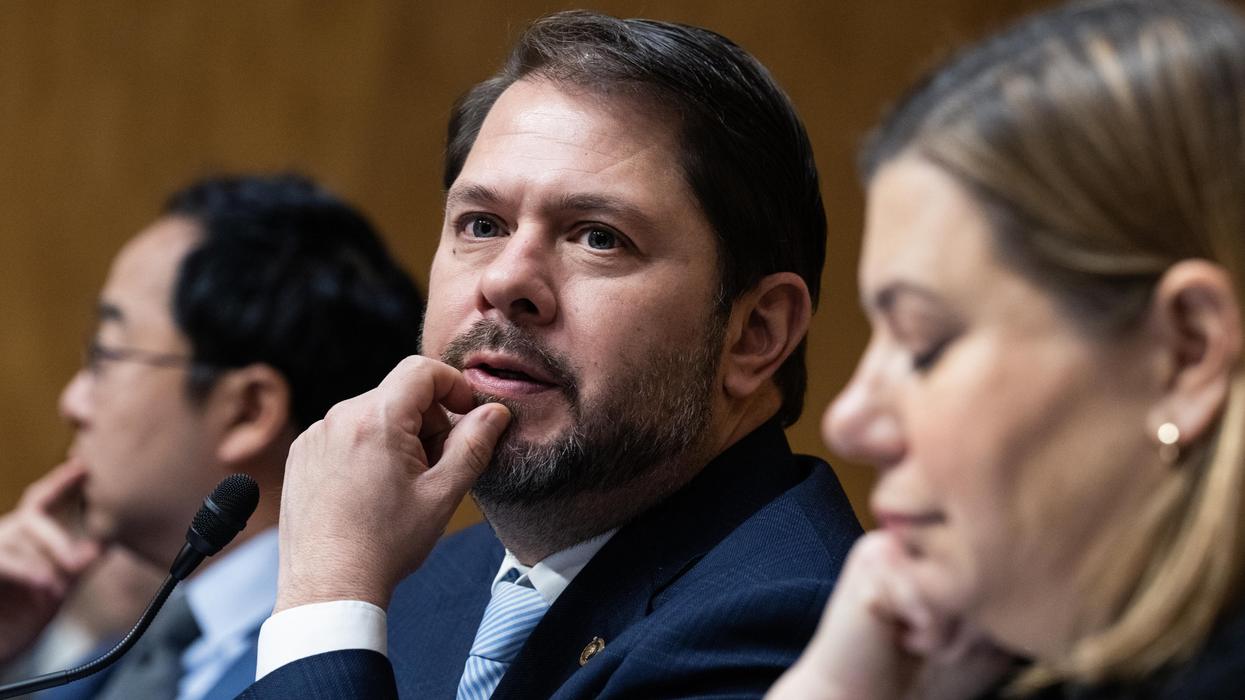
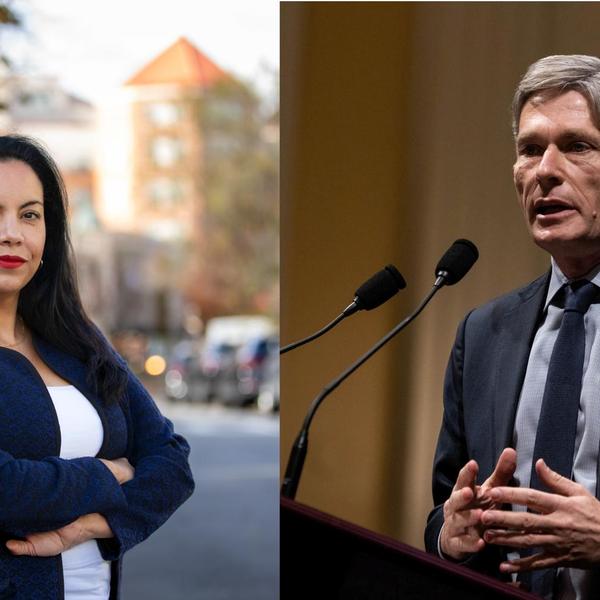
Top image credit: Sens. Andy Kim (D-N.J.), Ruben Gallego (D-Ariz.) and Elissa Slotkin (D-Mich.) sit look on during a congressional hearing in January, 2025. (Tom Williams/CQ Roll Call/Sipa USA)
Will Democrats pop Trump's $50 billion trial balloon for war?
March 06, 2026
On Wednesday, Sen. Ruben Gallego (D-Ariz.) told CNN that he would support new funding for the U.S. war with Iran — but only if Israel and Arab Gulf states help pay for it.
“We’re using our taxpayer money to protect those countries,” Gallego said. “We’re using our men to protect these countries. They need to throw in and have skin in the game too.”
But Gallego’s Goldilocks stance didn’t last long. Following a wave of online backlash, the senator changed course Thursday morning and declared his opposition to any “supplemental funding for the illegal Iran war.”
The sudden about-face demonstrates how the Democratic base is pushing its lawmakers to accept the “obvious political logic” of voting against new funding for the war in Iran, according to an advocate lobbying against the war, who requested anonymity to speak freely about congressional dynamics. The message, as the advocate put it, is simple: “a vote to fund this war is a vote for the war.”
Just days after launching a surprise campaign to topple the regime in Iran, the Trump administration has already floated the idea of seeking a $50 billion supplemental funding bill to help sustain its war effort, which is costing at least $1 billion per day. For now, it appears that such a request would sail through the Republican-controlled House. But any funding for the war will face a far more difficult test in the Senate, according to advocates and lobbyists who spoke with RS.
The math is straightforward. In order to advance a funding bill through the normal process, Senate Republicans will need to get at least seven of their Democratic colleagues on board. Sen. John Fetterman (D-Pa.) is the only Democrat who has made clear that he would support a supplemental, but his vote could well be cancelled out by Sen. Rand Paul (R-Ky.), who has been among the war’s sharpest Republican critics.
These seven votes could be hard to come by. Some Democrats have expressed openness to a funding bill, like Sen. Gary Peters (D-Mich.), who told RS in a statement that Trump must “provide a clear strategy” for the war before asking for more funds. Other national security Democrats, like Sens. Elissa Slotkin (D-Mich.) and Jack Reed (D-R.I.), have also left the door open to a “yes” vote.
But a large swathe of Democratic senators have united behind a strong anti-war message. And many of those who have floated the idea of funding the war, like Gallego, have been forced to walk back their stances. Take Slotkin, who said Wednesday that she doesn’t “rule anything out” since “we’re in it.” Following a wave of backlash, she softened her stance on Thursday, saying, “I will always look at anything that is brought to me, but I have a pretty skeptical eye.”
Progressive operatives see opposition to the war as a political winner. Democratic lawmakers can use a battle over a supplemental bill to attack Trump for spending money overseas while pinching pennies at home, argued Dylan Williams, the vice president for government affairs at the progressive Center for International Policy.
“Frankly, it's mind-boggling that any Democratic lawmaker would consider funding this war,” Williams said. “Trump and Republicans are running at full speed into a buzzsaw on kitchen table affordability issues, and this war makes that worse.”
Of course, the GOP does have some tools for twisting Democrats’ arms. One option under consideration is to tie Iran funding to a Democratic priority, like additional Ukraine aid or disaster funding. Another is to frame Democrats as insufficiently supportive of the troops, or insufficiently opposed to the “Ayatollah,” as Sen. Markwayne Mullin (R-Okla.) put it Tuesday.
But Williams expects that Democrats will hold out against these attacks. When it comes to questions of supporting soldiers, for example, the response is straightforward. “The best way to protect our troops is to end the war that has put them in harm's way,” Williams said.
Further bolstering Democratic arguments is the fact that the Pentagon is already flush with cash. The Defense Department has “barely obligated” any of the $150 billion in supplemental funding that it received from Congress last year, according to a senior congressional staffer who spoke on condition of anonymity. “It's essentially a slush fund,” the staffer told RS. “They can program that money to pay for whatever urgent needs are coming out of Iran.”
The problem for the Trump administration is that this money will only go so far in replenishing munitions stockpiles on short notice. If Trump wanted enough weapons to sustain a long war, the Pentagon would have had to invest some of that $150 billion when it received the funding last year. “There's no way that our munitions manufacturers can speed up production in the short term to meet urgent demand,” said the staffer. “It's the height of irresponsibility to launch a war of choice against a massive adversary like Iran when you know for certain that your stockpiles are in a dire situation.”
Given the limited near-term impact, a vote on a supplemental will serve primarily as a political litmus test. “Trump wants to signal to the world that he's serious about Iran by securing congressional support for a $50 billion supplemental,” the staffer said.
Democrats can thwart that message if they seize the opportunity to block additional funding, Williams argued. “The most immediate impact will be the political signal it sends to Trump that his war is deeply unpopular and cannot go on for the months the Pentagon is now planning for,” he said. “That limiting of political space around the president is critical.”
keep readingShow less

Top photo credit: Polymarket logo (Shutterstock/PJ McDonald) and Scene following an airstrike on an Iranian police centre damaging residential buildings around it in Niloofar square in central Tehran on march 1, 2026. (Hamid Vakili/Parspix/ABACAPRESS.COM)
Prediction markets are a national security threat
March 06, 2026
Hours before an Israeli attack in Tehran killed Ayatollah Khamenei, an account on the prediction market Polymarket made over half a million dollars wagering that Iran’s Supreme Leader would vacate office before 3/31. That account, named “Magamyman,” was not the only one to cash in on the attacks.
Half a dozen Polymarket accounts made over $1.2M betting that the U.S. “strikes Iran by February 28, 2026.” Those accounts were allegedly paid for through cryptocurrency wallets that had previously not been funded prior to Feb. 27. Overall, prediction market users bet over $255M on markets related to the attacks in Iran on the prediction markets Kalshi and Polymarket alone.
This is not the first time that prediction market users have profited off international affairs. For example, the night that the U.S. military embarked to capture Nicolás Maduro, an unknown individual placed a bet on the prediction market Polymarket that Maduro would be out of power by the end of January. That individual bet over $32,000, and, within hours, made over $400,000.
These unknown individuals may have had a particularly lucky hunch about US involvement in Iran or Venezuela. However, both timing and volume of the trading that occurred raise another explanation — that these individuals may have had inside information about the impending military action.
Betting activity like this shines a light on a new problem facing national security: prediction markets. As both policy and international affairs experts, we urge Congress to take action to change that.
Prediction markets (like Kalshi, Polymarket and Predictit) can be thought about like stock markets. Individual “traders” make predictions in the form of investments that certain events might come to pass (“event contracts”). Prediction markets cover sports (an active source of litigation in Massachusetts), celebrity gossip (e.g., Kalshi has a market for “who will attend the Oscars?”), and more.
Prediction markets also offer trading on international affairs. For example, a Predictit market allows users to bet on whether the question “Will the US purchase Greenland in 2026?” (defined as a situation wherein “the United States, as a sovereign entity, publicly purchases the Island of Greenland in 2026”). As of this writing, “Yes” values were trading at $0.06 USD, and “Nos” at $0.94. This means that someone investing buying 100 shares on the “Yes” outcome would win a net profit of $94 USD ($100 - $6) if the US were to purchase Greenland before 12/31/26. Another prediction market, Polymarket, even offered trading on whether a nuclear weapon would be detonated this calendar year, which experts cited as a potential national security risk. Polymarket quietly pulled the market however, following pushback on social media.
The incentive for prediction market abuse by government officials is, in our view, obvious for at least two reasons. One issue concerns fairness in prediction market operations. Government actors may have more information than most people about domestic and international politics. Officials in the Department of War, for example, could have far more information about whether or not leaders will be deposed, the onset of international conflict, and more.
Second, and more problematically, we worry that government officials can use prediction markets for personal gain, at the expense of national security. People with the power to influence international affairs could alter their actions in order to make a profit on a prediction market. If, for example, a government official in the Department of War had been invested in the market predicting when President Maduro would be captured, or when the U.S. might strike Iran, they might have altered the timing of the operation in order to make a profit.
It is important to note that Polymarket had previously been banned from operating in the U.S. under President Biden, due to regulatory considerations. However, it was allowed to return under the second Trump administration. Their willingness to do so may result from the prospect of personal financial gain. President Trump’s son Donald Trump Jr. has been serving as an advisor to Polymarket since August 2025.
Our point is that the potential for abuse exists. Congress must act to regulate it.
Failing to regulate prediction markets could pose important risks to national security. For example, prediction markets may become sources of intelligence for adversaries. By signalling when military action might be preparing to take place, military personnel may be put in more danger than is operationally necessary. Additionally, nefarious actors may use prediction markets to sow geopolitical instability. If foreign adversaries want to stoke international conflict they could manipulate the prediction markets by strategically placing wagers on events in order to send misleading signals about what traders expect to happen. It is not difficult to imagine Polymarket’s betting market on nuclear detonation, for example, sowing tension, uncertainty and anxiety, particularly if people think there is inside knowledge being used in the driving of the markets. That could make diplomacy more difficult and lead to foreign policy crises.
Congress has long recognized the importance of placing strict limits on some prediction markets. For example, the 2012 STOCK Act requires members of Congress and senior staff to (a) avoid investing in stocks and securities for which they may have insider information, and (b) regularly disclose their holdings. The law aims to guard against both unfairness and market manipulation by government actors.
Today, Congress is considering legislation that would aim to regulate insider trading on prediction markets. For example, newly introduced legislation in the US House (HR 7004) would ban elected officials in the federal government, Congressional employees, and other political appointees from participating in prediction markets if they have nonpublic information relevant to that market. Presently, though, the legislation does not go as far as the STOCK Act in terms of requiring disclosure of betting activity.
Whatever form legislation might take, action is necessary to regulate the ability of government officials to place wagers on prediction markets. U.S. national security depends on it.
keep readingShow less
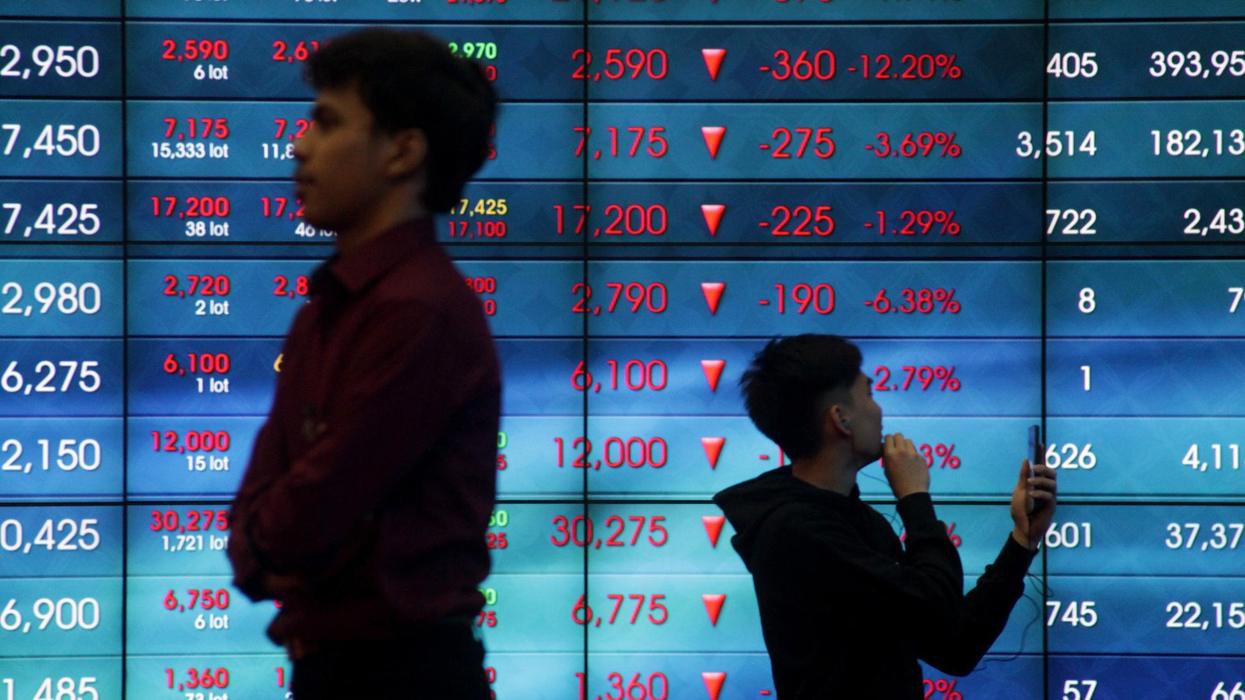
Top photo credit: (Shutterstock/Triawanda Tirta Aditya)
Trump's ‘move fast and break things’ war slams into economy
March 06, 2026
The launch of joint U.S.-Israeli strikes on Iran could lead to economic and financial disruptions that ripple across the countries of the Global South with devastating effects. And while a quick end to the war could dampen these effects, Defense Secretary Pete Hegseth has acknowledged that the war could even last up to 8 weeks, and Israel is now reportedly expecting a "weeks-long" war with Iran.
The fundamental issue here seems to be an increasingly expansive vision of American — and particularly Israeli — war aims. These have now gone well beyond Iran’s offer of substantial denuclearization to regime change, and some quarters have even more extreme visions like the potential Balkanization of Iran into multiple statelets. Such mission creep on the part of the U.S. and Israel has in turn changed incentive structures in Iran towards an expansion of the conflict to target both the Gulf States and global oil markets, a dynamic that threatens to broaden the conflict and extend it, with profound impacts on the global economy.
The dominant channel through which these impacts will be felt is of course the price of oil. And here, the issue is less the loss of Iranian production (exports amount to roughly 1.5 million barrels per day) as it is hostilities leading to an effective closure of the Strait of Hormuz, driven by a combination of attacks on ships and disappearance of private insurance coverage for tankers transiting the straits. As of this writing, 8 ships have reportedly been struck by Iran and hundreds more are waiting on either side of the strait. Meanwhile, private marine insurers have canceled coverage, and are likely to renew (if at all) at significantly higher rates.
In response, President Trump said earlier this week that he would order the Development Finance Corporation to provide cheap marine insurance to all merchant shipping traversing the strait and potentially also offer U.S. naval escorts to vessels that requested it. This may alleviate some of the pressure, but is not without its own logistical and political difficulties. The DFC (launched in 2019 and recently reauthorized to be substantially larger with a maximum contingent liability of $205 billion) does indeed provide political risk insurance that covers acts of war, as did a predecessor, the Overseas Private Investment Corporation. But the industry is reportedly skeptical about both the DFC’s financial capacity and the willingness of shippers to undertake voyages given broader uncertainties.
However, in comparable recent instances of such coverage (such as during the Iran-Iraq war of the 1980s), the U.S. was not a full-blown belligerent in the conflict as it is now, which might complicate decisions regarding underwriting and pricing. The agency’s announcement on the subject was relatively thin on details, and the underwriting process would likely involve extensive due diligence over the valuations of hundreds of vessels and the likelihood of adverse incidents. And shippers (and perhaps crews) are also likely to engage in such calculations before voyages in a war zone, particularly given the added risks stemming from recent revolutions in drone warfare.
As if all this were not enough, there might be political issues that stem from the fact the U.S. actually gets practically none of its oil through the Strait of Hormuz — most of it goes to Asia, with China being the single largest importer. Thus it is unclear how quickly White House financial initiatives can restore oil flows as long as the region remains a contested battlefield.
One result has been a very sharp jump in the price of oil, with benchmark Brent Crude topping $80 per barrel, up from $60 in early January, when Nicolas Maduro of Venezuela was overthrown. At the time, it appeared that oil prices were too low for the major oil companies to consider investing in Venezuela’s expensive and difficult oilfields, suggesting that there might be at least one economic winner in the Global South from a prolongation of the conflict.
In fact, if the patterns last seen during the early weeks of the Russian invasion of Ukraine hold, South America as an energy exporting continent could be hit less hard by events in the Middle East than East, Southeast, and South Asia, which account for the bulk of energy imports from the Persian Gulf region. Of the roughly 15 million barrels that flow through the Strait of Hormuz every day, roughly 12.5 million barrels go to Asia.
Among the major economies, India stands out for its high exposure to the Gulf. It is a current account deficit economy with a trade deficit that reflects substantial oil imports. India also has a large population of expatriates in the Gulf who account for roughly $48 billion in remittances every year, helping to cushion the balance of payments.
Similar exposure to the Gulf region was one of the reasons that the Indian economy hit a wall in 1990-91 (due to the first Iraq war), an event that forced the country to seek succor from the IMF and open its economy to the world. One consequence of the subsequent, major market reforms is that India is in better shape to face these travails with roughly $725 billion in reserves, a far cry from its empty cupboards in 1991.
But other small oil importing countries in the Global South with less diversified economies might not be as fortunate. And one of the unfortunate echoes of 2022 here is not just the jump in oil prices (which might come down), but a leap in fertilizer prices just ahead of planting season — exactly what happened in 2022. Natural gas is a key input for nitrogen-based fertilizers and the Persian Gulf region is a key global producer, accounting for roughly 45% of global urea production. A jump in fertilizer prices could hurt millions more than even a jump in oil prices.
Currency markets could be yet another source of pressure. To the surprise of some (but not all) observers, the dollar experienced a broad-based selloff last year in response to White House tariffs, giving countries in the Global South some respite from imported inflation that might have forced their central banks into rate hikes. But thus far at least, the jump in oil prices has bolstered the dollar, reflecting both America’s greater energy independence since the shale revolution and the expectation that a heightened risk of inflation could slow rate cuts by the Federal Reserve.
It should be noted, however, that while higher oil prices might bolster the dollar versus its competitors, they are unlikely to help the U.S. economy overall — America has a lot more people who buy gasoline than it has workers engaging in the oil or shale patch.
These financial and economic pressures that come from higher energy prices are also coupled with trade pressures directed at manufacturing-exporter economies (predominantly in Asia) that have been subjected to one form of tariff or another. China has been an obvious target but so have Japan, South Korea, the ASEAN states, and India, which was just told by a State Department official that the U.S. was not going to repeat the trade mistakes it had made with China. Beyond all this, some of the more extremist plans being mooted for the region, such as the breakup of Iran, could lead to increased instability not just in the Middle East, but also in South Asia via the impact on an economically tottering Pakistan, which would just add to economic burdens.
Thus, the White House seems to have borrowed the Silicon Valley maxim of “move fast and break things” to vast geographic areas, most alarmingly in the highly sensitive Middle East, potentially threatening the economic stability of what has been the world’s fastest growing region for the last 3 decades. In all this, the U.S. may be acting (contra Charles Kindleberger’s precept) as a hegemonic destabilizer rather than stabilizer.
keep readingShow less

Want more of our stories on Google?
Click here to make us a Preferred Source.
Click here to make us a Preferred Source.


Newsletter
Subscribe now to our weekly round-up and don't miss a beat with your favorite RS contributors and reporters, as well as staff analysis, opinion, and news promoting a positive, non-partisan vision of U.S. foreign policy.