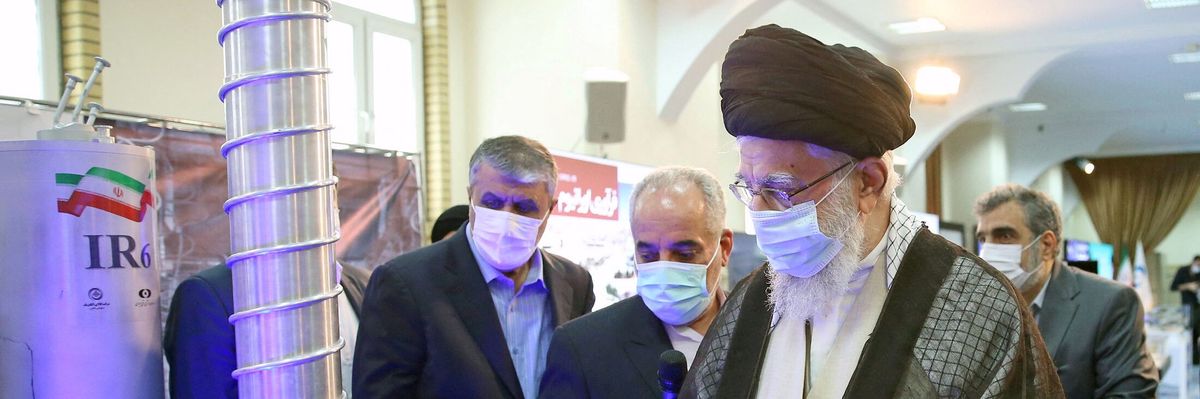
On June 11, Iran's Supreme Leader Ayatollah Ali Khamenei delivered a significant speech to a group of scientists, experts, and officials in Iran's nuclear industry. He praised their achievements and cautiously approved the possibility of a deal with the West regarding Tehran’s nuclear program but also emphasized the importance of preserving Iran’s nuclear infrastructure.
Given that the Supreme Leader holds the final authority in all foreign policy matters, his diplomatic language provides crucial insights into Iran’s negotiating stance and carries serious implications for the future of nuclear negotiations and U.S.-Iran relations.
The speech comes at a critical juncture for Iran’s nuclear program and its relations with Washington and its Western allies. The indirect talks between the U.S. and Iran have been stalled since September, with both sides accusing the other of making unreasonable demands. The Iranian government’s assistance to Russia in the Ukraine war and its brutal crackdown on a countrywide protest movement since that time have also stalled the negotiation process.
Meanwhile, Iran has been steadily advancing its nuclear activities by increasing its stockpiles of highly enriched uranium, installing more advanced centrifuges, and reducing cooperation with the International Atomic Energy Agency (IAEA). These moves, which exceed the limits established under the 2015 Joint Comprehensive Plan of Action that was negotiated between Iran and the five permanent members of the UN Security Council plus Germany have increased concerns about Iran’s intentions as it has approached nuclear breakout capability.
While a full restoration of the JCPOA appears increasingly unlikely, both sides could still benefit from a smaller agreement that involves mutual concessions. Such an agreement would help alleviate tensions and partially address their respective interests, thus averting an immediate crisis.
Khamenei’s approval of a potential agreement, albeit with the caveat that Iran’s nuclear infrastructure should not be compromised, could be interpreted as a signal that Tehran is now prepared to make some concessions for a deal. The key question, however, is what he meant by preserving Iran’s nuclear infrastructure, which could encompass advanced centrifuges, high-enriched uranium stockpiles, and other nuclear material and equipment that pose a proliferation risk.
Iran's primary concern lies in receiving assurances that the U.S. will honor any new deal, even if it isn’t legally binding. Hence, many in Iran argue that maintaining significant parts of its nuclear infrastructure, even if placed under IAEA or international supervision, is a necessary safeguard against any potential U.S. withdrawal from a new agreement. However, preserving the nuclear infrastructure as it exists today would clearly violate the limitations set forth in the 2015 nuclear deal.
In his speech, Khamenei also reiterated Iran's long-held position that it is not seeking nuclear weapons and emphasized that such weapons, along with chemical weapons that indiscriminately kill people, are prohibited on religious grounds. He insisted that the West’s claim about “the fear of nuclear weapons production in Iran” is a lie, adding that the U.S. intelligence community has acknowledged several times, including in recent months, that there is no sign of Iran moving towards producing nuclear weapons. He also urged Iran to maintain its cooperation with the IAEA within the framework of its safeguards agreement.
Interestingly, Khamenei’s speech coincides with reports — originating in Korean, Israeli, and Qatari media — suggesting that the U.S. and Iran are indeed considering a more limited or interim agreement. Such an agreement would involve freezing or rolling back some of Iran’s nuclear advances in exchange for partial sanctions relief. Both sides, however, have so far denied reaching any interim deal or alternative arrangement beyond the JCPOA.
Nevertheless, the stakes are high for both sides, as they face domestic and international pressures to resolve the nuclear impasse. Khamenei seeks to ensure conservative President Ebrahim Raisi's success as his protégé and potential successor, secure Iran's strategic interests and regional influence, and avoid military confrontation with the U.S. or Israel, both of which have threatened to use force if diplomacy fails to prevent Iran from acquiring nuclear weapons. On the other hand, President Biden aims to fulfill his promise of diplomacy with Iran, prevent a nuclear crisis that could negatively impact his 2024 reelection campaign, and address concerns from U.S. allies in the region, notably Israel and Saudi Arabia, regarding Iran's nuclear ambitions and regional behavior.
In this context, Khamenei's speech signals support for the Raisi government to pursue a diplomatic solution with Washington.
Any new agreement, however, carries risks and challenges for both parties. They must navigate the expectations and reactions of their domestic and international audiences, some of which may oppose or seek to undermine a deal. In the U.S., the Biden administration faces resistance from lawmakers, particularly Republicans, who have long opposed the JCPOA and favor maintaining, if not increasing tough economic sanctions against Iran. Biden would face a major challenge, particularly in light of Tehran’s closer ties with Moscow since Russia’s invasion of Ukraine, in persuading Congress and the American public that engaging with Tehran serves the national interest.
Similarly, Raisi must contend with hardliners to his right who oppose any compromises on Iran's nuclear program and argue that it would be foolhardy to trust that the U.S. would fulfill its promises given former President Trump’s unilateral withdrawal from the JCPOA. Nonetheless, Khamenei's speech may help protect Raisi against domestic criticism if his diplomats manage to secure a deal.
Ultimately, both Iran and the U.S. share a strong interest in reaching an agreement. A more limited or interim agreement could serve as a crucial bridge, effectively easing tensions and building a foundation for further negotiations. Khamenei's speech potentially paves the way for a breakthrough in the protracted nuclear impasse or, at the very least, mitigates the risk of further escalation and confrontation with the U.S. However, achieving such an outcome remains uncertain, as both sides face formidable domestic and international pressures that could derail the diplomatic process.