
Follow us on social

google cta
Shireen_abu_akleh_6

Reports: FBI investigating death of Palestinian-American journalist

The new probe comes amid a spike in tensions between Washington and Tel Aviv following the rise of far-right leaders in Israel.

Middle East
google cta
google cta

Reports say that the FBI has opened an investigation into the death of Palestinian-American journalist Shireen Abu Akleh, who was killed by Israeli soldiers last May while covering an Israeli raid in Jenin, a major city in the occupied West Bank.

The revelation, which was first reported by Israel’s Channel 14 and confirmed by Axios, emerged after American officials notified Tel Aviv’s Justice Ministry of the investigation. Neither the Department of Justice nor the FBI have yet confirmed the existence of the probe.

Sen. Chris Van Hollen (D-Md.), who has helped lead the charge for accountability for Abu Akleh’s death, praised the FBI’s decision, calling it “an overdue but necessary and important step in the pursuit of justice and accountability.”

The unprecedented move could open Israeli soldiers to U.S. legal liability for any involvement in the killing, a fact that will surely add to brewing tensions between the Biden administration and the incoming government of former Prime Minister Benjamin Netanyahu, which is expected to include several ministers from a far-right, Jewish supremacist party.

One such member, Itamar Ben-Gvir, will likely take over as minister of public security in a Netanyahu government. Ben-Gvir’s likely appointment has drawn significant backlash given his history of support for Jewish extremists, including the perpetrator of a 1994 terrorist attack on a mosque in Hebron that left 29 worshippers dead and 125 injured.

Even Sen. Bob Menendez (D-N.J.), a strong supporter of U.S.-Israel ties, has reportedly warned Israeli officials that making Ben-Gvir a minister would damage the relationship between the two countries.

The FBI investigation comes after US and Israeli officials separately determined that Abu Akleh had most likely been killed by a stray Israeli bullet. A range of activists and politicians have fought that conclusion, with some arguing that soldiers may have intentionally killed the prominent Palestinian journalist. 

Notably, Sen. Patrick Leahy (D-Vt.) has previously threatened that Abu Akleh’s killing could imperil Washington’s massive annual military aid to Tel Aviv. “Unfortunately, there has been no independent, credible investigation,” Leahy said in September, adding that there is “a history of investigations of shootings by IDF soldiers that rarely result in accountability.”

A number of questions remain about the investigation. As Jamil Dakwar of the ACLU noted on Twitter, it remains “unclear if Israeli authorities would fully cooperate with the FBI,” which could complicate efforts to reach a definitive conclusion about why and how Abu Akleh was shot.


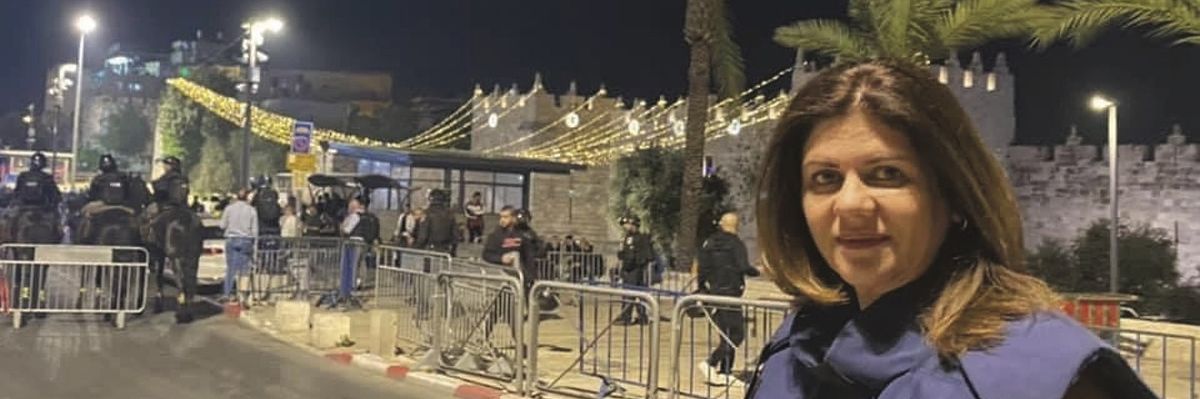
Slain Palestinian-American journalist Shireen Abu Akleh (via Al Jazeera/ CC-BY-SA-4.0)
google cta
Middle East
Israel’s push for Somaliland base raises fears of wider war
Top image credit: Israeli Foreign Minister Gideon Saar and Somaliland President Abdirahman Mohamed Abdullahi participate in a joint press conference during Saar's visit to Somaliland on January 6, 2026. (Screengrab via X)

Israel’s push for Somaliland base raises fears of wider war

QiOSK

Bloomberg reported Wednesday that Israel is in talks with Somaliland officials to form a strategic security partnership, which might include granting Israel access to a military base or other security installation along the Somaliland coast from which it can launch attacks against Yemen’s Houthi rebels.

With war raging in the Middle East, the Horn of Africa is a particularly important geoeconomic and geopolitical puzzle piece. Its location near the Bab el-Mandeb strait, which connects ships traveling through the Red Sea with the Gulf of Aden and the Indian Ocean, makes it a strategic location from the perspective of global shipping, 10% to 12% of which travels through the strait annually.

keep readingShow less
Most Iranian Americans want diplomacy with Iran: poll
Iranian-Americans in the age of Trump, the Travel Ban, and the Threat of War

Most Iranian Americans want diplomacy with Iran: poll

QiOSK

Recent data released by the National Iranian American Council (NIAC) suggests that a strong majority of Iranian Americans support diplomacy to resolve tensions between the U.S. and Iran — a finding at odds with the dominant conversation online suggesting that most Iranian Americans are in favor of the Iran war.

The data was collected through a survey of 505 Iranian Americans conducted by Zogby Analytics between Feb. 27 and March 5. Among the most notable results were that a clear majority of Iranian Americans — 61.6% — support diplomacy to move toward de-escalation and a negotiated path forward.

keep readingShow less
Oil disruption from Iran war won’t end any time soon
REUTERS/Essam al-Sudani/File Photo

People walk near farmland by the Zubair oil field as gas flares rise in the distance, in Zubair Mishrif, Basra, Iraq, amid regional tensions following the recent disruption to shipping in the Strait of Hormuz and the U.S.-Israeli conflict with Iran, March 9, 2026.

Oil disruption from Iran war won’t end any time soon

QiOSK

The US-Israel-Iran war has led to extraordinary volatility in global energy markets this week, and there is little reason to think that it will abate any time soon.

Benchmark Brent crude, which traded below $60 per barrel early this year, jumped to $80 last Thursday. It then bounced to $120 in thin weekend markets and, as of this writing, has settled in around $92. In other words, the range of the recent oil price has been 50% of where it was a mere five days ago.

keep readingShow less
google cta
Want more of our stories on Google?
Click here to make us a Preferred Source.

LATEST

QIOSK

Newsletter

Subscribe now to our weekly round-up and don't miss a beat with your favorite RS contributors and reporters, as well as staff analysis, opinion, and news promoting a positive, non-partisan vision of U.S. foreign policy.