

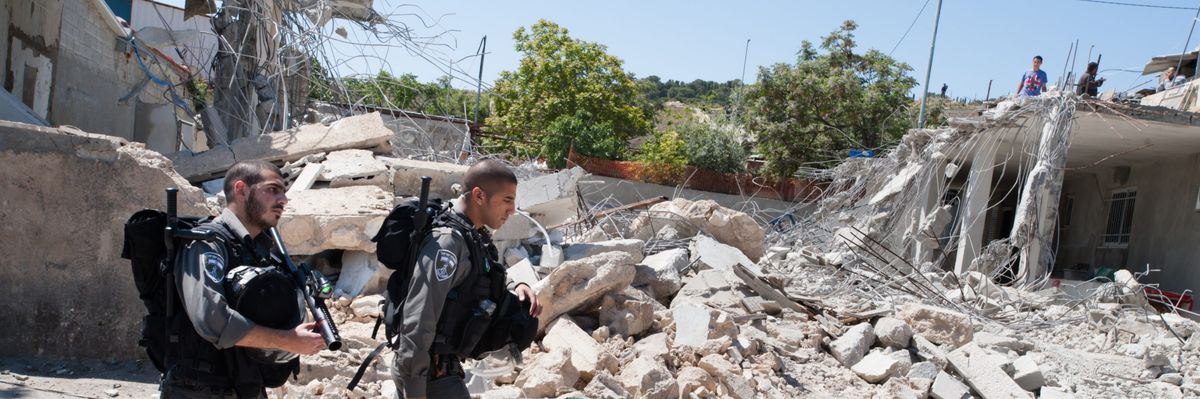
When Israeli bulldozers stormed the West Bank community of Humsa al-Fuqa (Khirbet Humsa) and demolished its structures on Nov. 3, leaving 11 Palestinian families homeless, some Democrats in Washington, D.C. took notice.
Two weeks after the Israeli demolition, which took place under the cover of U.S. election day, Rep. Mark Pocan (D-Wisc.) and 39 of his Congressional colleagues sent a letter to Secretary of State Mike Pompeo criticizing Israel’s actions as “a serious violation of international law” and an example of “creeping annexation.” Pocan’s letter also demanded that Pompeo examine whether Israel had utilized U.S.-made equipment during the demolition operation.
The demolition of Humsa al-Fuqa has attracted widespread attention in recent weeks. Israel’s army routinely demolishes Palestinian structures in the occupied West Bank that are built without Israeli-issued permits, which are nearly impossible to obtain. But this particular demolition, which was approved by the Israeli Supreme Court, led to the destruction of 76 structures — the largest amount demolished in a single operation over the past decade.
“There is no excuse for the de facto annexation of Palestinian land, and America cannot remain silent in the face of these human rights abuses any longer,” Pocan said in a statement after the letter’s release.
Now, the lobby group Democratic Majority for Israel (DMFI) is trying to undermine the letter. In a DMFI memo sent to Democratic staffers in Congress obtained by +972 Magazine, the group says that the members who signed Pocan’s letter were “misinformed,” and goes on to blame Palestinians living in the village for “knowingly put[ting] themselves in danger,” effectively justifying Israel’s demolition operation.
The memo offers a peek into the increasingly heated debate over Palestine between progressive and establishment members of the Democratic Party — and a look into how DMFI is trying to interfere with efforts in Washington to criticize Israel’s occupation.
DMFI is the newest pro-Israel lobby group to set up shop in Washington, but its members are no strangers to the Hill. Run by longtime Democratic consultant Mark Mellman, its leadership and board are stacked with party insiders with close ties to the American Israel Public Affairs Committee (AIPAC), the Israel lobby’s flagship organization in Washington.
“It’s completely unjustifiable to be rationalizing kicking people out of their homes in the middle of a global pandemic,” said Emily Mayer, political director of the anti-occupation Jewish group IfNotNow, who reviewed the DMFI memo. “But it’s unsurprising because the memo perfectly encapsulates what DMFI is: on its face trying to appeal as progressive, but behind closed doors repeating the insidious talking points that justify the status quo.”
Excusing Israel’s demolition
The two-page DMFI memo targeting the Pocan letter was circulated on Dec. 1. It notes that Israel’s demolition of Humsa al-Fuqa took place in Area C of the West Bank — which “was designated for full Israeli control” under the Oslo Accords. No reference is made to the fact that Area C, like the rest of the West Bank, is under military occupation according to international law.
In an echo of the Israeli army’s own justification for destroying the hamlet, the memo goes on to say that the community was “illegally placed in the midst of an area used by the Israeli military for live fire exercises since 1972,” and that because of this, “those living in the encampment knowingly put themselves in danger.”
Included in the memo is an aerial photograph marking the Israeli military firing zone that encompasses Humsa, taken from the website of Regavim, a right-wing Israeli settler group, whose logo is featured on the top-left corner of the picture.
“Perhaps it would have been better for the Israeli government to have refrained from taking this step, or taken it differently,” wrote DMFI, “but attempting to label the removal of these 7 tents and 8 animal pens ‘illegal’ or ‘creeping annexation’ or (as some have) ‘ethnic cleansing’ reflects either ignorance of the facts or an intention to create hostility toward Israel in spite of the facts.”
The memo concludes that a “negotiated two-state solution” would put an end to Israeli home demolitions, and urges the Palestinian Authority to “return to the negotiating table.”
In response to questions posed by +972, Mark Mellman, the head of DMFI, said that his organization “has stood strongly for a two-state solution to the Israeli-Palestinian conflict and that includes publicly and privately criticizing the Israeli government’s annexation proposal, settlement development in E-1 and Secretary Pompeo’s shift in U.S. policy toward settlement expansion.”
Mellman continued: “DMFI’s memo made clear that we were not taking a position on the destruction of the encampment, but rather pointing out problems with the content of the congressional letter and the intent of its progenitors who misstated facts and used hyperbolic language in discussing it. In pointing out that the residents had no legal claim to the land and that they set up their encampment in, a place designated as a free fire zone in a military training area for 48 years, we were following last year’s ruling by Israel’s Supreme Court, which we quoted, and which has, in other cases, rightly stopped Jewish settlers from displacing Palestinians from land actually owned by Palestinians.”
‘Democrats masquerading for impunity’
Since the 1970s, the Israeli army has declared 18 percent of the occupied West Bank as zones for military training. According to Palestinian human rights group Al-Haq, about 6,200 Palestinians live in these zones, placing them at great risk of demolition and eviction. Al-Haq says that Israel’s threats of displacement and restrictions on access to resources “create a coercive environment that places pressure on Palestinian communities to leave these areas and relocate elsewhere.” Israel’s Supreme Court, meanwhile, has routinely given the green light to evict these Palestinian communities — effectively legitimizing the army’s use of firing zones as a pretext to displace Palestinians.
In a J Street response memo circulated to House Democrats that was also obtained by +972 Magazine, Debra Shushan, the liberal group’s director of government affairs, pushed back against DMFI’s claims. She asserted that DMFI’s arguments “mirror Regavim’s talking points” and that “Israel has declared many areas as firing zones to displace Palestinian communities and maintain Israeli control.”
“DMFI is attempting to shield Israel from criticism over its policies that imperil prospects for a viable Palestinian state and a negotiated end to the Israeli-Palestinian conflict,” Shushan concluded in her memo. “In undermining a two-state solution using pro-annexationist right-wing sources and talking points, DMFI’s defense of demolitions and forced relocations not only runs counter to democratic values, but harms Israel’s future.”
Launched in January 2019, DMFI’s activities have worked to ensure the Democratic Party keeps criticism of Israel muted. In its almost two years of existence, DMFI has spent millions of dollars defending Democrats who faced primary challenges from progressives speaking out for Palestinian rights. According to The Intercept, DMFI, with the help of AIPAC donors, also spent heavily on attack ads against Bernie Sanders during the 2020 presidential primary; although the ads did not mention Israel, Sanders had repeatedly criticized the Israeli government while on the campaign trail.
Meanwhile, on Capitol Hill, DMFI has harshly attacked progressive Democrats like Congresswomen Betty McCollum and Rashida Tlaib for their Palestinian rights advocacy, all while claiming to support a “progressive policy agenda.”
“AIPAC has become so toxic among Democrats after they worked tirelessly to undermine the first African-American President that other groups like this have popped up hoping to advance a similar agenda with another name,” said Yousef Munayyer, a non-resident fellow at the Arab Center Washington DC. “These so-called Democrats masquerading for impunity [DMFI] peddle the same old story, pretending that endless human rights abuses by Israel are actually complicated and that at the end of the day, Palestinians are to blame for their own suffering.”
This article has been republished with permission from +972 Magazine.