

Arab leaders have long evinced an ability to reinvigorate their ruling institutions when confronted with tough challenges. While state collapse or civil war have wreaked havoc in Libya, Iraq, Syria, and Yemen (with the exception of Tunisia and the partial exception of Iraq and Lebanon), it is authoritarian survival—and the unceasing struggle against it—that define the political contours of much of the Arab world today.
Will COVID-19 change these realities? Like their cohorts in powerful positions around the world, Arab leaders are using the coronavirus pandemic to increase political control. This crisis, however, has unique features that could complicate efforts to defend autocracy, creating both headaches and opportunities. What is at stake now is not only regimes but myriad state institutions whose mission should be to ensure a basic level of economic, personal, and human security for their citizens. The nightmare facing many Arab leaders is that the rapid spread of COVID-19 might outpace their capacity to adapt state institutions to an unprecedented and dangerous threat.
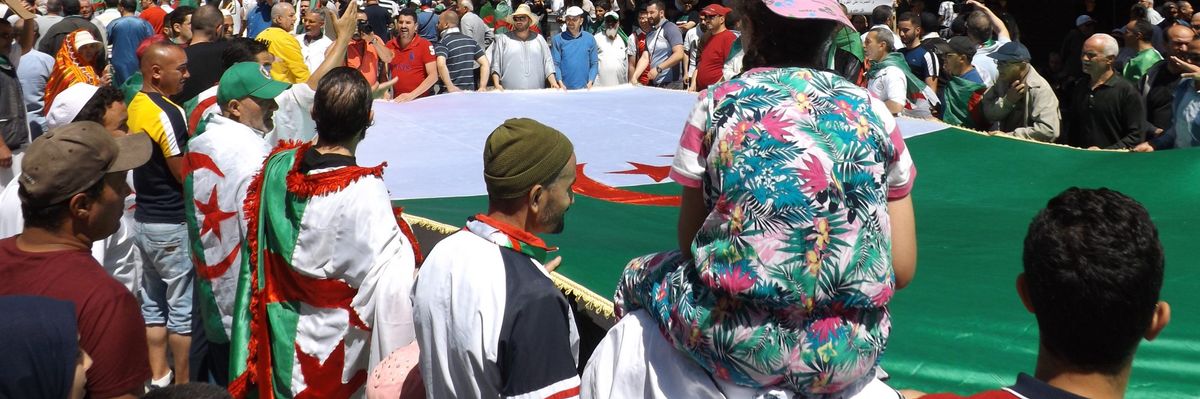
Algeria provides a telling example of the challenges posed by the coronavirus where, as of April 21, 2,811 cases of infection and 392 deaths have been reported. The virus arrived just as Algeria was about to mark a full year of weekly street protests; as the anniversary of the Hirak movement, the protesting group’s political future was unclear. That uncertainty had much to do with the regime’s shrewd decision to tolerate rather than repress the protesters. But COVID-19 seemed to remove any uncertainty about the regime’s calculations. Seizing on the undeniable—if useful—imperative of enforcing social isolation, and gradually imposing lockdowns on different sectors and areas of the country, Algeria finally declared a national lockdown on April 5. This gave authorities a range of powers, including the right to ban all streets protests. As for the Hirak movement, its forced retreat into the uncertain sanctuary of home and family will weaken an already weak hand. Nevertheless, some Algerian activists also see in this crisis a chance to create the kind of wider political strategy and capacity that Hirak has thus far failed to forge.
The military’s (flattening) learning curve
Algeria’s military and political power is rooted in far more than its capacity to repress: it also derives from the imposing fact that the military controls the state and the distribution of the goods and benefits provided by the state-owned oil sector. Because revenues from oil and gas resources are channeled through an array of formal state institutions and informal networks that are controlled by allies of the military, the generals assume that the weakening of any part of this sprawling infrastructure will lead to a collapse of the entire system. This intertwining or “pillaring” of Algeria’s vertical division of state power inclines the military and its allies in state institutions to view even modest political reform as threatening. Moreover, during moments of crisis or menace the generals have ample incentive to put aside clan or personal divisions and close ranks. As a result, opposition groups—including the Hirak movement—have no reliable interlocutors within the military, no soft-line faction that might negotiate the terms of political reform. At the end of the day, the Algerian military is a hard-line united front that will not abide any serious talk of political change.
Why, then, did a military that is deeply allergic to any hint of real opposition tolerate a year of massive street protests that were centered in Algiers but echoed throughout the country? While it is impossible to answer this question precisely, the most likely explanation is that the generals calculated it was better to tolerate the protests than try to repress them. Waiting out the demonstrators was preferable to taking measures that might only provoke a violent response that would, in turn, require greater force to suppress successfully. Going down this slippery slope risked provoking the kind of civil strife that engulfed Algeria following the military’s decision to shut down democratic elections in 1991.
Moreover, the Hirak lacked an authoritative leadership that could draw on the protests to create negotiating leverage with the regime. The one thing on which the protesters agreed was demanding the fall of the regime; beyond that, there was no consensus as to what kind of government—or democracy—should follow, or the demands that would advance a democratic bargain the opposition could envision. Last but not least, the demonstrations did not translate into wider public support for democratic change. Indeed, in 2019 only 41 percent of Algerians who were polled indicated that they believed that democracy was always superior to other forms of government. In short, however inspirational, the Hirak did not pose the kind of threat that would have justified a decision to favor confrontation over regime caution and patience.
In addition to waiting the opposition out, by emulating many of the tactical reforms that other Arab leaders had taken to contain opposition, the regime displayed its resiliency. For example, it initiated a national dialogue while insisting on maintaining its control during negotiations with protesters. At the same time, the military maneuvered to defend its long-term interests. Thus Lt. General Ahmed Gaid Saleh—who was widely viewed as the country’s most powerful military leader—forced Bouteflika to resign in April 2019 and then purged the former president’s allies. Having neutralized his potential internal rivals, Salah presided over the election of a new president. Elected on December 12, 2019 in a low turnout election (40 percent of eligible voters participated), Abdelmajid Tebboune (who had briefly served as prime minister in 2017) provided a paper thin veneer of civilian legitimacy for the military’s institutional primacy.
Saleh’s sudden passing on December 23 did not change one basic fact, namely that the new president could make no move that threatened the generals. Thus while Tebboune pledged to pursue radical political reforms, he in fact had little room for maneuver. Similarly, the release of 76 protest detainees—along with Tebboune’s creation, in January 2020, of a new committee to reform the constitution—inspired little confidence, especially in the formal opposition, whose leaders pushed for what turned out to be a widespread boycott of the December election. But the Hirak was not well positioned to leverage the potential opportunity presented by a newly elected president who was struggling to gain popular support. Lacking allies in the military and an authoritative leadership, the Hirak’s only alternative was to continue relying on Friday protests. When the coronavirus crisis eliminated this option, it seemed only a matter of time before the regime would begin a comprehensive clampdown on all forms of political and social dissent.
COVID-19 creates dangers and possible opportunities for the regime
The arrests of several social and political activists in February and March seemed to signal the beginning of just such a campaign. Not surprisingly, these activists were charged with an array of vague alleged crimes, not least of which was making statements that endangered the reputation of the military. But the onset of the COVID-19 crisis in Algeria generated a number of challenges that complicated any bid by the regime to widen the net of repression. While enforcing social isolation also worked in favor of political isolation, the regime had ample justification to advance these measures as necessary for protecting the general welfare. But COVID-19 is an equal opportunity virus whose rapid spread could literally weaken the human and institutional infrastructure that is at the heart of a repressive apparatus. Such a prospect was hardly on the radar screens of Algeria’s leaders in early February, when only a handful of coronavirus-related cases were officially reported.
The ability of the regime to address this growing threat has been hampered by a national health system that lacked the resources to fight the spreading disease, by widespread distrust of the regime, and—last but not least—by a steep decline in oil revenues. What could worsen this situation is the collapse in oil prices, which would result in serious cuts in spending because of the country’s dependence on the hydrocarbon sector. Algeria has been suffering from 12.35 percent unemployment in 2019 (26.9 percent among the youth). Its regime’s capacity to channel subsidies and other support to the vast urban middle class and to state employed workers had already been weakened. The country is now facing an even deeper social crisis.
The military’s fate will depend in part on how well it manages the current challenges. The regime has tried to relieve the burden on the state’s overcrowded prison system by releasing 10,000 prisoners in February and more than 5,000 others in April. This has left some 43,000 prisoners in 150 prisons, 30 of which are now being used to produce face masks for a health system that is unprepared for the COVID-19 onslaught. But political prisoners are not among those who have been released, a fact that has prompted demands from the official political parties that the government release “all prisoners of conscience” and to take measures to create a genuine state of law and real democracy. Of course, the military and its allies in the police and intelligence services will dismiss or ignore these demands, not only because they clash with the security sector’s interests but also because Algeria’s escalating health crisis might just give military leaders the opportunity to prove that they are the most effective institution in the country. Given the widespread perception that economic and social problems, rather than democracy, should be the first order priority of the regime, Algeria’s actual rulers might be well poised to regain public trust, which only a few short years ago remained strongly behind the military.
Whatever its intentions, the fact of the matter is that the security apparatus is vulnerable to COVID-19. While it is hard to secure a definitive estimate of the size of this sector, in 2019 the defense budget stood at $9.6 billion, far higher than any other ministry. With a security sector that, according to a 2016 NATO report, employs over half a million troops and a vast intelligence apparatus, the generals will have their hands full containing a virus that could sap the capacity and will of the military to address myriad domestic challenges, not to mention abiding security threats along its border with Libya, Morocco, as well as the Sahel region.
The Hirak: reassessing, retreating, or both?
The Hirak’s anniversary provided a moment of introspection. Scholars and activists would do well to reevaluate their position within the body politic. What it needed, first and foremost, is the creation of the institutional basis for an enduring presence in the political terrain. For this purpose, it appears that the Hirak not only has to secure closer ties with formal political parties, but also more enduring linkages to civil society organizations and to organized labor, whose unions have often depended on state support for their very survival.
This could be a tall order, one that would require considerable imagination from a community of activists who are now more physically isolated or fragmented than ever before. Anticipating or reflecting these challenges, Hirak activists issued calls for the people to remain at home, thus suggesting that the real authority behind the campaign for social distancing emanated from the people rather than the regime. Thus the Hirak-linked Student Rally for Change (REC) proclaimed1 that in light of the regime’s failures and “the weakness of our health system,” the REC was announcing the temporary suspension of its participation in the popular protests.
Amplifying this theme, Hirak-linked activists have mounted online campaigns to underscore their determination to frame popular concerns about the health crisis into a wider message of social activism and political solidarity. Not surprisingly, the government-linked media has responded with reports clearly designed to discredit these new initiatives. But the regime must be careful what it wishes for. Given the scope of the escalating health crisis, the claim that these social activists have been “infiltrated by certain political currents” who are trying to “make it divert from its civic, patriotic, democratic and plural vocation” could boomerang. After all, the regime will not be able to fight the coronavirus without some partnership with the wider society. It thus faces a conundrum: how to secure the trust and cooperation of society without inadvertently empowering a beleaguered opposition. At the same time, social activists face the tricky task of seizing the social and ideological terrain without giving credence to claims that they are merely advancing their own narrow interests, and without provoking a backlash from the security apparatus. In Algeria, as in the wider Middle East, the dance of state power and social resistance continues, but now under conditions that are creating multiple dilemmas for all the key forces and leaders.
Where next?
Given the global challenges posed by COVID-19, Algeria’s leaders will have a tough time mobilizing international assistance. For the United States and for the European Union as well, any failure by Algeria to meet this challenge could have serious security implications for North Africa and the Sahel. But given the troubles the EU faced following Brexit and COVID-19—and in light of the multiple challenges that the Trump Administration is now confronting—Algeria will probably have to fend for itself as it struggles with threats to all aspects of what we might broadly call human security.
This article was republished with permission from the Arab Center Washington DC.