
Follow us on social

google cta
J.D. Vance

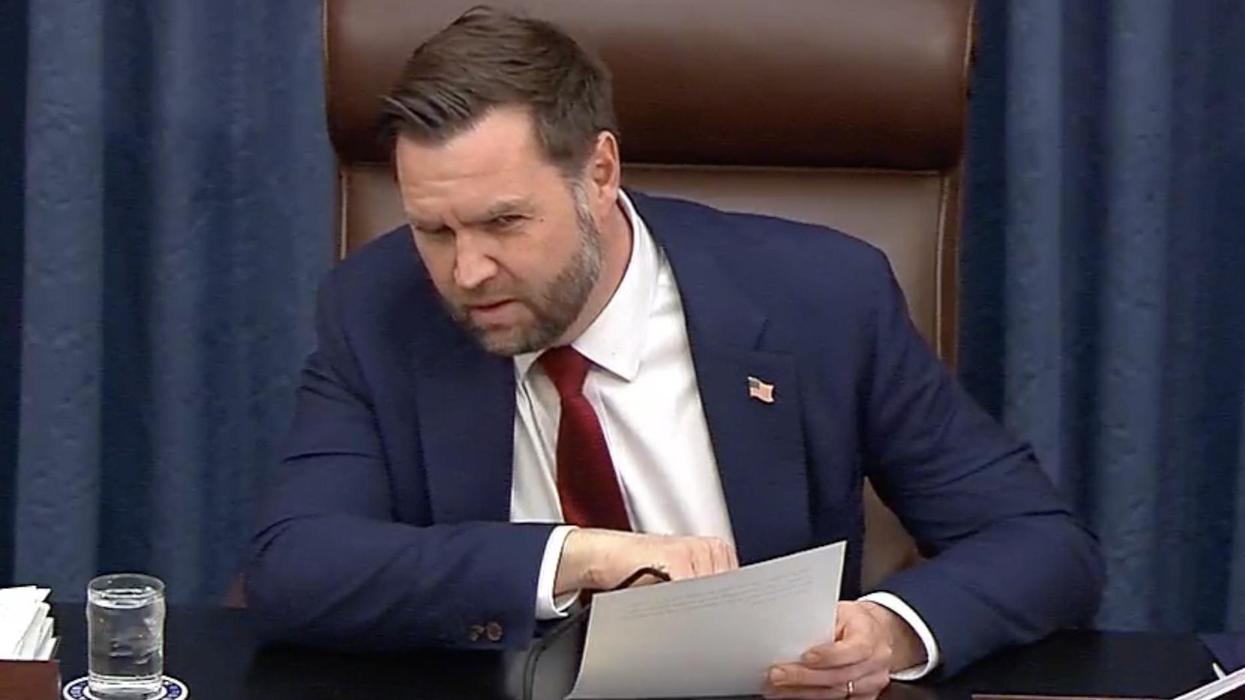
J.D. Vance is tie-breaker killing War Powers vote

Republicans stopped the process before colleagues could even weigh in on further military force in Venezuela

Reporting | QiOSK
google cta
google cta

Republican senators used a procedural measure to kill a resolution today that would have halted unauthorized hostilities against Venezuela.

Before a vote could take place for S.J. Res. 98, sponsored by Sen. Tim Kaine (D-Va.), Sen. Jim Risch (R-Id.) challenged the resolution’s privileged status in a point of order along the lines that there were no ongoing hostilities with Venezuela.

That point of order prompted a vote, which tied 50-50. Vice President J.D. Vance broke that tie and voted for the point of order, thus removing the resolution from immediate consideration on the Senate Floor.

Sens. Todd Young (R-In.) and Josh Hawley (R-Mo.), who voted to advance the resolution last week, also voted for the point of order.

On the Senate floor the day of the vote, Republican leadership asserted that war powers are unnecessary, because there are no ongoing hostilities between the U.S. and Venezuela.

“We have no troops on the ground in Venezuela. We’re not currently conducting military operations there,” Sen. John Thune (R- S.D.) said before the vote.

“The objective of this resolution is to stop something that is not happening,” Sen. Jim Risch (R- Id.) said.

Angered by the procedural move to quash the vote, resolution supporters contended that hostilities with Venezuela have already begun, and that Congress must assert its power to block further unauthorized action.

“Certainly [the senators moving to block the resolution] must think that invasion of a capital is a war, that removing a president is war, or a blockade of a country. So even though the first incursion, the first invasion, may well be over — is the blockade of a country not a war?,” Sen. Rand Paul asked. “Are we not at war when we have a military blockade of a country?’

“An argument that the Venezuela campaign is not imminent hostilities, within the meaning of the War Powers Resolution, is a violation of every reasonable meaning of that term,” Sen. Kaine charged. “To pretend otherwise would weaken the respect that this institution should aspire to.”

The Trump administration previously said it was “not afraid” to put “boots on the ground” in Venezuela if needed. It also said it would have to “run” the country until a transition of power can occur.

Before today’s failed attempt to assert its war powers there were a string of other unsuccessful efforts, which aimed to either stop hostilities against Iran, Venezuela, or attacks on the so-called “narcoterrorist” boats in the Caribbean.

The Senate last passed a War Powers Resolution back in 2020, to bar unauthorized hostilities against Iran; Trump vetoed that resolution.


Top image credit: senate.gov [screenshot]
google cta
Reporting | QiOSK
Trump Venezuela
Top image credit: President Donald Trump monitors U.S. military operations in Venezuela, from Mar-a-Lago Club in Palm Beach, Florida, on Saturday, January 3, 2026. (Official White House Photo by Molly Riley)

Geo-kleptocracy and the rise of 'global mafia politics'

Global Crises

“As everyone knows, the oil business in Venezuela has been a bust, a total bust, for a long period of time. … We're going to have our very large United States oil companies, the biggest anywhere in the world, go in, spend billions of dollars, fix the badly broken infrastructure, the oil infrastructure, and start making money for the country,” said President Donald Trump the morning after U.S. forces invaded Caracas and carried off the indicted autocrat Nicolàs Maduro.

The invasion of Venezuela on Jan. 3 did not result in regime change but rather a deal coerced at the barrel of a gun. Maduro’s underlings may stay in power as long as they open the country’s moribund petroleum industry to American oil majors. Government repression still rules the day, simply without Maduro.

keep readingShow less
Russian icebreakers
Top photo credit: Russian nuclear powered Icebreaker Yamal during removal of manned drifting station North Pole-36. August 2009. (Wikimedia Commmons)

Trump's Greenland, Canada threats reflect angst over Russia shipping

North America

Like it or not, Russia is the biggest polar bear in the arctic, which helps to explain President Trump’s moves on Greenland.

However, the Biden administration focused on it too. And it isn’t only about access to resources and military positioning, but also about shipping. And there, the Russians are some way ahead.

keep readingShow less
Iran nuclear
Top image credit: An Iranian cleric and a young girl stand next to scale models of Iran-made ballistic missiles and centrifuges after participating in an anti-U.S. and anti-Israeli rally marking the anniversary of the U.S. embassy occupation in downtown Tehran, Iran, on November 4, 2025.(Photo by Morteza Nikoubazl/NurPhoto via REUTERS CONNECT)

Want Iran to get the bomb? Try regime change

Middle East

Washington is once again flirting with a familiar temptation: the belief that enough pressure, and if necessary, military force, can bend Iran to its will. The Trump administration appears ready to move beyond containment toward forcing collapse. Before treating Iran as the next candidate for forced transformation, policymakers should ask a question they have consistently failed to answer in the Middle East: “what follows regime change?”

The record is sobering. In the past two decades, regime change in the region has yielded state fragmentation, authoritarian restoration, or prolonged conflict. Iraq remains fractured despite two decades of U.S. investment. Egypt’s democratic opening collapsed within a year. Libya, Syria, and Yemen spiraled into civil wars whose spillover persists. In each case, removing a regime proved far easier than constructing a viable successor. Iran would not be the exception. It would be the rule — at a scale that dwarfs anything the region has experienced.

keep readingShow less
google cta
Want more of our stories on Google?
Click here to make us a Preferred Source.

LATEST

QIOSK

Newsletter

Subscribe now to our weekly round-up and don't miss a beat with your favorite RS contributors and reporters, as well as staff analysis, opinion, and news promoting a positive, non-partisan vision of U.S. foreign policy.