

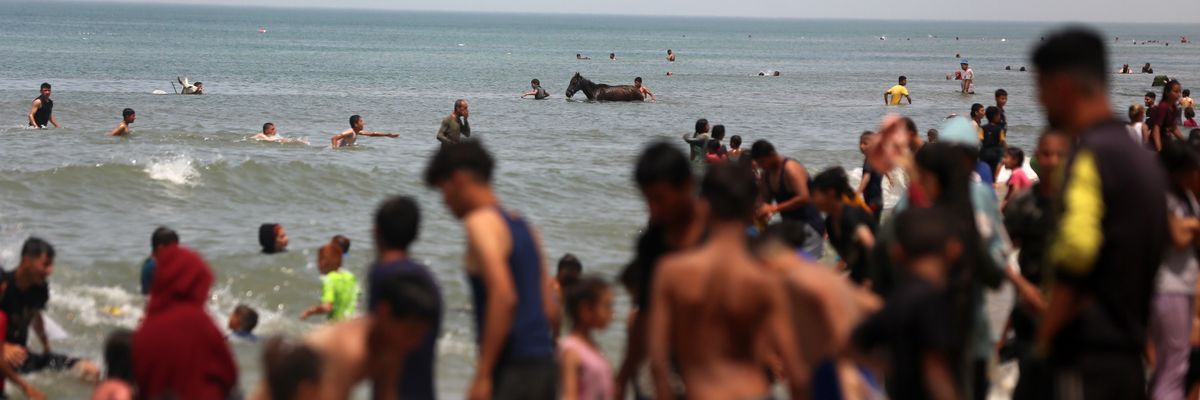
The Gazan beach staging area for the future American "surge" of humanitarian aid to the Palestinians there has already been attacked, according to official reports.
According to U.S. and Israeli sources, United Nations reps who were on the beach prepping the area for the new pier came under limited mortar fire early Thursday. No one was hurt, and there was minimal damage to some engineering equipment. Early reporting from i24 News speculated that Palestinians were targeting Israeli Defense Forces in the area, but that has not been confirmed. The Pentagon did not return a request for comment from RS.
Gen. Charles Q. Brown Jr., chairman of the Joint Chiefs of Staff, said Thursday that he believes the risk can be mitigated, though there seems to be outstanding questions on who exactly is providing the security on the beach for this project.
“Nothing we do is risk-free,” the general said during an appearance at Georgetown University in Washington.
The U.S. Army vessels that are supposed to be marshaling the supplies and equipment to build a floating pier and causeway to surge humanitarian aid into Gaza are in place in the Mediterranean. The project, which will ostensibly allow the U.S. to facilitate aid from inspection points in Crete to the floating pier then onto a trident causeway off the beach and into Gaza, will supposedly be ready early-May, according to the DOD.
The U.N. has agreed to serve as the delivery system into the strip. The Biden Administration has insisted no American troops will be operating on the ground.
That last point is the critical one since critics say Washington is playing a dangerous game by getting so close to the battlefield of a brutal conflict. The attack this week, no matter how minimal, underscores the dangers of a spark setting off a situation in which U.S. personnel come under fire and are forced to react.
"Placing American service members in harm's way will not solve the underlying crisis in the Middle East and will continue to escalate tensions," read a statement by Concerned Veterans of America yesterday. "After decades of open-ended missions in the region, @POTUS needs to immediately reevaluate involvement in a crisis that risks American lives, now, before casualties occur."
Interestingly, the Washington Post and others are now reporting that the pier will be near Wadi Gaza, a coastal area near the corridor that the Israelis have established cutting across the Gaza strip and upon which are establishing what appears to be permanent outposts. The Post indicates this will make it easier for aid to travel north and south, but will the location of a new pier allow Israel to deliver supplies and equipment to its own military, too?
- Military pier project in Gaza could be 'on ice' ›
- Mission creep: Will pier become a beachhead for US in Gaza? ›
- It's May, where is the US military's $320M pier project? | Responsible Statecraft ›
- $320M US military pier to open for business, but storms ahead | Responsible Statecraft ›
- US aid from pier in Gaza looted, none distributed so far | Responsible Statecraft ›
- By the numbers: US Gaza pier project appears sunk | Responsible Statecraft ›
- US Gaza pier op was more than a flop, it was a gigantic hazard | Responsible Statecraft ›