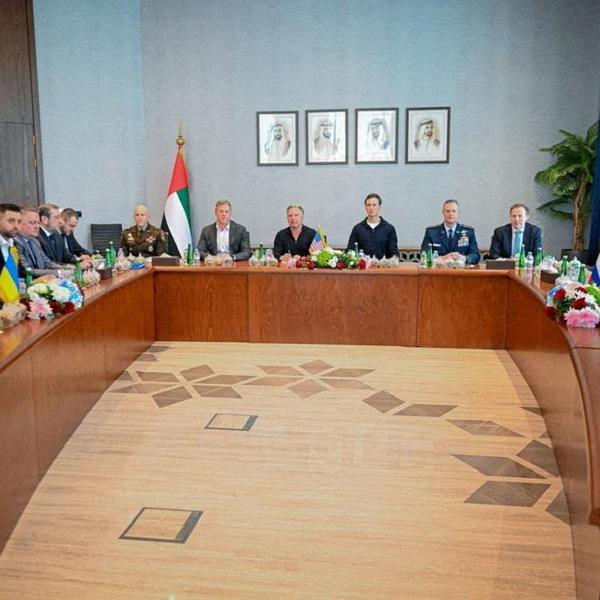
In a major diplomatic development, the long-awaited Ukraine minerals deal, where Ukraine would give the U.S. access to its mineral deposits in exchange for previous wartime U.S. support and post-war Ukraine rebuilding, is set to be signed late next week.
Indeed, Ukraine and the U.S. signed a "memorandum of intent" late Thursday on the deal, which advances the deal but falls short of a final, fully agreed upon one.
“We have a minerals deal which I guess is going to be signed [next] Thursday,” Trump said Thursday at a White House meeting with visiting Italian PM Giorgia Meloni. “And I assume they’re going to live up to the deal.”
Ukrainian President Volodymyr Zelensky also said Thursday that a minerals deal with the U.S. could be finalized imminently.
This came on the heels of comments he made the day before. “The basic legal stuff [for a deal] is almost finalized, and then, if everything moves as quickly and constructively, the agreement will bring economic results to both our countries,” Zelensky explained.
State Department spokesperson Tammy Bruce, when asked at the daily briefing, said she couldn’t provide more information about the deal. What is known, however, is that Washington has softened its demands for one. In this respect, a source told Agence France-Press that recent drafts of the agreement did not cite previous U.S. military aid to Ukraine as a debt it would need to pay off.
That doesn’t mean Trump is totally happy with Kyiv. “I don’t hold Zelensky responsible but I’m not exactly thrilled with the fact that war started,” Trump said Thursday. “I wouldn’t say he’s done the greatest job.”
Meanwhile, U.S. Secretary of State Marco Rubio and President Donald Trump’s envoy Steve Witkoff arrived in Paris Thursday for high-level talks with European officials and — previously unannounced — Ukrainian diplomats.
After continued fears of diplomatic shut out, Ukrainian and European officials alike hope the Paris talks steer ongoing war negotiations in their favor. "Everyone wants to get peace. A robust and sustainable peace. The question is about phasing,” French President Emmanuel Macron said.
"What's important is that we have started a process in Paris today that is positive and where the Europeans are associated," a senior adviser to Macron told reporters Thursday.
Other diplomatic efforts remain challenging; participants remain optimistic about prospects for improved U.S.-Russia relations, if not a negotiated political solution to end the conflict altogether.
In an April 14 Fox News interview, Witkoff called his in-person meeting with Russian President Vladimir Putin late last week “compelling.” He concluded from it that Russia was open to a “permanent peace,” but admitted that negotiations remained complex.
“There’s security protocols. There’s ‘no NATO,’ ‘NATO,’ article 5…it’s a complicated situation…rooted in some real problematic things happening between the two countries,” he explained.
“We might be on the verge of something that would be very, very important for the world at large,” Witkoff said. “On top of that, I believe there’s a possibility to reshape the Russian-United States relationship through some very compelling commercial opportunities that I think give real stability to the region too.”
Albeit less optimistic than Witkoff about peace prospects, Russian officials likewise expressed support for strengthening U.S.-Russia ties.
“Reviving relations practically from scratch is a very difficult matter, it requires very intense diplomatic and other efforts,” Kremlin spokesman Dmitry Peskov explained, saying “everything is moving very well” in an interview with Russian journalist Pavel Zarubin.
“But here, we just need to understand how serious the damage was done to bilateral Russian-American relations under the [Biden] administration” Peskov noted. “In reality, the situation is slightly different, it is much more complex, requires more work, requires more time.”
In other Ukraine war news this week:
According to Daily Mail, Russia is building military infrastructure along its border with Finland, which joined NATO after the start of the Ukraine war. “During the war there were about 20,000 soldiers stationed and about four standby brigades, now we see that Russia is building new infrastructure and as soon as they can, more troops in this region,” Lieutenant General Vesa Virtanen, Finland's Deputy Chief of Defense, said about the development.
Virtanen warned that Russia was “deliberately testing NATO's unity” with the infrastructure development, perhaps also testing whether it would trigger Article 5, NATO’s collective defense clause.
According to the Economist, Pentagon officials questioned an unnamed European ally about its continued military assistance to Ukraine, in addition to saying they are privately “fed up” about Europe’s continued Ukraine aid efforts amid the administration’s diplomatic strides toward Moscow.
Two Russian missiles hit the Ukrainian city of Sumy on Sunday, according to CNN, killing at least 35 people and wounding 117 others.
From State Department Press Briefing on April 17
At an April 17 State Department press briefing, State Department Spokesperson Tammy Bruce emphasized the need for a negotiated solution to the Ukraine war — as soon as possible. “President Donald Trump has been clear: this madness has to come to an end, quickly and completely. During his recent visit to NATO. Secretary Rubio also noted that the time for peace is now: not in months or years. It is now.”
Bruce echoed Trump’s belief that the war would not have happened under his watch. “Trump’s vision and demand for an end to the hostilities remains a north star for Secretary Rubio, Ambassador Witkoff, Special Presidential Envoy for Ukraine Keith Kellogg, and so many others who are determined to make clear to everyone around the world that the Russia-Ukraine war would never have happened if President Trump had been president at the time.”