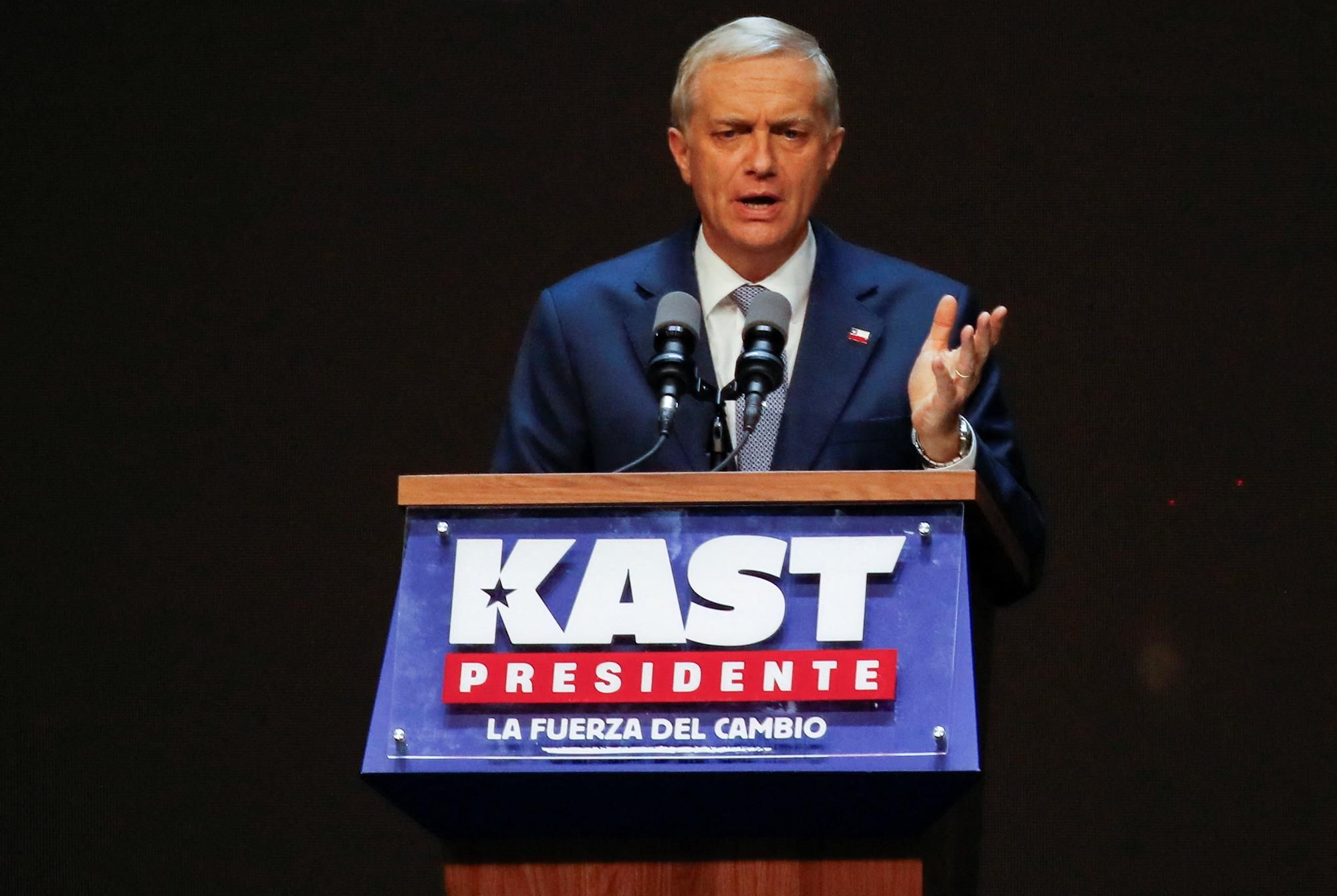
The very first congratulatory note received from abroad by Chilean President-elect Jose Antonio Kast of Chile on December 14 came from U.S. Secretary of State Marco Rubio.
“Under his leadership, we are confident Chile will advance shared priorities to include strengthening public security, ending illegal immigration and revitalizing our commercial relationship,” Rubio declared in a press statement.
At a White House press conference the next day, President Trump expressed his satisfaction: “A few hours ago I learned that in Chile the person that I endorsed, who was not leading in the polls, ended up winning quite easily. So, I look forward to paying my respects to him. I hear he is a very good person.”
The truth is that Jose Antonio Kast had been leading in polls in Chile for several months now, and Trump’s endorsement, though nice to have, probably did not make much difference to the outcome. That said, one can understand the giddiness in the State Department — Deputy Secretary of State Christopher Landau, who knows Chile well, also released a congratulatory statement — and the White House about Kast’s victory in Chile.
Rightly or wrongly, Chile, albeit not among the biggest South American countries, has traditionally been seen as a harbinger of things to come in terms of regional (and occasionally, even global) political trends. There is a reason why Henry Kissinger, whose controversial tenure in government overlapped with that of the presidency (1970-73) of the first democratically elected Socialist government in Latin America, was sometimes described as, in effect, “the desk officer for Chile” during his tenure at Foggy Bottom.
Thus, the victory of a far-right candidate like Kast, who campaigned on a hardline law-and-order and anti-immigration platform, in the land that elected Salvador Allende to the presidency 55 years ago, confirms the view that the hard right is on the rise. This plays nicely into the Trump administration’s recently released National Security Strategy 2025 to “Enlist and Expand” established friends and cultivate new partners in the hemisphere, “to control migration, stop drug flows and strengthen stability and security on land and sea.”
The significance of Kast’s victory should not be underestimated. With 7.1 million votes, he is the Chilean president elected with the most number of votes ever (helped by the fact that voting became mandatory since the last election). With 58% of the vote, he is also the candidate to win the greatest share of votes in a run-off since the 1990s, save for Michelle Bachelet, who received 62% in 2013. Kast is also the first open supporter of Gen. Augusto Pinochet’s dictatorship (1973-1990) to reach the presidency; Sebastian Piñera, who served two terms, 2010-2014 and 2018-2022, and was elected by a right-wing coalition, was a centrist who opposed military rule.
Kast will thus join the lengthening list of right-wing Latin American leaders, including Javier Milei of Argentina (whom Kast visited Tuesday), Nayib Bukele of El Salvador, Daniel Noboa of Ecuador, and Santiago Peña of Paraguay, who see themselves as aligned with the Trump agenda and the MAGA movement,. They are proving to be willing allies in the Trump administration policy towards Latin America.
Still, none of this means that Kast will have an easy time enacting his domestic program. The right lacks a majority in the Chile’s National Congress, and building coalitions and reaching across the aisle has never been Kast’s forte. On the contrary, the signature feature during his political trajectory has been to stand on principle and not budge, come what may.
He proved this when, in Chile’s second Constitutional Convention in 2023, in which his party and its allies enjoyed a controlling majority, instead of going for a conciliatory text that would have satisfied all parties, they went for an extremist document that ended up being rejected by the electorate. His recent declarations that much of what he wants to do can be done via executive decree rather than through legislation do not bode well in that regard. He has promised major changes in the way the country is run. Such intentions, by definition, requires going through Congress.
In Chile, as in other countries, foreign policy is rarely a significant campaign issue, and this was very much the case this year. In the two leading candidates’ programs, foreign policy was hardly mentioned. Yet, arguably, one of the most significant challenges the Kast presidency will face lies precisely in the conduct of its foreign affairs.
Chile is a country that depends very heavily on its foreign trade, which makes up 65% of its GDP. It is also one of only six countries in the world that has free trade agreements (FTAs) both with the United States and China. In fact, one of the reasons for Chile’s economic success — it is considered the region’s most developed country — has been its early bet on free trade agreements and on the Asia-Pacific, which led to a nine-fold increase in its exports 1990-2007, to $81 billion.
Chile was also the first country in the world to sign a bilateral FTA with China in 2005. Since then, bilateral trade with China has increased ninefold, reaching $61 billion in 2024. Today, 40% of Chile’s exports go to China and 60% to Asia. Foreign direct investment (FDI) from China has also increased in the last decade, reaching around $10 billion. In those terms, Chile is now the country in Latin America that is most integrated with China.
This does not mean that Chile has neglected its ties with the United States, its second largest trading partner after China, and one with which Chile runs a trade deficit. Chile was a firm supporter of the Free Trade Area of the Americas (FTAA) project promoted by Washington in the 1990s and early 2000s; it hosted the second Summit of the Americas in Santiago in 1998; and it is the only country in the Americas that benefits from the U.S. Visa Waiver Program, proof positive of its good standing in Washington.
More recently, the strength of these links was ratified by the U.S. Senate’s approval and coming into effect of a U.S.-Chile treaty to avoid double taxation, the first such treaty ratified by the Senate in a decade. Mexico is the only other country in Latin America to have such a treaty with Washington.
In short, Chile has reached its current state as a country that has made much progress over the course of the past 35 years — despite some rocky moments in the recent past — due to an important degree to the careful balancing and deft handling of its relationship both with Washington and with Beijing. As mentioned above, all indications are that the Kast government will pursue a foreign policy that on many issues will align much more closely to the preferences of the Trump administration than has been the case under the current government of President Gabriel Boric. Elections have consequences, and that is how democracy works.
However, for the reasons cited above, the main foreign policy challenge for a Kast presidency — and this should be noted in Washington — will be to maintain the balanced and equidistant relationship that Chile has so successfully managed between Washington and Beijing over many decades now. Pressing Chile to do otherwise for the sake of ideological purity or sheer international one-upmanship, would not be a good idea. It would lead to significant pushback by the Chilean business community and public opinion more generally.
In turn, the worst thing that a Kast government could do would be to fall into the trap of attempting to be “holier than thou” and substantially reduce its ties with China for the sake of ingratiating itself with the Trump administration. It would mean shooting itself in the foot from the word go.
 Screengrab via niacouncil.org
 Screengrab via niacouncil.org