

Any hopes that Wednesday’s meeting of Greenland and Denmark’s foreign ministers with Vice President Vance and Secretary Rubio might point toward an end of the Trump administration’s attempts to annex the semiautonomous arctic territory were swiftly disappointed. “Fundamental disagreement” remains, according to Danish Foreign Minister Lars Lokke Rasmussen.
That these talks would yield no hint of a resolution should not be surprising. Much of Trump’s stated rationale for seeking ownership of Greenland — the need for an increased U.S. military presence, the ability to access the island’s critical mineral deposits, or the alleged imperative to keep the Chinese and Russians at bay — is eminently negotiable and even achievable under the status quo. If these were the president’s real goals he likely could have reached an agreement with Denmark months ago. That this standoff persists is a testament to Trump’s true motive: ownership for its own sake.
In the past two weeks and throughout his first year in office, Trump has made no secret of his desire for territorial expansion or his fixation on incorporating Greenland into the United States. “The United States will once again consider itself a growing nation — one that increases our wealth, expands our territory, builds our cities, raises our expectations, and carries our flag into new and beautiful horizons,” he declared in his inaugural address. “Anything less” than U.S. possession of Greenland, Trump wrote on Wednesday, “is unacceptable.”
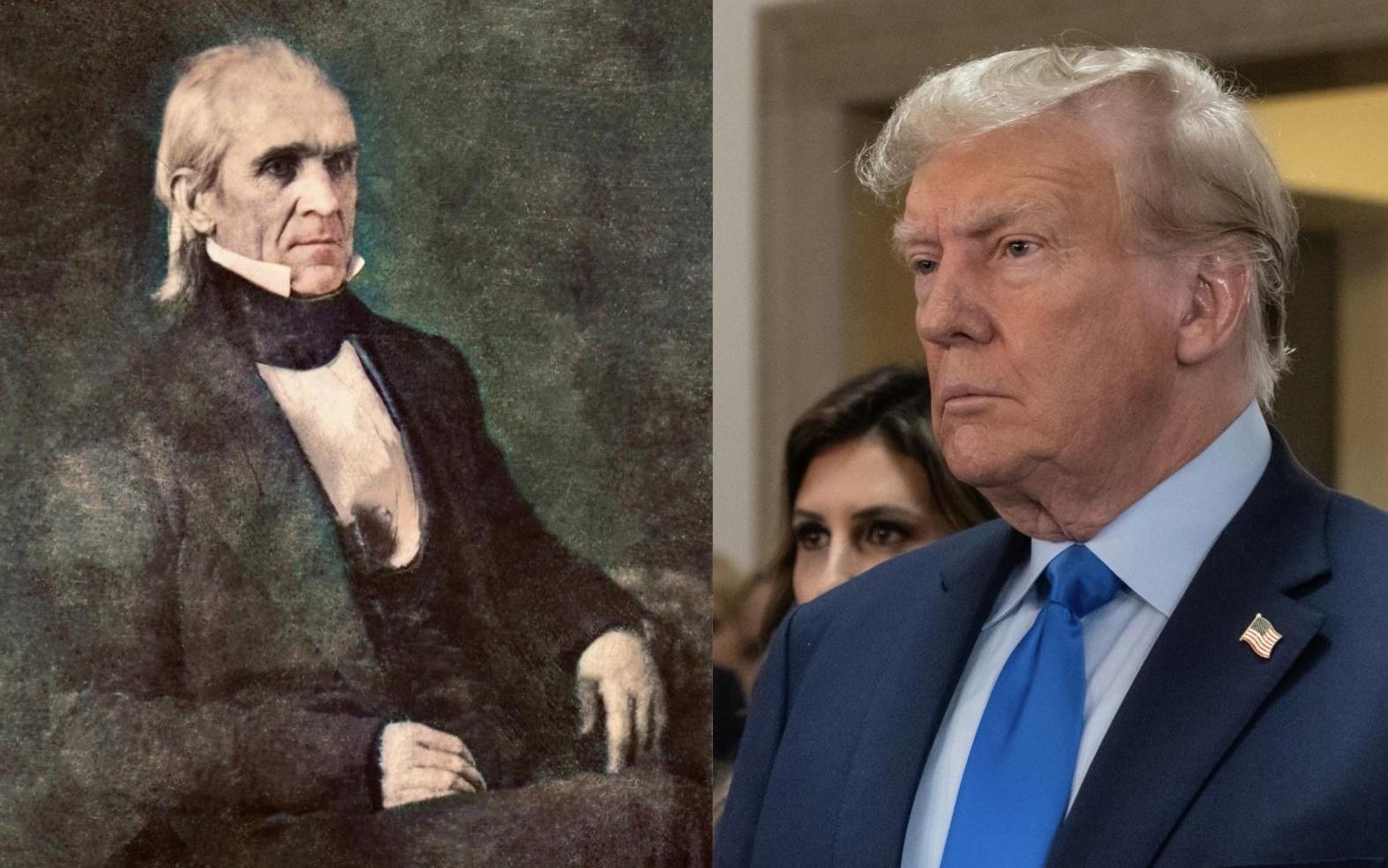
These have not been mere one-off statements or sleep-deprived Truth Social posts, but reflect a deep component of Trump’s governing philosophy and understanding of his historical role as U.S. president. Last year, The Wall Street Journal reported that Trump went out of his way to acquire a portrait of President James K. Polk, which he hung in the Oval Office. The president made it clear that this was an homage to the territorial expansion that occurred under Polk, who doubled the size of the United States by waging a war of conquest on Mexico. “He got a lot of land,” Trump said at the time.
Trump apparently believes presiding over a similar acquisition would cement his legacy. In 2021, he told journalists Peter Baker and Susan Glasser that securing Greenland was “not different from a real estate deal” and suggested that it would earn him a place in U.S. history. He further explained his rationale: “Look at the size of this, it’s massive, and that should be part of the United States.”
These are the kind of accomplishments that the president believes could get his face on Mount Rushmore. One can imagine Trump’s delight at seeing history books credit his name with the first expansion of the U.S. map in nearly 100 years. All the better that the acquisition of Greenland would allow the United States to leapfrog Canada to become the world’s second largest nation, an achievement that the superlative-loving president would certainly relish. Never mind that expanding U.S. territory through coercion would seem to conflict with his fixation on winning the Nobel Peace Prize — after all, Teddy Roosevelt was able to do both.
Despite the abundant evidence for the expansionist motives driving Trump’s Greenland ambitions, much of the resulting commentary has focused on debunking his claim that acquiring the territory is essential for U.S. national security (and to a lesser extent, that it offers a bonanza of oil and critical minerals).
These arguments are important, as the administration has publicly staked its effort to annex Greenland on these claims. It’s therefore vital to note that the U.S. already has the ability to expand its base and troop presence in Greenland under the 1951 Greenland Defense Act, and that it has drawn down that presence since the Cold War entirely of its own volition. Indeed, Denmark and Greenland have stated their openness to an expanded U.S. presence under the current framework. Likewise, it matters that Russian and Chinese naval vessels are not constantly stalking the waters around Greenland as Trump alleges, and that Greenland and Denmark have already been cooperating with U.S. efforts to keep Chinese investment out of critical infrastructure on the island.
Yet there is some risk that a domestic and international response which focuses unduly on rebutting Trump’s security claims inadvertently grants some legitimacy to his annexation drive. For even if the president’s arguments had more merit, the attempt to seize an ally’s territory through coercive diplomacy or military action, against the will of its inhabitants, would still be wildly illegitimate. The notion that the United States ought to be able to invoke its “national security” to run roughshod over self determination, sovereignty, and decades-long treaty commitments ought to be opposed on its own terms.
That successive U.S. governments have previously invoked national security to justify such abuses is unquestionable. Trump himself has cited national security as license to do everything from raising tariffs on kitchen cabinets to fast-tracking deportations. An annexation of Greenland would only be an unusually flagrant and self-defeating expression of this tendency. As the danger of a president who views his power as essentially unlimited becomes more clear, however, it is incumbent upon the American people, elected officials, and international actors to draw a firm line on principles like territorial integrity and self determination.
Some have argued that the Trump administration’s national security arguments point to its real, more limited goals for Greenland — namely, securing greater military access to the island while ensuring Russia and China are kept at arms length.
While it’s hard to reconcile this view with Trump’s statements or the fact that the U.S. could already do these things under its present arrangements with Greenland, it's entirely possible that Trump will find a need to back down from, or at least postpone his designs on the territory. He may be thwarted by defiant congressional Republicans, or persuaded that the consequences for transatlantic relations are too great and that the idea is too unpopular domestically. He may be distracted by another foreign or domestic crisis. Regardless, he could easily pocket an agreement with Greenland and Denmark to increase U.S. troops and bases on the island, as well as deals for U.S. companies to extract oil, gas, and critical minerals there. This would be enough for him to claim victory, and for his allies to claim that actually, this was what he was after all along.
Certainly this outcome would be acceptable to most parties involved. It may suit Denmark, ultimately, to treat Trump’s national security concerns as very serious and try to address them, playing for time while also planning for the possibility that he might simply declare U.S. annexation of Greenland via Truth Social post.
In any case, no one can count on him giving up and moving on. Trump has made it abundantly clear: he views the U.S. acquisition of Greenland as an end unto itself — another way to impose his will on history. That he might be willing to use force or coercion to achieve this goal will remain a live possibility for the duration of his presidency.
- Trump digs in as Europe sends troops to Greenland ›
- Is Greenland next? Denmark says, not so fast. ›
- Tech billionaires behind Greenland bid want to build 'freedom cities' ›
- Trump's 'gangster' threats against Greenland, allies, crosses new line ›
- Meet Trump’s man in Greenland | Responsible Statecraft ›