

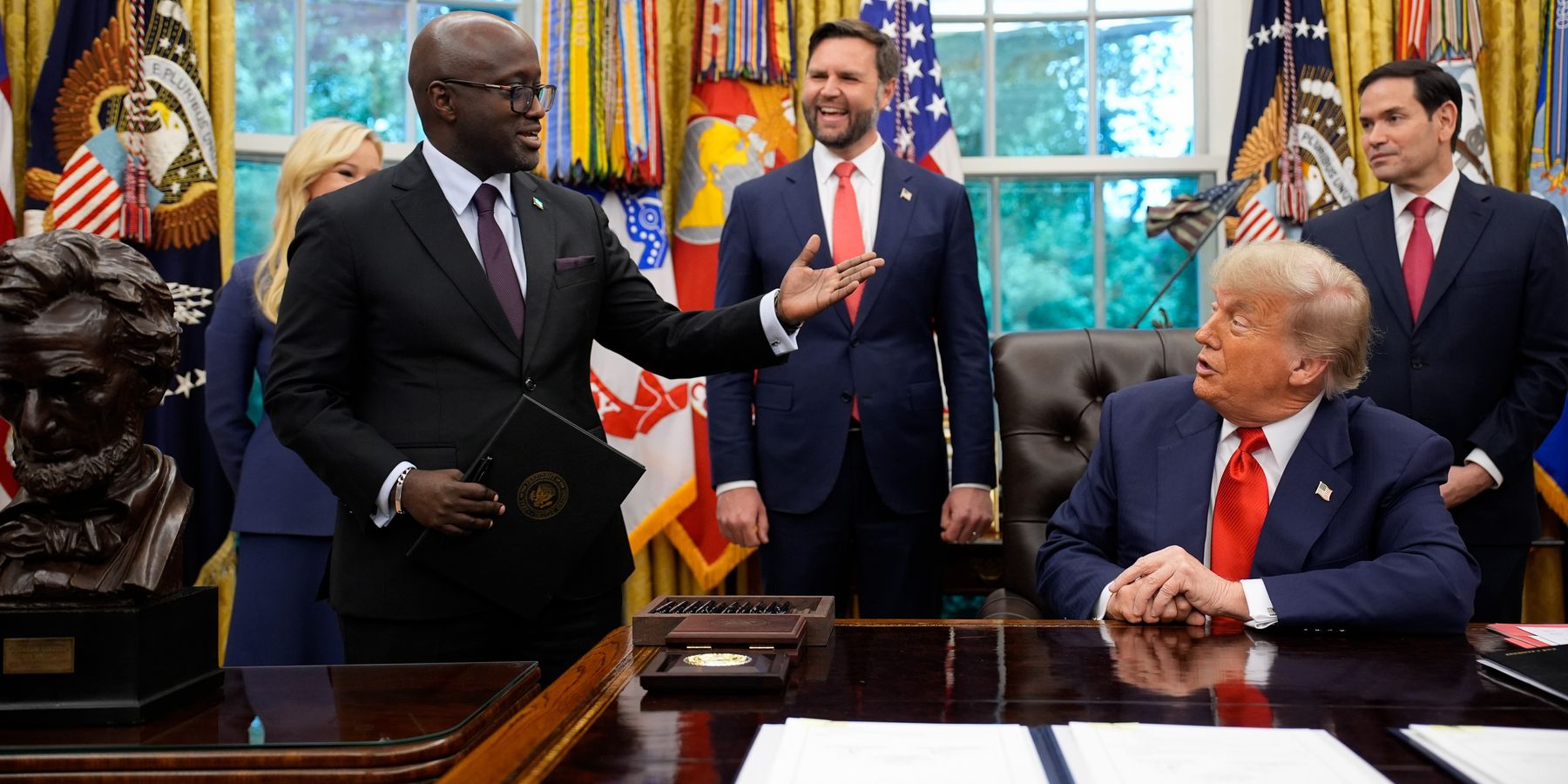
President Trump’s policy towards the African continent in 2025 was loaded with personal disagreements, peace negotiations, and efforts to improve economic exchange.
Through the ups and downs of Trump’s Africa policy, it became increasingly clear as the year wore on that contrary to observers’ early expectations, Trump’s team is indeed prioritizing Africa.
Here’s a review of the top five stories that defined Trump’s policy towards Africa in 2025.
Diplomatic Scuffle with South Africa
The president’s term began with a proverbial shot across the bow. Just days into his administration, the president accused the South African government of failing to halt a genocide he claimed was being perpetrated by the country’s native black population against white farmers part of the Afrikaner ethnic group.
He then signed an executive order on February 7, accusing Pretoria of expropriating the land of white South Africans without fair compensation, and giving that land to the country’s black population. Trump ordered the U.S. to “not provide any aid or assistance to South Africa,” and also to “promote the resettlement of Afrikaner refugees escaping government-sponsored race-based discrimination, including racially discriminatory property confiscation.”
The rift culminated in an extraordinary argument in the Oval Office on May 21 between South African President Cyril Ramaphosa and Trump. During the encounter, Trump continued his attacks on the South African government with his counterpart sitting beside him.
At one point, Trump ordered the lights to be dimmed and drew attention to a television screen, which played clips of leaders from a South African minority political party calling for attacks against the country’s white population. Trump then held up printed copies of news articles he claimed discussed the death of white South Africans.
The relationship never mended. Under Trump’s demand, the United States government boycotted the Group of 20 (G20) summit in late November hosted by South Africa in Johannesburg, and disinvited South Africa from next year’s G20 summit, which is to be hosted by the United States in south Florida.
Massad Boulos' role as Senior Africa Advisor
Among the early signs that Trump would prioritize Africa as part of his administration’s broader foreign policy came on April 1, when Massad Boulos was announced as Trump’s Senior Advisor for Africa.
Although Boulos, the father-in-law to Trump’s daughter Tiffany, had no previous experience in diplomatic affairs on the continent, he has a close relationship with the Trump family, and has proven himself to be the president’s right-hand man on Africa policy.
Without Boulos, Trump’s policy towards the continent would have likely been muddled in layers of State Department bureaucracy.
Peace agreement between the Democratic Republic of the Congo (DRC) and Rwanda
President Trump has spoken extensively over the course of his second term of his desire to be seen as a peacemaker who ends lengthy international conflicts. In Africa, this desire has manifested itself most fully in the administration’s effort to end the decades-long war between the DRC and Rwanda. Boulos’ first task as senior advisor was to work with the Qataris to mediate a permanent ceasefire in the war between the DRC and Rwanda.
Among the major reasons the Trump administration spotlighted this conflict as its first peace initiative on the continent was a desire to tap into the region’s vast mineral wealth. The DRC and surrounding countries are home to some of the world’s largest reserves of critical minerals, important for a vast number of technologies used in products such as electric vehicles, smartphones, and batteries.
The conflict between the DRC and Rwanda is complicated by the mix of rebel groups involved. M23 is the primary Rwanda-supported rebel force opposing the DRC and its many militias, known collectively as the Wazalendo. The governments of the DRC and Rwanda have themselves been fiercely antagonistic to one another, making a lasting peace deal all the less likely to take root.
Yet, to the administration’s credit, it achieved a preliminary peace agreement that was signed by the foreign ministers of both countries in a ceremony overseen by President Trump in the Oval Office on June 27. Then, on December 4, the presidents of both countries met in Washington in a very rare face-to-face encounter to sign the second phase of the agreement, which included American access to mineral wealth.
Although fighting has continued sporadically since June’s peace agreement, Trump’s emphasis on ending the conflict has at the very least created a framework for what a lasting peace could look like.
Effort to end the war in Sudan
Boulos has also been leading the president’s effort to secure peace in the intractable civil war in Sudan between the country’s Sudanese Armed Force (SAF) and the Rapid Support Forces (RSF).
Boulos, who said Sudan would become his top priority after the DRC-Rwanda deal was signed in June, has joined forces with counterparts in the United Arab Emirates, Egypt, and Saudi Arabia — known collectively as the Quad — to try to negotiate an end to the war.
But the Quad has failed to substantially move the peace process forward. Just one day after the group met for negotiations in Washington in late October, the RSF succeeded in their 18-month siege of El-Fasher, overrunning SAF forces to take over the capital of North Darfur province. El-Fasher’s fall has solidified the geographic splitting of the country, with the RSF controlling the southwest and the SAF ruling much of the rest of Sudan.
And yet, Trump’s team continues its effort to resolve the conflict. In mid-December, Boulos met with SAF leader Abdel Fattah al-Burhan in Riyadh as part of mediation discussions. The effort to end this war will likely be among the administration’s top priorities for Africa in 2026.
Economic engagement with Africa
Beyond the efforts to end wars on the continent, Trump has also set his sights on advancing American economic engagement with Africa. As part of this, the U.S. government promoted the U.S.-Africa Business Summit in late June in Luanda, Angola. The event secured a record $2.5 billion in business deals between American and African partners in a range of industries, including digital infrastructure, cybersecurity, energy, and hospitality.
This event followed through on the State Department’s launch of a commercial diplomacy strategy for the continent in May. In a speech launching the strategy, Senior Africa Bureau Official Troy Fitrell said that Africa “is the world’s largest untapped market,” and that officials in this administration “no longer see Africa as a continent in need of handouts, but as a capable commercial partner.”
In line with the desire to increase America’s economic connectivity to the continent, the administration has continued investing in the construction of the Lobito Corridor, a collection of rail and feeder roads connecting inland mining sites and cities to the Lobito Port on Angola’s Atlantic coast, from where finished and unfinished goods can access the world. On December 17, the administration announced a $553 million loan through the Development Finance Corporation to support the corridor’s construction.
Trump has also signaled support for the extension of the African Growth and Opportunity Act (AGOA), a preferential trade deal that lapsed this past September. The agreement provides duty-free access to over 1,800 goods from Africa to the United States, increasing the accessibility of the American market to African sellers who would otherwise struggle to compete with the low price of goods coming from other regions.
But, in typical Trump fashion, his AGOA support suffers from a contradiction. The sweeping global tariffs that he implemented in an effort to force what he considers to be improved trade relations with the United States included a 15% tariff rate on 13 AGOA-eligible countries, as well as a 30% tariff for AGOA-eligible South Africa, effectively eliminating AGOA benefits for these countries.
The U.S. bombs Nigeria
On Christmas, the United States launched an airstrike that killed members of the Islamic State in northwest Nigeria. In a post on his Truth Social account, the president said these terrorists "have been targeting and viciously killing, primarily, innocent Christians." In an interview on local television after the attack, Nigeria's Foreign Minister Yussuf Tuggar said that his country's government had coordinated with the United States on the attacks, which had been planned for weeks.
This strike comes after the American president had ordered Nigeria to be placed on a "watch list" in late October for violence the president claims has been committed by non-Christian armed groups against the country's Christian population. In an October 31 post on Truth Social, Trump said, "Christianity is facing an existential threat in Nigeria. Thousands of Christians are being killed. Radical Islamists are responsible for this mass slaughter. I am hereby making Nigeria a ‘COUNTRY OF PARTICULAR CONCERN’.” Days after the post, Nigerian government leaders denied Trump's claim that armed groups in the country target people because of their religious affiliation.
- Could the war in Ukraine spoil US-South Africa ties? ›
- Symposium: Have US military programs made African countries less safe? ›