

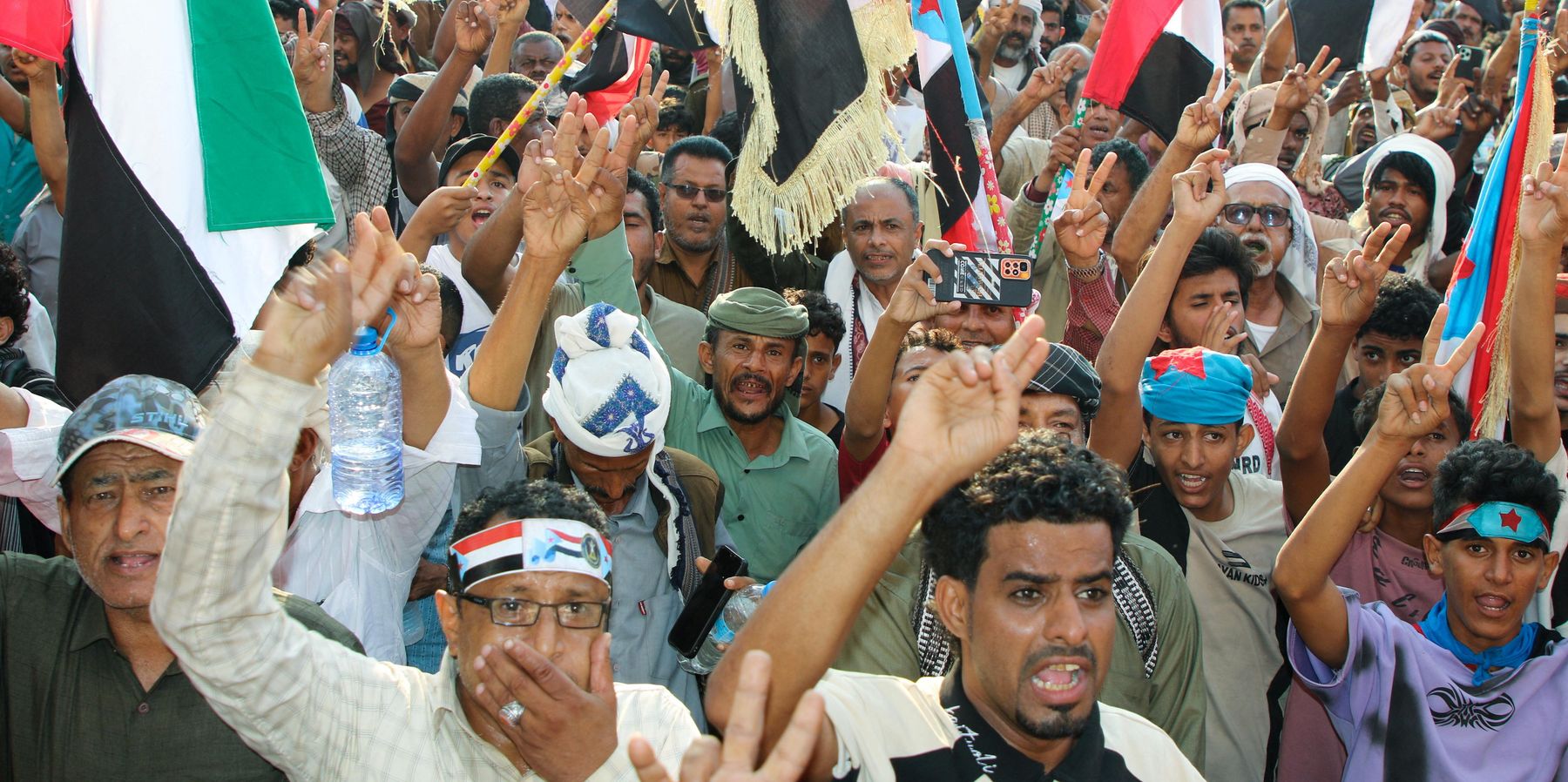
The Saudi airstrikes against UAE-backed secessionists this week will by no means set back the carving out of a new ‘South Arabia’ from the formal Republic of Yemen.
In fact, while the Tuesday announcement of the UAE’s military withdrawal from Yemen was clearly in deference to Saudi policy there, it will not weaken the Emirates’ security role in the south, nor necessarily the prospect of secession by its armed Yemeni allies, the Southern Transitional Council (STC).
The recent territorial expansion of the STC into southeastern Yemen has already created important facts on the ground. The STC and its UAE backer can continue to leverage such territorial facts toward their shared objective of a revived state of “South Arabia” in southern Yemen. The UAE will retain its small but highly strategic coastal holdings in this aspirant state, including in Mukalla and Aden, in addition to its both direct and indirect role in those parts of the Red Sea littoral of northern Yemen not controlled by the Iranian-backed Houthi.
In the south its partly non-uniformed UAE security and intelligence presence will not be abandoned by Abu Dhabi after its announced termination of what it describes as its counterterrorism role in the Saudi-led international “coalition” in southern Yemen. Nor will the STC realistically concede to the demand of the weak but mostly internationally-recognized nominal Government of the Republic of Yemen, led by the Presidential Leadership Council (PLC) to hand over its recent southeastern Yemeni territorial gains in favour of the Saudi-created “National Shield” Yemeni militia.
This latter police force currently corralled by the STC in different parts of southeastern Yemen, and part of contested but STC-dominated Aden in the southwest, is more a Saudi mercenary brigade than the claimed state force of the Republic of Yemen.
When the UAE-backed Southern Transitional Council (STC) took control of much of the south in early December, STC-aligned militias had expanded into the interior of the huge, energy-rich, southeastern Yemeni province of Hadhramawt, which runs from the border with Saudi Arabia to the Arabian Sea. This relatively easy battlefield success was coupled with STC-aligned fighters taking the neighboring and equally strategic province of Mahra, which also runs from Saudi Arabia to the Arabian Sea, but shares a long border with Oman, at which the STC claims to be countering smuggling by local tribes to the Iran-backed Houthi forces running much of the north.
With these two vital southeastern Yemeni territories in the STC’s grasp — in addition to the STC’s control of the southeastern island of Socotra, a de facto Emirati protectorate in the Indian Ocean — the southern secessionist project is on a roll. Until December, the STC existed mainly as a “shadow state,” assisted by Emirati-backed militias in much of southwest Yemen, including in its small but strategic “capital” in Aden. Amid such advances, speculation that the STC could declare independence mounted sharply.
The STC has long sought to realize its ambition to reestablish, in territorial terms, the independent southern Yemeni state that existed from 1967 to 1990 by persuading Western and regional powers that it could serve as a bulwark against the threats to maritime security in the Red Sea posed by the Houthi Zaydi Shia movement that governs much of northern Yemen. The STC’s recent expansion has made its relatively hollow counter-terrorism pitch of two years ago seem more compelling.
President Donald Trump, who is obviously open to gaining military and territorial advantage against Iran in ways that bolster both Saudi Arabia and Israel, may yet look with favor on a plausible South Arabian state whose domain runs from the Red Sea to the Indian Ocean.
The Houthi northern Yemeni regime continues to constitute a potential Iran-assisted maritime security threat to shipping it deems connected to Israel, despite a truce of sorts that was reached between the Trump administration and the Houthis last May. The agreement ended more than a year of airstrikes by U.S. and British forces against Houthi targets in retaliation for the group’s attacks on international shipping. (Israel has continued to attack Houthi targets, while the Houthis periodically hit Israel.) The Houthis had originally launched their attacks on ships plying the Red Sea in solidarity with Gaza after Israel launched its military campaign against Hamas in October 2023.
Aidarous Zubaidi, the STC leader, told Emirati media in late September 2025 that his planned new Arab state would join the U.S.-sponsored Abraham Accords. He described these peace deals with Israel as a boon to regional security, provided that Palestinian “rights” are part of the package.
A southern Yemeni secession could be backed by Israel. According to Israeli media the Israeli government is being discreetly encouraged by the STC to support its cause. Despite the fact that the UAE, the leading external proponent of southern independence, is Israel’s key regional partner, the Netanyahu government is holding back. This is in large part due to Saudi and therefore U.S. disquiet at the STC’s armed push for southern statehood at the expense of other Yemeni allies.
There had been speculation however that the recent territorial gains made by the UAE-backed STC in the southeast were secretly coordinated with Saudi Arabia. According to this account, Riyadh had become exasperated with the ongoing political and military infighting in that version of the Republic of Yemen, organized as the Presidential Leadership Council (PLC). The PLC, the power-sharing executive of the internationally recognized Yemeni government, was formed by Saudi Arabia with UAE support in 2022 under a new president, Rashad Al-Alimi. The ostensible goal was to end what had largely become a conflict between UAE-backed southern fighters and those loyal to Islah, a Yemeni party loosely affiliated with the Muslim Brotherhood, and to join ranks against the Houthis in the north instead.
In reality, the “legitimate government” of Yemen continued to be as fractious politically as its components had been militarily, and this national weakness was the backdrop to the STC’s territorial expansion in December. Forces loyal to Islah were previously an important part of military authority in the Hadhramawt interior (Wadi Hadhramawt). Yet Wadi Hadhramawt is also motivated by its own separatist ambitions, embodied by its tribal leader Amr Bin Habraish, who is also a Saudi ally. In addition to the Saudis’ reserve option of Hadhramawt independence, Riyadh has previously found Islah’s brand of “tribes and technicians” Islamism useful in defense of a united Yemen, despite Islah’s historic Muslim Brotherhood associations. Islah was pivotal in crushing an attempted southern secession in 1994.
Recent events in Hadhramawt have seemingly put Islah into political and, arguably, military eclipse, not least when its position in much of the north is heavily constrained by the Houthis. In addition, the Trump administration does not seem sympathetic to Islah. In late November, Trump moved to designate as terrorists “certain” (as yet undefined) chapters of the Muslim Brotherhood, a global group the UAE portrays as an existential threat to itself and all pragmatic, Western-aligned regional leaders.
However Islah’s acting secretary-general, Abdel-Razaq Al-Hijri, stressed to this author that the group no longer has an armed wing. Islah’s supporters, he said, are part of the “legitimate government’s” Ministry of Defense, and therefore under President Al-Alimi’s command. It remains to be seen whether such claimed military discipline among “former” Islah militiamen would apply in the defense of those northern territories that the STC is now interested in liberating. After all, Al-Hijri claims that “the leaders of the army” did not issue a command to defend Hadhramawt and Mahra against the STC.
But Yemeni unionism is not yet out of favor in Riyadh or Washington. The Saudis’ own Yemeni “national” fighters, the Saudi-funded and trained tribal forces known as Daraa Al-Watan (National Shield) that had held Seiyun, the capital of Wadi Hadhramawt, until the STC fighters arrived, abandoned their nearby Tarim military base and redeployed to western Hadhramawt. At the same time, National Shield forces are still present, if likewise non-resistant to the STC, in neighboring Mahra, where Oman-backed local tribal fighters are located. As noted, Saudi-backed National Shield troops are also present in Aden province.
In other words, the Saudis have Yemeni mercenaries in the south, albeit much weaker than the UAE’s STC-aligned troops who since December have been in the ascendent there. Amid such a highly volatile situation, the emboldened STC talked of participating in an internationally agreed force to liberate northern territory from the Houthis, including areas vital to its claims of strategic international indispensability — that is, the whole of the Bab al-Mandab in the Red Sea.
The popular southern clamor for independence (and a willingness of some southerners to gamble on the STC to deliver it) may make it difficult for the secessionists to avoid declaring sovereign statehood, in the south at least. When it ambiguously declared “self-administration” in 2020, the STC did not carry the clear support of the UAE. To declare sovereignty now, it would not only need Abu Dhabi firmly on board, but also to be sure that the Saudis could find a UAE-backed state creation useful to Riyadh’s own strategic interests in what is truly for the Saudis an existential matter.
While the southern Arabian peninsula provides the UAE with useful assets, like overseas naval outposts, Saudi Arabia considers the whole of Yemen a crucial matter of national security. This was emphasized by Saudi airstrikes against the STC in Hadhramawt on December 26, albeit not admitted to by Riyadh. The next day the Saudis publicly stated that, if the STC did not withdraw from the territory it had advanced into in the southeast, then Riyadh would act to ensure it did. None of this means that Riyadh is opposed to southern statehood, just that it rejects Emirati-encouraged unilateral expansionism. The Saudi bombing of an Emirati weapons delivery to the Hadhramawt port of Mukalla on December 30, weapons which Riyadh alleged were for the STC, was in line with this.
Their tough rhetoric and armed messaging aside, the Saudis are likely to resume their traditional foreign policy equivocation when it comes to Yemen, long the site of intra-Gulf competition. Saudi tactical calculations encourage them to keep both unionist and secessionist options alive in preference to a forced new state of South Arabia. Trump, and thus his European friends, are unlikely to try to persuade Riyadh differently given the extent of intra-southern Yemeni challenges, which declaring statehood could easily exacerbate. The supposed prize of an official anti-Iranian and pro-Israeli South Arabian buffer state still seems too unpredictable for the U.S. to want to “recognize.” U.S. and Israeli gains in Syria, and seemingly in Lebanon, probably make fighting Iran via another Yemeni state unappealing — at least for now.
- What the UAE takeover of Yemen's islands really means ›
- Houthi rivals in Yemen want to exploit Red Sea rift ›
- Is the Saudi-UAE Rivalry Heading for More Violence? ›