

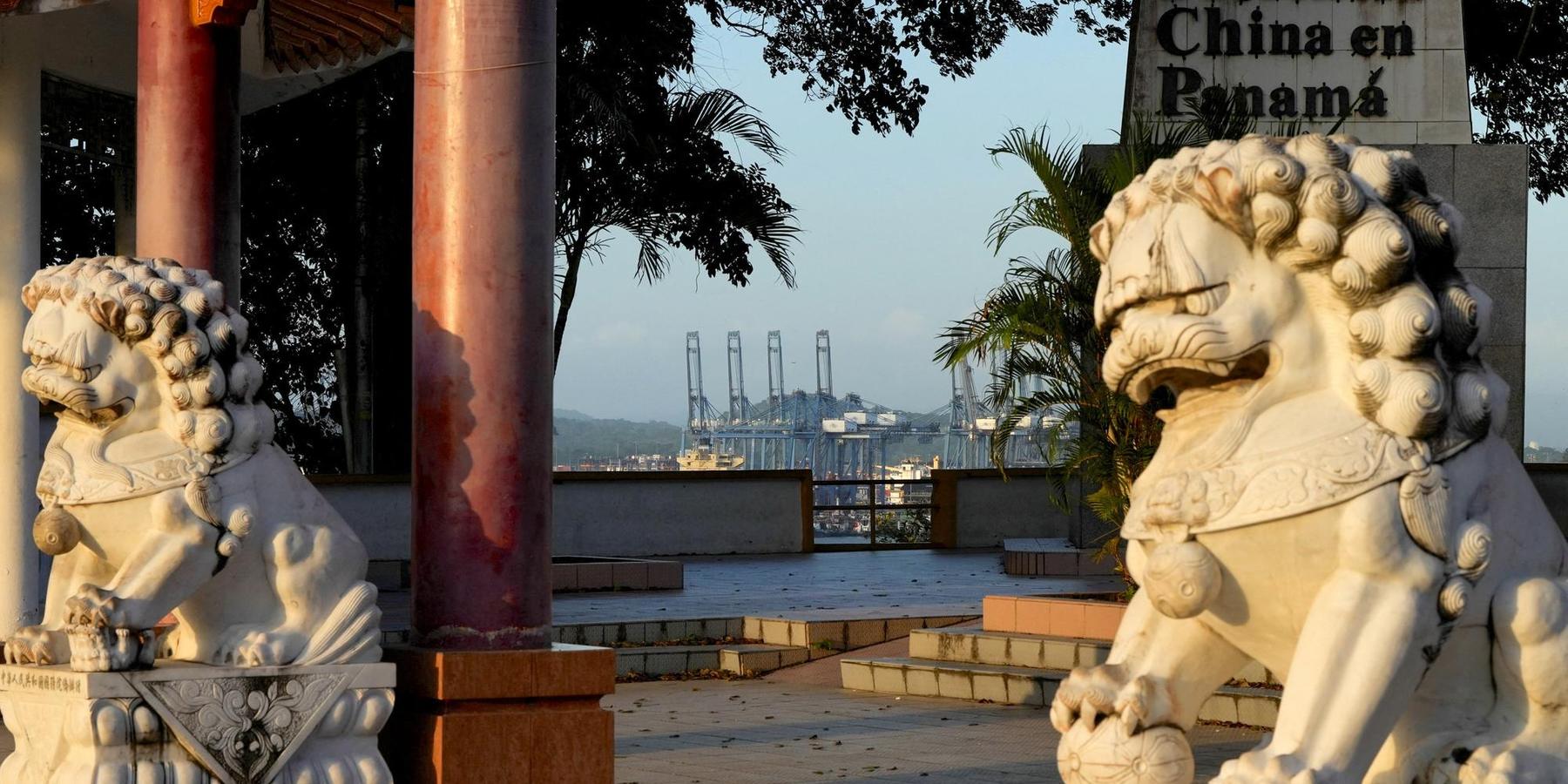
Update 1/30: Panama's highest court ruled Friday that the CK Hutchison leasing contract to run the Panama Canal's key ports was unconstitutional, setting the stage for the Hong Kong company to leave, a ruling that is sure to be welcomed by the Trump Administration today.
During his inaugural address, President Donald Trump made very clear his thoughts on the Panama Canal: “We have been treated very badly from this foolish gift that should have never been made, and Panama’s promise to us has been broken.”
Chief among his concerns was that China was in effect operating the waterway. “We didn’t give it to China. We gave it to Panama, and we’re taking it back,” Trump said. And almost exactly one year later, a court decision may make Trump’s dream a reality.
The Supreme Court of Panama is currently finishing up deliberations that will determine whether CK Hutchison, a private Hong Kong company, will be allowed to continue running two ports on opposite ends of the Panama Canal — a decision imbued with significant geopolitical tensions.
Mounting tensions
These tensions have been brewing for decades. While the U.S. originally built and operated the canal in the early 20th century, Panama gained full control in 1999 and around the same time, Chinese companies, through Hong Kong-based subsidiaries, began operating port facilities out of the canal.
While there is no evidence that the Chinese government operates the canal, as Trump claims, Chinese companies, both private and state owned, have a significant presence in Panama. China is the second-largest user of the Panama Canal, and China’s national security law mean that the Chinese government can exercise oversight and influence over mainland and Hong Kong-based companies, like CK Hutchison.
This to no small extent has caused security concerns in Washington, according to David Gantz, fellow in Trade and International Economics for Rice University’s Baker Institute for Public Policy.
“It is not irrational to argue that a major Chinese presence at Cristóbal and Balboa could raise national security concerns,” Gantz told Responsible Statecraft. “The Panama Canal is vitally important to the United States. An interruption would be extremely disruptive to the U.S. economy.” CK Hutchison originally began operating the two ports in 1997 and has come to be seen as a company under “strong influence of the Chinese government and the Chinese Communist Party,” Gantz added.
The canal is an important fixture of both the American and global economies, with at least 5% of global trade flowing through the waterway annually. Concerns about any interruptions to this vital aspect of the economy, coupled with security concerns raised in some U.S. policy sectors about a Chinese presence in the canal, have contributed to Trump’s hard stance on its status and threats to seize it by force, according to Karthik Sankaran, senior research fellow in geoeconomics at the Quincy Institute.
“That concern intensified once it became clear that a company perceived as affiliated with China was controlling the ports on both sides of the canal and the locks themselves,” Sankaran told Responsible Statecraft. “It ended up superimposing contemporary fears about China onto longstanding anger over the canal’s status.”
A legal battle begins
The Hong Kong-based company resurfaced in the national conversation after Trump’s fierce avowal to “take back” the canal from Chinese influence during his Inaugural Address. Later that same day, Panamanian comptroller general Anel Flores announced an audit of Panama Ports Company, the owner of the two ports, in which CK Hutchison holds a stake of 90%.
In March of 2025, a potential solution came in the form of an announcement made by BlackRock, an American firm that happens to be the biggest asset manager in the world. The financial institution announced that it would be working with the Mediterranean Shipping Company (MSC) to acquire Panama Ports Company and 41 other ports within CK Hutchison’s global portfolio.
This move would have assuaged national fears and security concerns over Chinese influence in the canal. However, as expected, the Chinese government did not back down easily, threatening to block the agreement unless Cosco, a Chinese state-owned shipping company, was included as a veto-holding member of the takeover consortium.
“One of the key questions is whether China actually wants to retain control of the canal, or whether an entity linked to it does, or whether Beijing is simply looking for a better quid pro quo from the United States,” Sankaran said. “My suspicion is that it’s less about holding onto the canal for nefarious strategic reasons and more about leverage.”
Later, a prolonged legal dispute emerged as Flores called Panama Ports’ contract “unfair” and “abusive,” claiming that the company had not paid enough royalties to the government and that its 25-year extension, finalized in 2023, had not taken place with the necessary authorizations.
Along with private lawyers, Flores filed lawsuits against CK Hutchison, seeking to nullify the recently signed contract and declare it unconstitutional.
“Hutchison’s relationship with Panamanian society over the past decades has been very tense and difficult,” Felipe Chapman, Panama’s finance minister, said in an interview with the Wall Street Journal.
However, experts note that these legal challenges come at the height of geopolitical tensions between the U.S. and China regarding the canal; tensions that are expected to bleed into the long-awaited Panama Supreme Court decision. Panama is “between a rock and a hard place,” said Benjamin Gedan, director of the Stimson Center Latin America Program.
“On one side, its most important international geostrategic partner, the United States, is threatening to invade, to seize by force, the most important economic engine in the country,” Gedan told RS. “On the other hand, China is an important investor in Panama, and the Panamanian private sector certainly values Chinese commercial engagement in Panama. Panama… does not want to provoke Donald Trump, nor does it want to lose access to Chinese financing and trade.”
There is no doubt that the Panama Supreme Court is facing serious pressure. If it rules to allow CK Hutchison to continue operating out of the ports, it risks upsetting Trump — who, with a recent invasion of Venezuela and threats to Canada, Greenland, and Cuba, has proven he is willing to wield a big stick.
“When Trump got involved, that woke up Panama to the fact that the primary relationship in the international system has to be with the United States…I think that kind of shook Panama to the fact that we don't want to be isolated from the United States,” Andrew Thomas, author of “The Canal of Panama and Globalization: Growth and Challenges in the 21st Century,” told Responsible Statecraft.
Aside from political pressures, Panama has serious economic vulnerabilities that contribute to the “substantial leverage” that the U.S. has over Panama, according to Sankaran. “It is a dollarized economy, which makes it extremely vulnerable to U.S. financial pressure. Cutting off access to dollars, even indirectly, would be devastating,” Sankaran said.
Future influence in Latin America
Regardless of any influential factors, the lawsuit will either strip CK Hutchison of its license, with expected legal and political retaliations to follow, or the company will be allowed to continue running the ports, albeit with some potential fines or remedy measures.
However the case is decided, Gatz is certain of the eventual outcome: “one way or another, I don’t think CK Hutchison will remain there long term,” he said. Even if the Supreme Court upholds Hutchison’s position, he suspects that American pressure will force the company to negotiate an exit with the Panamanian government.
While a ruling against CK Hutchison could indicate that Trump has won the battle, the war for Latin American influence is far from over. Sankaran points out that “China’s economic ties to Latin America are deep and structural,” with the economies being “naturally complementary.”
Additionally, China shows no signs of retreat. Following the U.S. invasion of Venezuela, China announced that they are forming a Latin America task force to look at how to protect their interests in the region.
Regardless, the court decision, which is expected to be announced soon, is likely to play a major role in the geopolitical significance of the Panama Canal in the years to come.
“I think the issue will come down to what, if anything, will satisfy Donald Trump,” Gedan said. “Will he insist on the United States retaking the Panama Canal, or will he claim victory if his pressure pushed a Chinese company out of the former Panama Canal Zone? That will be the big question in the next phase of this drama.”