

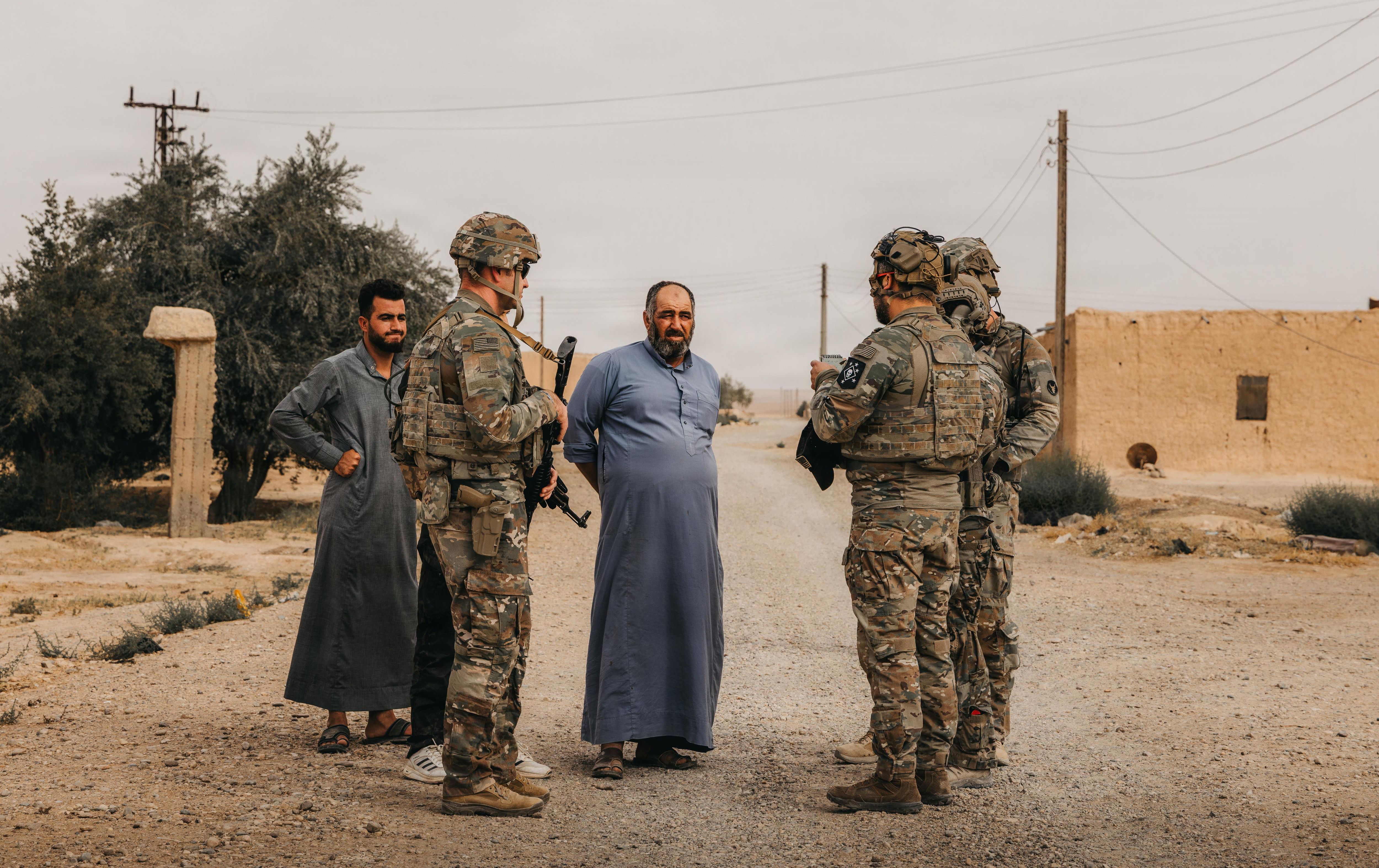
Two U.S. National Guard soldiers died in an ambush in Syria this past weekend.
Combined with overuse of our military for non-essential missions, ones unnecessary to our core interests, the overreliance of part-time servicemembers continues to have disastrous effects. President Trump, Secretary Hegseth, and Congress have an opportunity to put a stop to the preventable deaths of our citizen soldiers.
In 2004, in Iraq, in a matter of weeks, I lost three close comrades I served with back in the New York National Guard. In the following months more New York soldiers, men I served with, would die.
In 2024, three U.S. Army reservists were killed at Tower 22 in Jordan supporting a mission whose purpose remains a mystery; and now two more soldiers were shot to death in Syria after being pulled from their civilian lives to serve in the Middle East.
None of these soldiers will ever return to the families and the lives they were called away from. We need to think about how we got here and why they were sacrificed.
The National Guard grew out of the U.S. tradition of states’ militias, and like the various branches’ reserves, historically served as a strategic military backup, for use during emergencies requiring large and rapid mobilizations of national military power.
This began to change in 1973 when the Department of Defense adopted the “Total Force Policy.” This post-Vietnam shift had several rationales and effects. With the end of conscription, the U.S. military needed a larger, more easily mobilized, and more integrated reserve. Additionally, many policymakers believed, in the wake of major conflicts in Korea and especially in Vietnam which relied nearly entirely on a draftee active-duty force, that greater reliance on part time citizen soldiers would lead to better decisions on when the U.S. would conduct large-scale, long-term military operations.
This resulted in an evolution from the traditional role of strategic reserves to a more integrated operational reserve force. By the 1990s, reserve and National Guard units were participating in the Gulf War and supplanting active duty forces on routine peacekeeping missions in the Sinai and in the Balkans. The evolution understandably changed immediately after September 11, 2001, when Air National Guard units scrambled to provide immediate patrols of skies. Shortly thereafter, then-Secretary Rumsfeld began large-scale mobilizations. They never stopped.
Since 2001, more than 900 U.S. reserve component service members have died in conflicts. A handful of these were among those called to action in Afghanistan after 9/11. The vast majority occurred during our prolonged nation-building efforts there and Iraq.
The military’s reserves now make up nearly 40% of the force, and our generals have grown too dependent on them. Active duty forces are stretched thin, and adding requirements for ground forces in peacekeeping, stability and support, and train and advise missions would stretch them even thinner.
So, we must ask “why are they there?” Are our operations in Iraq, Syria, or Jordan achieving truly “vital” national security objectives? Are they worth keeping our young men and women in remote locations far from home, away from civilian lives while facing constant attacks? Why do we remain committed to leaving 2,000 troops in Iraq alone?
The two soldiers killed in Syria over the weekend have been identified as Sgts. Edgar Brian Torres Tovar, 25, and William Nathaniel Howard, 29, of the Iowa National Guard. The Army reservists killed at Tower 22 in Jordan in 2024 were Sgt. William Jerome Rivers, 46, Spc. Kennedy Ladon Sanders, 24, and Spc. Breonna Alexsondria Moffett, 23, all from Georgia. These names are added to the more than 8,000 service members who also died in the post September 11 conflicts.
President Trump and Secretary Hegseth have chosen to revert the Department of Defense into the Department of War. They have emphasized the proper role of the military as securing U.S. interests by use of force only when necessary. Secretary Hegseth has particularly called for a return to a military identity as a lethal fighting force.
Under the Total Force Policy, this includes the entire reserve component. This strategy implies that our reserve supply of citizen soldiers, sailors etc., should only be called to active duty when American interests are worth fighting for. It highlights the fact that our current “boots on the ground” missions in Iraq, Syria, and elsewhere in the Middle East are not essential to the current administration’s definition of U.S. interests, especially as clarified under the new National Security Strategy.
The “Total Force Policy,” in its 21st century interpretation, is probably here to stay. We can’t return to a military that relies almost solely on our active-duty force. We can, however, ensure that when we do call up our part-time military members, it is only for true national interests.
Our current interests in the Middle East are not worth the lives of “boots on the ground,” from any service component, citizen soldiers least of all. The White House and Congress should cooperate to ensure we are wisely deploying our young service members into danger only when necessary.
- Why are US National Guardsman getting killed in Syria? ›
- US to bring troops home from Iraq, but why not from Syria, too? ›