

For weeks the question animating the Washington D.C. commentariat has been this: When will President Donald Trump make good on his threat and launch a second round of airstrikes on Iran? So far at least, the answer is “not yet.”
Many explanations for Trump’s surprising (but very welcome) restraint have emerged. Among the most troubling, however, is that it is a lack of the necessary munitions, and in particular air defense interceptors, that is giving Trump second thoughts. “The missile defense cupboard is bare,” one report concludes based on interviews with current and former U.S. defense officials.
Even those who hope Trump chooses to avoid military action in Iran altogether should be taken aback to hear that eight months after the last extended U.S. military campaign ended (the defense of Israel during the 12-day war and Operation Midnight Hammer), American missile defense arsenals could still be in such rough shape.
To be sure, slow production timelines and the deep materiel debt mean that any effort to fully restore U.S. stockpiles to their pre-2022 level will take time. But eight months should be sufficient to return stocks of some types of defense interceptors to less critical levels. If the missile defense cupboard is truly still bare, however, something else must be going on.
That something else, it turns out, is Ukraine.
Although President Trump and his advisers are quick to argue that the United States is no longer paying for the military aid supporting Ukraine’s ongoing war, this is only one piece of a larger story. In fact, the United States is still sending billions in weapons to Ukraine, often diverting new weapons intended for the U.S. military directly to Ukraine instead. The implications of this reality are far-reaching — for U.S. military readiness, the Pentagon’s ability to respond in case of a real threat to U.S. interests, and diplomatic efforts to end the war.
To understand the scope of the continuing U.S. commitment to Ukraine, we need to look closer. There are two primary channels through which U.S. weapons continue to make their way to Ukraine instead of into U.S. military arsenals.
For starters, there is the Ukraine Security Assistance Initiative, which the Trump administration tried to cut out of its most recent budget, before Congress saved it. The $400 million in aid allocated for 2026, however, is a small piece of resources currently in this aid pipeline. Something on the order of $19 billion in outstanding orders, contracts signed under the Biden administration, have yet to make it to Ukraine. This new production will flow into Kyiv and to Ukraine’s frontline over the course of 2026 and 2027. Among the weapons included are air defense interceptors as well as other types of valuable munitions, GMLRS and 155mm shells.
This money was appropriated before Trump came into office, so this is not new spending. But the orders themselves are filled from the same production lines as the ones that would go to replenish the U.S. military’s own stockpiles. In effect, Ukraine’s defense needs compete with those of the U.S. military for scarce U.S. defense industrial capacity.
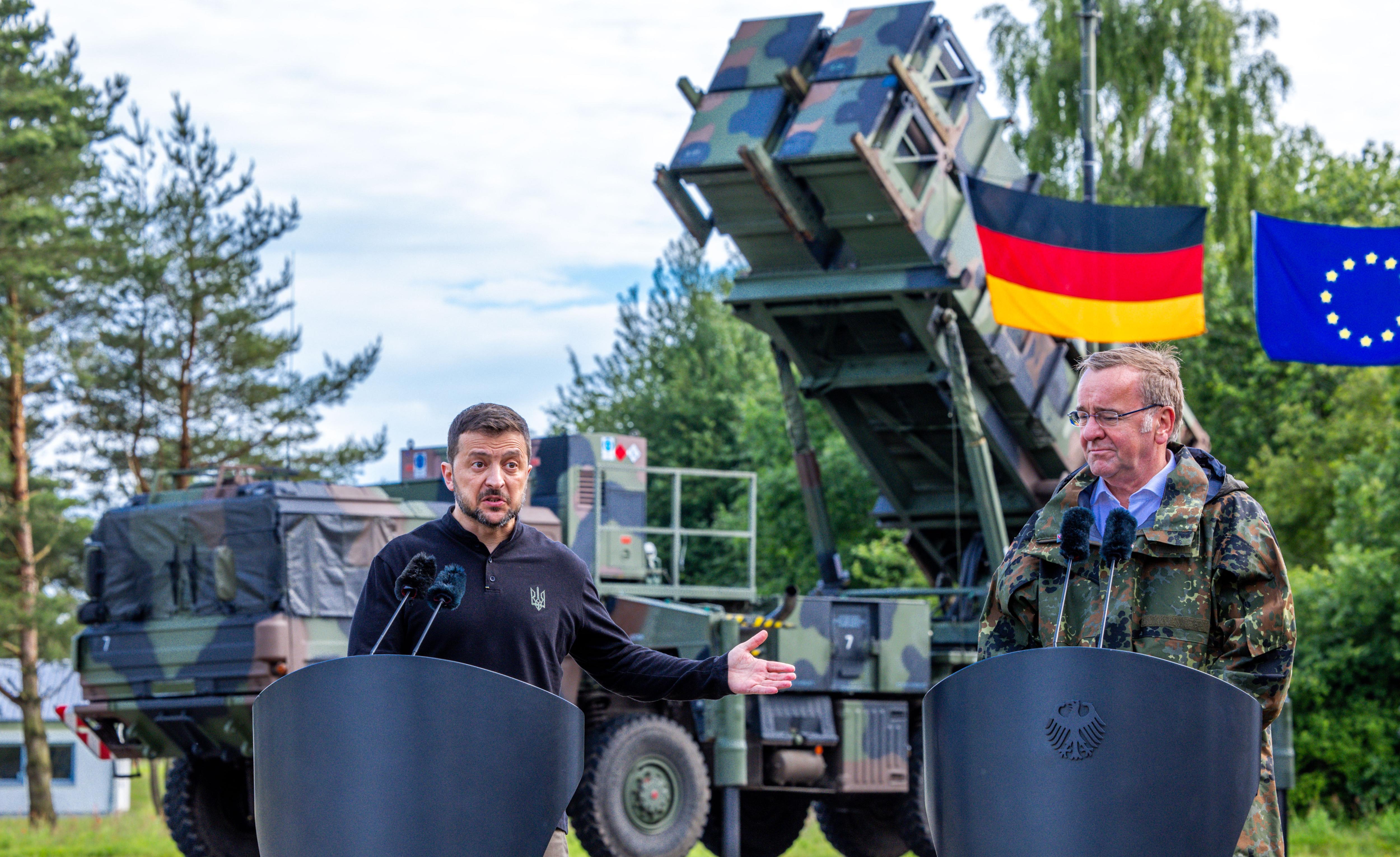
The second way that Washington continues to arm Ukraine at the expense of production that might go to the U.S. military is through the PURL program. Promoted as a mechanism to force Europeans to pick up the bill for arming Ukraine, the program does not directly involve U.S. taxpayer funds. Instead, European countries buy new U.S. weapons that then go to Ukraine.
So far, NATO has pledged over $4 billion in funds for PURL and two $500 million shipments have already been sent through the program, which expects to grow to $15 billion in 2026. PURL has been heavily used for specific types of weapons, including especially air defense and munitions of all kinds. Reports suggest that as much as 75 percent of Patriot missiles used in Ukraine (and 90 percent of all air defense) comes through this mechanism. Reports say two additional packages (via Canada and Germany) at $500 million a piece were being readied, and more were being coordinated by the U.S., at the end of 2025.
URL sounds good on the surface, since it shifts the cost of arming Ukraine from the United States to Europe. However, once again, the U.S. military likely comes out on the losing end.
What Europeans actually purchase through PURL is prioritized spots in the manufacturing queue, near the front of the line. This allows Europe, and by association Ukraine, to again skip the wait, receiving new missiles and military hardware originally intended for other buyers right away. The defense contractor gets money, but orders for the original buyers, including most likely the Pentagon, are necessarily delayed in part or in full. In some cases, PURL buys weapons directly out of U.S. stocks, meaning that PURL not only slows replenishment of U.S. arsenals, but drains them further.
It is hard to say how extensive delays caused by PURL are, either in terms of length or quantity of munitions or other materiel involved. We also don’t know for sure how much of the burden of any delay falls on the United States versus other clients. But given Ukraine’s significant demands and slow U.S. production timelines, it is likely that the impact on all buyers is substantial. Only about 60 Patriot missiles can be produced per month, for example, leaving limited supplies of this key interceptor to meet Kyiv’s stated requirements (which may be as high as 60 Patriot missiles per month) and all other global demand.
There is one more piece to the puzzle and this one implicates U.S. taxpayers. Aware of the continued readiness impact of aid to Ukraine — not just in the past but ongoing — the Pentagon has asked for significant investment in the defense industrial base, including the 2026 appropriation bill and most likely in the $90 billion classified spend plan Secretary of Defense Pete Hegseth submitted to Congress in February. This money is intended to speed up production, to backfill the weapons and hardware the U.S. military needs more quickly.
Certainly, some investment in U.S. air defense and munitions production is needed no matter what, but the amount requested is likely higher (since it is classified the American public has no visibility here) than what would be required if the United States prioritized U.S. military requirements more narrowly. U.S. taxpayers may not be paying directly for aid to Ukraine. But they are subsidizing European purchases of weapons for Ukraine in the form of the higher contributions to defense industrial base expansion needed to meet Ukraine’s needs and those of the long list of existing clients (including the United States).
The implications here are many.
First, no matter what senior U.S. officials say, U.S. aid to Ukraine continues to drain U.S. military resources and leave the United States less prepared than it should be for real threats to U.S. interests that might emerge in the future. Already resource constraints are impinging on U.S. strategy. If limited stockpiles are what is keeping the United States from bombing Iran, this may be a blessing in disguise, but the broader loss of U.S. strategic flexibility is something everyone should worry about. If the United States is currently not prepared to operate in the Middle East, imagine how far it is from being ready for a contingency in Asia or some real challenge to U.S. interests elsewhere. This puts the Trump administration’s more accommodating position toward China in the National Security and Defense Strategies in a new light.
Second, there is the issue of transparency. The costs of continuing aid to Ukraine may now be smaller for taxpayers than under Biden and indirect, but policymakers owe the general public a clear and upfront explanation for how U.S. resources and military power is being distributed abroad. This would include an accounting of previously contracted aid still to go to Ukraine and an honest summary of how PURL works and its implications for the United States.
Finally, continued U.S. aid to Ukraine on the scale described here complicates U.S. efforts to end the ongoing war. Trump has suggested that the United States intends to act as a neutral mediator — not on Ukraine’s side, not on Russia’s side. But with billions in U.S. military aid flowing to Ukraine, this claim strains credulity. The United States is most certainly still a party to this war and despite complaints that Trump has taken Putin’s side, it is Kyiv that Washington continues to back institutionally, if indirectly in part.
This does not doom negotiations or prevent the United States from leading the way toward peace, but it likely does require a different approach, one where Washington is honest about its continued role as a party to this war.
As for war with Iran, it is becoming clear that the U.S cannot afford to engage everyone, everywhere, at once. Let us hope the White House can fully grasp that truth, too.