

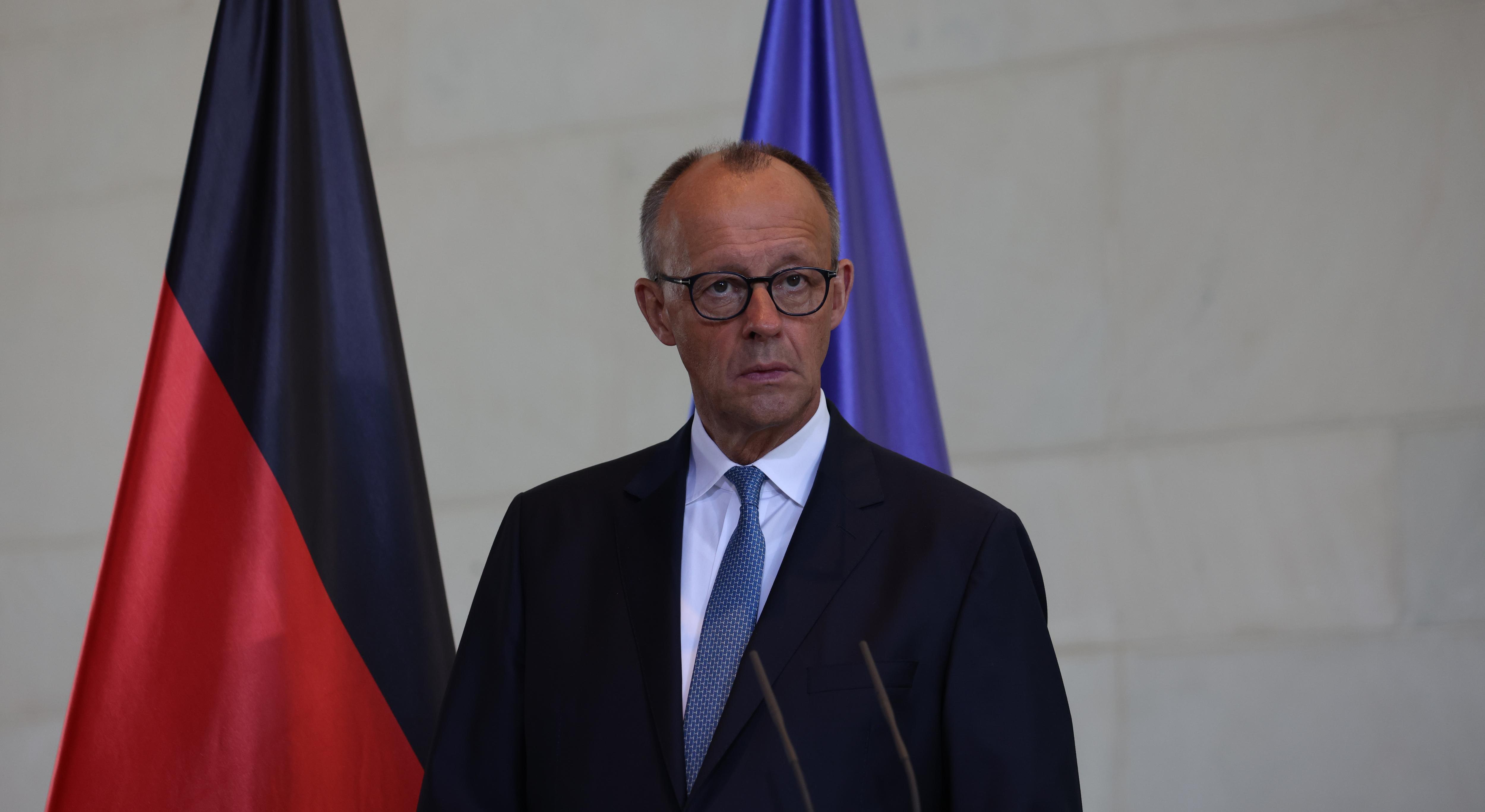
In a striking display of recklessness, German Chancellor Friedrich Merz declared the Islamic Republic of Iran to be in its “last days and weeks,” a regime he asserted had “no legitimacy.”
While other Western leaders condemned the bloody clampdown on the protests in Iran — with, according to conservative estimates, around 2,500 a in few days — none of them went so far as to boldly prognosticate an imminent demise of the regime in Tehran.
The response from Tehran was swift and trenchant. Iranian Foreign Minister Abbas Araghchi shot back that Germany had “obliterated any shred of credibility” through its blatant double standards, asking what Merz had to say about his support for the “mass murder” in Gaza while lecturing others on human rights.
The Merz-Araghchi dialogue of the deaf is not an isolated diplomatic spat, it’s the logical culmination of a European Union trajectory toward Iran over the last few years that has devolved into performative posturing, strategic shortsightedness, and a loss of leverage.
To understand Araghchi’s retort, one need only look back to the summer of 2025. Following Israeli-U.S. airstrikes on Iran, Chancellor Merz offered not caution or calls for de-escalation — a standard staple of diplomatic discourse — but enthusiastic praise for the strikes. He notoriously hailed the attacks as Israel doing Europe’s “dirty work.”
While no other European leader went to such lengths to endorse Israel’s actions, none has condemned it either. This comment, delivered by the continent’s most powerful country, signaled to Tehran that Europe had abandoned any pretense of being a constructive actor or guardian of international law. Instead, it revealed an entity fully aligning itself with a maximalist U.S.-Israeli pressure campaign. In that moment, Germany and the EU voluntarily incinerated whatever diplomatic capital they still had in Iran.
With Merz setting the tone, the European Parliament’s president Roberta Metsola, seeking re-election in 2027, seized on an opportunity to bolster her own visibility. She sent a letter to European Commission President Ursula von der Leyen and the High Representative for Foreign Affairs Kaja Kallas demanding more, and tougher, sanctions against Iran. Kallas has promised swift action.
The question is what kind of action? As Brussels has grown addicted to sanctions as a default instrument of statecraft, it has essentially run out of options on Iran, already one of the EU’s most sanctioned countries. Blacklisting the Islamic Revolutionary Guards Corps (IRGC) as terrorist organization in its entirety has become some sort of a magic wand for those who demand more action — this is the only substantive demand in Metsola’s letter.
Such attempts were already undertaken in the past. However, a unanimity of member states has to approve. Some of them, like Spain, Italy and France, object to the measure as the IRGC is not just a security body, but also a prominent economic and political actor. With the looming succession in Iran, it is plausible that the IRGC will play a substantial role in the transition and in whatever new order will emerge, short of a sudden and wholesale dismantling of the regime, however unlikely.
The IRGC is not monolithic. There are extremist elements within it for sure, but also pragmatists who could work with the West. It would therefore be unwise for the EU to rule itself out of any contact with the organization as a whole, as opposed to individual sanctions on those who committed gross human rights violations.
Given that backdrop, the focus on designating the IRGC reveals more of an urge to “do something” than a strategically sound move.
While it is up to the EU Council (member states) to decide on the IRGC, Metsola banned Iranian diplomats from the European Parliament premises. This, however, is a hollow, performative gesture — any MEP or official wishing to meet can simply do so elsewhere.
More revealing still is who remains welcome. Operatives of the Mujahedin-e-Khalq (MEK) — a cult-like exile group only removed from the EU terror list on a technicality — roam freely in the assembly’s halls in Brussels and Strasbourg. So do advocates for various ethnic separatist causes — they are granted platforms to lay out visions for Iran’s disintegration along ethnic lines.
For hardliners in Tehran, these facts confirm their narrative that the West seeks not reform and human rights but a violent regime change or dismemberment of Iran. By hosting these factions, the EU undermines the very Iranian civil society it claims to support, reinforcing the regime’s talking points that reduce dissent to a foreign-backed conspiracy.
This shift from engaged diplomacy to performance has exacted a heavy price. Europe’s leverage, once rooted in its role in forging the nuclear deal (JCPOA) and Tehran’s primary trading partner, has evaporated. The profound irony is that the Gulf Arab states, such as Saudi Arabia and the United Arab Emirates, that once dismissed the EU’s engagement with Iran as “appeasement,” are now actively pursuing détente with Tehran. Europe, by contrast, having absorbed the hardline narratives it once resisted, now finds itself isolated, its condemnations ignored by the regime it targets.
Furthermore, Merz’s public endorsement of the regime’s imminent collapse is strategically short-sighted. The actual violent disintegration of the Iranian state — a scenario his rhetoric encourages — could trigger a multi-sided civil war, a humanitarian catastrophe, and fresh threats to Israel as Iran’s ballistic missile arsenal and nuclear knowledge won’t disappear. With the removal of the current leadership and fragmentation of the state, armed groups would emerge unbound by any constraints. Most perilously to Europe, Iran’s collapse could ignite a massive new refugee crisis directly on Europe’s doorstep.
Incidentally, Germany and Merz are most vulnerable to such developments. His own political position is precarious with the right-wing Alternative for Germany (AfD) surging in polls and overtaking his own center-right Christian Democratic Union’s lead. More refugees from the Middle East will most certainly boost the AfD’s popularity further. Merz is blindly betting on chaos he is utterly unprepared to manage.
Counterfactuals are fraught, but a credible argument can be made that had Europe maintained its strategic autonomy ensuring the JCPOA survived — rather than becoming a junior partner to a U.S.-Israel regime change agenda — the trajectory inside Iran could be different. It almost certainly would have boosted moderate, pragmatic forces within Iran. In turn, sustained economic engagement, dialogue on regional security and human rights could have created more space for incremental change in the interests of the majority of the Iranian population.
The path Europe is on today — marked by virtue signaling, performative hawkishness, and strategic incoherence — serves no one. For the EU to regain relevance and protect its own interests, the first step is to recognize that when you applaud someone else doing your “dirty work,” you inevitably get your own hands dirty and lose all control over the “job” being done.
- In twist, Europe appears to be deliberately undermining Iran talks ›
- The EU's pathetic response to Trump's Iran attack ›