

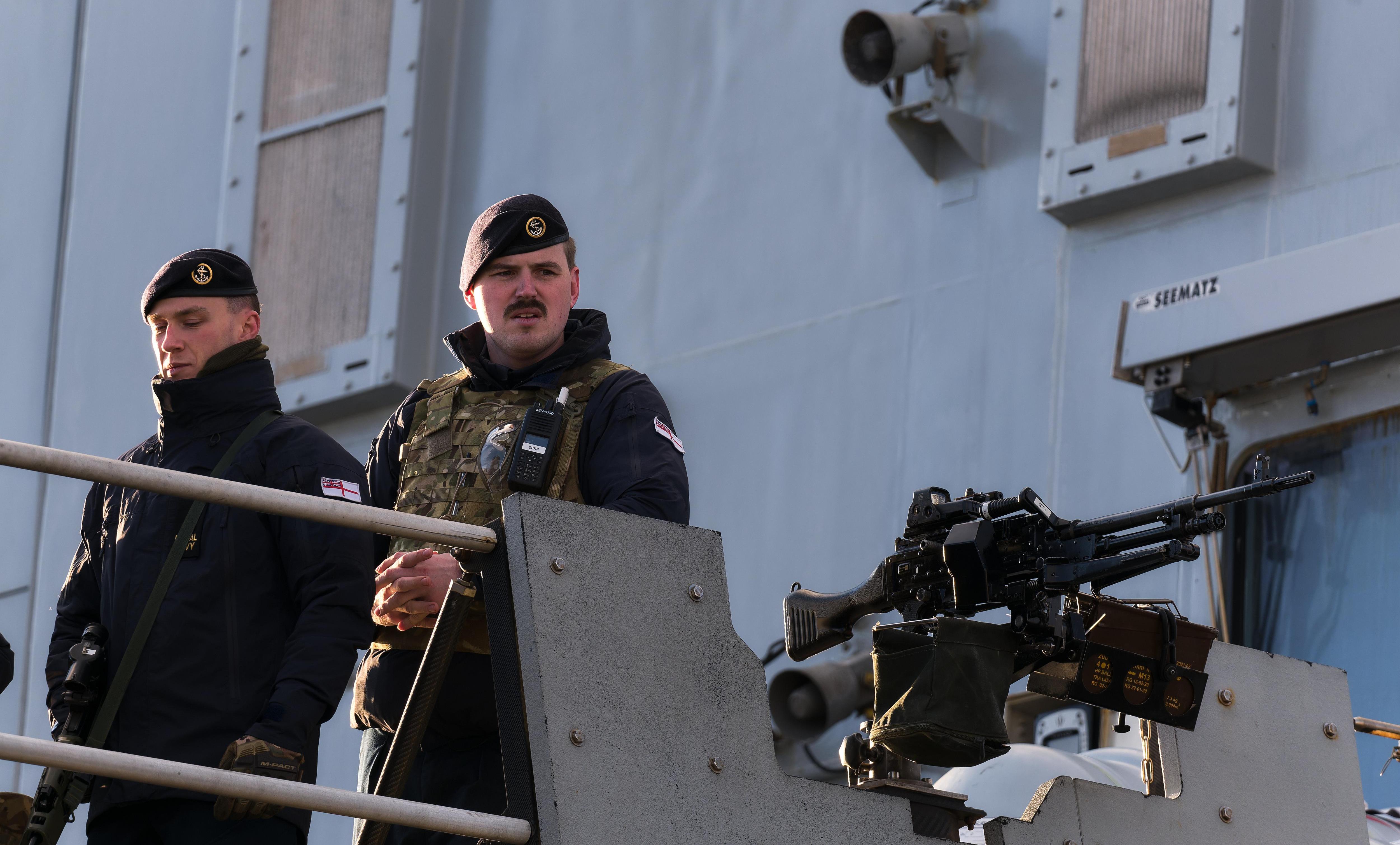
Inspired by the U.S. seizure on the high seas of ships carrying Venezuelan oil, Britain and other NATO countries are now considering using their navies to do the same to ships carrying Russian cargoes.
This would be a radical escalation of existing moves against Russia’s so-called “shadow fleet,” which have been restricted to the ports and territorial waters of NATO states. As such, they can be considered to fall under the sovereign jurisdiction of the states concerned. An extension of this strategy, as presently contemplated by some European countries, would be a limited but reasonable and comparatively risk-free way of increasing economic pressure on Russia.
Seizing ships on the high seas is a very different matter. If conducted by non-state actors, this has been considered piracy; if by states, an act of war. The danger is even greater because more and more of these ships are now sailing under the Russian flag.
Both Americans and British might wish to remember that U.S. fury at similar actions by British warships was one of the causes of the War of 1812. Given very credible Russian threats of retaliation, it is extremely unlikely that the British or other European countries would in fact take such action without a U.S. green light and firm U.S. guarantees of military support. The Trump administration must not give such a guarantee. The result could very easily be escalation towards the direct NATO-Russia conflict that both sides so far have been careful to avoid, with a real and horrifying risk of nuclear war.
Russian retaliation could take two forms. The first would be to escort as many ships as possible with Russian warships and submarines. The second would be retaliatory seizures of British ships or cargoes. The Russian navy is admittedly in poor shape to do this. On paper, the active ships of the Russian Northern Fleet (i.e. those not in reserve or under repair) tasked to operate in the Atlantic include eight nuclear attack submarines, seven conventional attack submarines, four destroyers and 10 frigates and corvettes.
It is questionable how many of these can actually be put to sea, but the Northern Fleet can now be reinforced via the Arctic by ships of Russia’s Pacific Fleet.
Then again, the Royal Navy is in even worse shape, with only 13 escort vessels, most of them undergoing refits, and only one attack submarine currently fit for action. That is another reason why the U.K. is very unlikely to initiate the seizure of Russian cargoes without full U.S. backing.
Something that European NATO members could do on their own would be to block the exit from the Baltic between Denmark and Sweden. That would be a clear violation of their treaty obligation to guarantee free international transit, and Russia would almost certainly send warships to face the Danes and Swedes with a choice between backing down and allowing free passage.
If the Russians did this and the Scandinavians decided to fight, then any such Russian force would be destroyed; just as the U.S. and British navies together would be quite enough to make any large-scale Russian convoy system impossible. But that is really not the point. The issue is that the moment a NATO warship sinks a Russian one or vice versa and kills seamen, we are in a completely different world. Whichever side loses a ship would feel virtually compelled to retaliate in kind; and given Russian military weakness, there are severe limits on how far Russia could retaliate without resorting to nuclear weapons, or at least the fully credible threat of their use.
It is vital in this regard for U.S. and NATO planners to understand Russian fears concerning the Russian exclave of Kaliningrad, now cut off from Russia by NATO territory. NATO has become obsessively worried by a supposed Russian threat to the “Suwalki Gap” between Poland and Lithuania on the one hand, and Kaliningrad and Belarus on the other.
As emphasized by President Putin in his annual address to the Russian people last month, the Russian government on the other hand is worried — with far more reason — that if as part of escalation against Russia, Lithuania cuts land access to Kaliningrad (as it threatened to do once before), and NATO blockades the exclave by sea, Kaliningrad would be starved into surrender. That would be a defeat that the Putin regime could hardly survive.
A Russian attempt to break through to Kaliningrad by land would almost certainly be defeated by the powerful Polish army, even without U.S. support. With its forces tied down in Ukraine, Russia simply does not have an additional army capable of fighting Poland and NATO. The result once again (and as members of the Russian establishment have warned me) would be an early Russian recourse to nuclear weapons.
What is the point of running such a risk of escalation when the Russian army has been fought virtually to a standstill, and the chief remaining obstacles to peace are the issue of control over a tiny area of the northwest Donbas, and a European “reassurance force” for Ukraine that the Europeans have no real intention of risking in war?
From a British and European point of view, it is also necessary to point out that to take this kind of action against Russian cargoes would make them totally dependent on U.S. military backing. As a result, they would be completely incapable of resisting — even diplomatically — any moves that the Trump administration made to seize Greenland.
So for the sake of an unnecessary and horribly dangerous escalation of their role in a war that is not in defense of NATO territory (for Ukraine is not and never will be a NATO ally), they would sacrifice an actual NATO ally, Denmark, and open themselves to a humiliation that would shred whatever remains of their international prestige.
Finally — and for whatever international legality may still be worth in today’s world — it is necessary to point out that seizing on the high seas the property of a state with which you are not at war is completely illegal. Not so very long ago, the overwhelming consensus in Britain and Europe was that only the U.N. had the right to impose such measures.
The British government is now trying to construct a legal case that it can seize ships of Russia’s shadow fleet because they are not “legitimately flagged,” but this comes after more than half a century during which Britain has accepted ships sailing under “flags of convenience,” however unclear the ownership and fictitious the jurisdiction involved. In terms of legal validity and international legitimacy, this approach is on a par with the legal case Tony Blair’s government cooked up for invading Iraq, and will be regarded in the same light by most of the world.
And here is the final tragic irony. The British Empire, and the subsequent U.S. empire and its British auxiliaries, have made the security of international maritime trade a key part of their claim to international legitimacy. An alleged (though actually up to now non-existent) Chinese threat to trade in the South China Sea has been used as an argument for America’s right and duty to resist Chinese territorial claims in the region.
Yet it is now the U.S. and U.K. that are threatening to violate the laws and rules of international trade, and set a disastrous precedent for other states to follow. If, God forbid, our governments proceed further down this path then they will have only themselves to blame if more and more countries come to see China as a better representative of international order and legality.
- US capture of Russian-flagged ship could derail Ukraine War talks ›
- Europe's risky war on Russia's 'shadow fleet' ›
- A Euro leader cursed for calling for peace — with Russia | Responsible Statecraft ›