

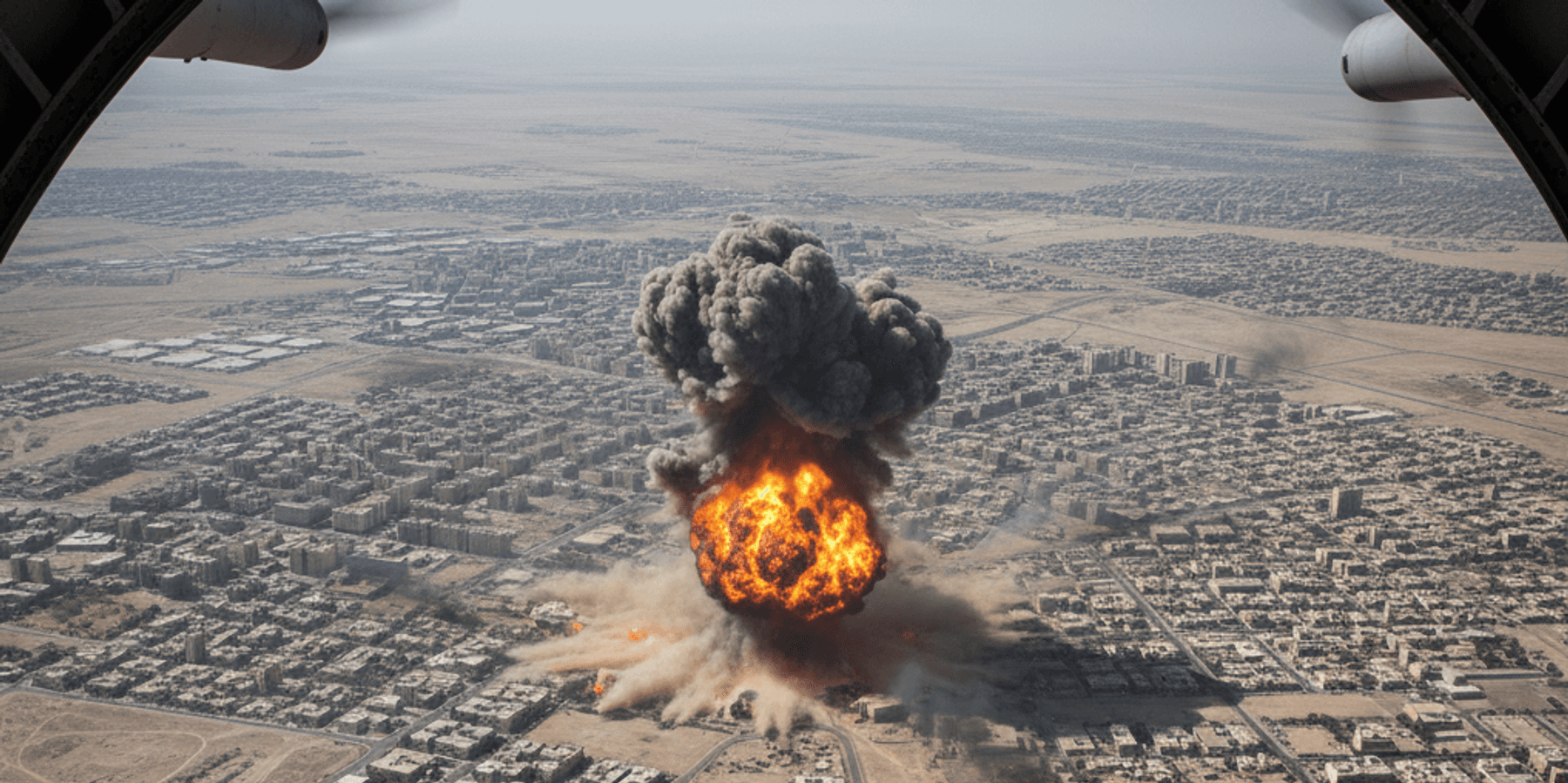
In recent weeks, President Donald Trump has deployed a massive U.S. naval and air armada to the vicinity of Iran, seeking to coerce the Islamic Republic into signing a deal that mostly favors the U.S. side.
These assets have arrived with explicit and public warnings that comply and “say uncle” or be punished from the sky.
Meanwhile, Iranian and American diplomats have been negotiating indirectly in Oman, with another meeting planned for Thursday, to find a diplomatic solution to Iran’s nuclear program. The U.S. wants Iran to dismantle and give up its uranium enrichment program, while Iran continues to insist that it is exercising its rights under the Article IV of the Nuclear non-Proliferation Treaty (NPT).
What is unfolding bears the hallmarks of 21st Century gunboat diplomacy, in which naval and air power are deployed not merely as deterrents, but as instruments of coercive bargaining.
As of this writing, Trump has discussed limited airstrikes to coerce Iran to sign a deal, or face larger campaigns against “regime facilities” potentially aimed at toppling the Islamic Republic. Some reports have also suggested that one of the potential scenarios against Iran is a direct strike against Supreme Leader Ayatollah Khamenei and his son, Mojtaba. The logic behind Trump’s thinking is quite straightforward: he believes that after the June 2025 war on Iran conducted with Israel, and the recent massive protests in the country, the Iranian leadership, which is grappling with multiple crises at the same time, would be desperate for a deal.
But Trump’s assumption rests on a familiar, but flawed, strategic premise that air campaigns are an effective instrument of coercing adversarial states into submission, or in the case of U.S. policy on Iran, bringing an end to the Islamic Republic. It echoes a long lineage of airpower doctrines dating back to Giulio Douhet’s early 20th century notion that bombing cities could shatter morale and force governments to submit to political demands.
For presidents wary of protracted ground wars, airpower can appear to provide decisive action while minimizing American casualties and long-term commitments. Since taking office in January 2025, Trump has bombed Iran, Iraq, Yemen, Syria, Nigeria, Somalia and Venezuela, and has kidnapped a country’s leader, at almost no cost to the United States.
Time and again, however, modern warfare has demonstrated the limits of this notion.
During Operation Rolling Thunder in Vietnam (1965–1968), the United States launched a sustained bombing campaign intended to compel North Vietnam to negotiate on American terms. Instead, Hanoi adapted by dispersing infrastructure, hardening defenses, and mobilizing political resolve. The bombing failed to break North Vietnam’s will or force meaningful concessions.
In the 1991 Persian Gulf War, sustained aerial attacks did not by themselves compel Iraq to withdraw from Kuwait; it was the ground invasion that proved decisive. More recently, Russia’s air and missile campaign against Ukraine underscores the same strategic lesson: sustained strikes on infrastructure and military targets, absent decisive control on the ground, have failed to compel the political leadership in Kiev to agree to Moscow’s territorial ambitions.
University of Chicago Professor Robert Pape’s systematic study of air campaigns reinforces this pattern. Airpower tends to succeed not through punishment of civilian infrastructure, but when it is linked to a credible threat to seize or hold territory. Even NATO’s campaign in Kosovo — often cited as a triumph of airpower — became coercive only when Serbian forces on the ground were increasingly threatened and the prospect of a NATO invasion appeared plausible. The lesson is consistent: without jeopardizing territorial control, bombing alone rarely compels capitulation or surrender.
Iran is unlikely to be an exception to the rule. The United States’ unmatched air superiority is a powerful tool for destruction, but that does not necessarily translate into political submission. President Masoud Pezeshkian captured this sentiment when he announced on February 21 that “world powers are lining up to force us to bow our heads… but we will not bow our heads despite all the problems that they are creating for us.”
Indeed, Iran, because of its size and strategic depth, can absorb plenty of punishment from the air without capitulating. In fact, the last time Iran was forced to surrender to a foreign adversary was when British and Soviet forces violated its neutrality during the Second World War and occupied Iran in August 1941, after it refused to capitulate to their demands to expel German nationals from its territory.
The Islamic Republic has spent decades preparing precisely for a confrontation defined by superior U.S. firepower, and its military doctrine emphasizes asymmetric warfare, dispersal, and hardened facilities. Reports indicate that in the anticipation of U.S. air strikes, Iran has begun reinforcing its nuclear facilities to minimize the impact of U.S. attacks. Even in the event of total destruction, Iran has the technological and industrial capacity to rebuild them over time: bombs can destroy physical infrastructure, but cannot destroy knowledge and technology.
More importantly, the Islamic Republic's political system is quite resilient. It was born into a revolution, survived assassinations and a total war for eight years, and consolidated itself under decades of U.S. economic warfare without capitulating. During the Iran–Iraq War, Iran absorbed hundreds of thousands of military and civilian casualties, yet the Islamic Republic neither collapsed nor surrendered.
Instead, the war was framed as a sacred defense of the nation, and the language of sacrifice and martyrdom became embedded in state ideology and political mobilization. This historical experience matters. The regime is structurally insulated from popular pressure in ways that limit the coercive leverage airpower seeks to generate, and it possesses institutional mechanisms to ensure leadership continuity even in the event of decapitation strikes.
At the same time, Iranian decision-makers understand the asymmetry in casualty sensitivity. American political culture, shaped by democratic accountability and media scrutiny, tends to react sharply to sustained losses. By contrast, Iranian culture has historically demonstrated a far higher tolerance for prolonged hardship and sacrifice in the face of external attack. Under such conditions, aerial punishment is more likely to consolidate regime cohesion and nationalist resolve than to compel capitulation.
Airpower is an imperfect instrument of political coercion. It can destroy facilities. It cannot occupy territory, replace regimes, or compel durable political surrender absent credible ground threats. Prussian military theorist Carl von Clausewitz’s central warning was that war has its own dynamics once begun. Political leaders may choose when to start it, but they do not control its trajectory in a linear way. Once force is unleashed, escalation, retaliation and unintended consequences often follow paths that no planner fully anticipates.
If Washington proceeds under the illusion that bombs alone can coerce Tehran, it may discover what history has repeatedly shown: punishment from the sky often hardens resolve rather than breaks it — and wars begun as instruments of pressure can evolve into conflicts far larger than those who initiated them intended.
- No, even a 'small attack' on Iran will lead to war ›
- Why Arab states are terrified of US war with Iran ›