

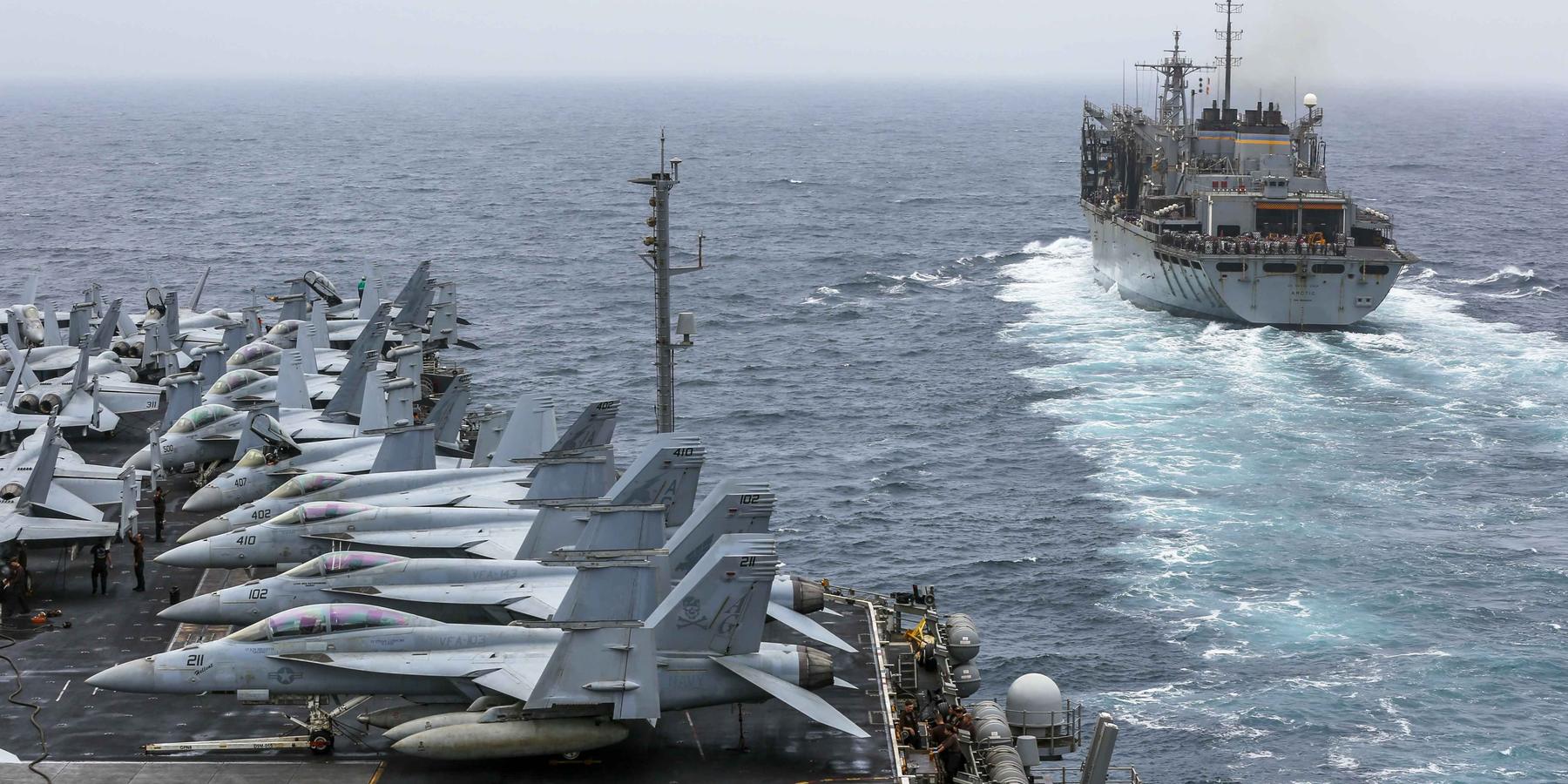
Although many newly deployed assets appear to be defensive, the intensifying U.S. build-up around Iran raises the possibility of a limited U.S. strike against Tehran — if not a wider campaign — soon.
Yesterday, the USS Abraham Lincoln aircraft carrier and warships supporting it entered the greater Middle East region. That carrier joins other U.S. assets sent there in recent weeks, including THAAD and Patriot missile systems, and F-15E Strike Eagles.
Israeli network Ynet reported the presence of P-8A Poseidon maritime patrol aircraft, MQ-9 Reaper drones, refueling aircraft, as well as C-17 cargo carriers. The USS Lincoln itself carries substantive military assets, including F/A-18E/F Super Hornets and F-35s, both attack aircraft, and EA-18G Growlers, which can jam adversarial tech.
Earlier this month, the U.S. established the Middle Eastern Air Defense — Combined Defense Operations Cell (MEAD-CDOC) at Al Udeid Air Base in Qatar, bolstering its integrated air and missile defense in the region.
Jennifer Kavanagh, senior fellow and director of military analysis at Defense Priorities, told RS that, if the brief Israeli war on Iran this summer is any indication, many assets being moved to the region will help the U.S. protect what that it already has there, in case of attack.
“When the United States decided to bomb Iran's nuclear facilities in the Middle East in June, it did not rely much on military assets in the region for those attacks. It relied on bombers flown from the U.S. and fighter jets and aerial refuelers mostly from Europe,” Kavanagh told RS. “Military assets in the region were used mostly for defensive operations, to protect U.S. bases and forces and to help Israel defend itself against Iranian retaliation.”
“I would expect that any future campaign would be similar. Assets moved into the region seem to be those intended to defend U.S. forces, bases, and military hardware, more than what the U.S. might use for offensive strikes on Iran,” Kavanagh said.
Crisis Group’s Iran Project Director, Ali Vaez, wrote on X that the ongoing build-up could simply be deterrence: “Threat of retaliation and protection of assets/allies keeps Iranian govt from making a first move, while upping sanctions pressure and diplomatic isolation in the meantime,” he wrote.
Although, Vaez said that more offensive U.S. plans are possible, perhaps along the lines of a “high-value but limited strike,” or even a “substantial campaign” against Iran, which could target leaders or other strategic assets.
Placing the ongoing build-up in context, Sebastian Bruns, a fellow at the Royal Swedish Society for Naval Sciences, said the arrival of a carrier to the Middle East, which, while not novel, suggests Washington intends to act.
“Historically, at least since the creation of US CENTCOM…American military assets have been strong in the area, with some waxing and waning in between periods of high tension… Stretched for ready aircraft carriers, the US had [later] opted to give up on the permanent carrier presence in the region, with a renewed focus on China,” Bruns told RS. “So: a carrier isn't new to the region, but it is a sign of power projection and if Venezuela is any guidance the Trump administration means business by deploying it.”
“However, a host of assets is needed to guard the ship, for Iran sports a more capable defense than Venezuela ever did,” Bruns told RS. “Hence, the build-up…can be sustained for a while, but needs to be either withdrawn or used in some form eventually. This introduces the element of time.”
Other observers, meanwhile, see strikes as likely.
“The overall force posture suggests to be that the US intends to carry out an initial strike to neutralise key targets like air defences and airbases (possibly using a mix of B-2s, F-35Cs and EA-18Gs), followed by potential several days or even a couple of weeks worth of further strikes…using the F-15Es and other assets,” says Jon, a senior editor of the UK Defence Journal and open source military tracker at @DefenceGeek on X, told RS in an email. The refueling tankers and cargo aircraft present would support those operations.
“During any initial strikes, I foresee [F-15Es] being used…as air defence interceptors for the region — carrying a mix of traditional air-to-air missiles for defence against Iranian cruise missiles, and the [Advanced Precision Kill Weapon System] APKWS guided rockets for use against any [adversarial drones there],” he predicted.
A Gulf official told Middle East Eye that the U.S. is considering high-precision strikes in Iran, as early as this week. CENTCOM announced today, further, that Air Force Central will be conducting military readiness exercises in the coming days. Iran says it will consider any attack against it “all-out war.”- Report: Incoming Trump officials mulling attack on Iran ›
- Tracking the US military build-up today in the Middle East ›
- Military tankers for Iran attack deploying near Iraq War levels | Responsible Statecraft ›