

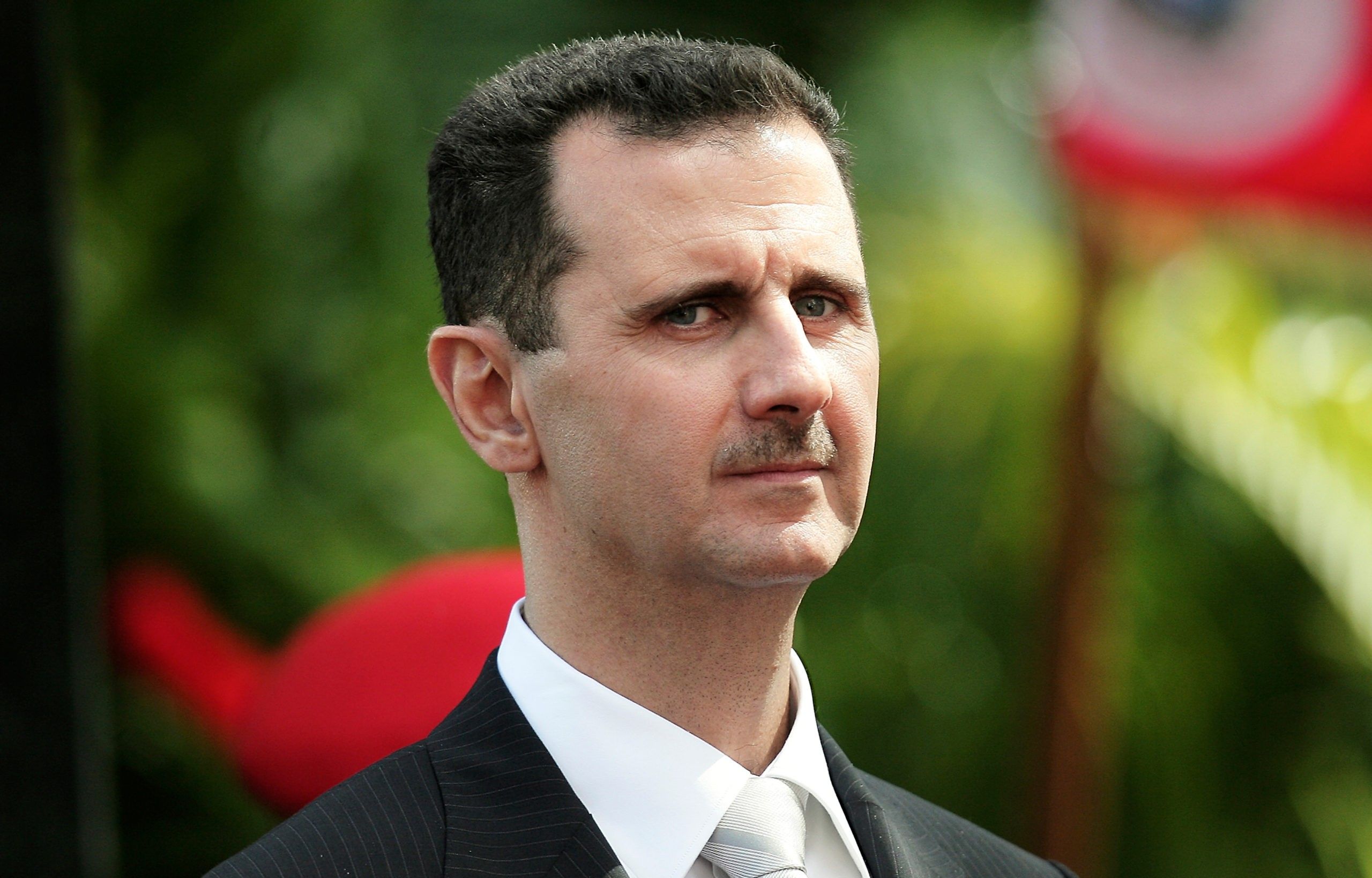
In early November of last year, the Assad regime had a lot to look forward to. Syrian President Bashar al-Assad had just joined fellow Middle Eastern leaders at a pan-Islamic summit in Saudi Arabia, marking a major step in his return to the international fold. After the event, Turkish President Recep Tayyip Erdogan, who had spent years trying to oust Assad, told reporters that he hoped to meet with the Syrian leader and “put Turkish-Syrian relations back on track.”
Less than a month later, Assad fled the country in a Russian plane as Turkish-backed opposition forces began their final approach to Damascus. Most observers were taken aback by this development. But long-time Middle East analyst Neil Partrick was less surprised. As Partrick details in his new book, “State Failure in the Middle East,” the seemingly resurgent Assad regime had by that point been reduced to a hollowed-out state apparatus, propped up by foreign backers. When those backers pulled out, Assad was left with little choice but to flee.
On the first anniversary of the fall of Assad, RS spoke with Partrick to better understand how a 50-year dynasty collapsed in a few short weeks. The conversation has been edited for length and clarity.
RS: What did so many outside observers miss about the weakness of the Assad regime in the leadup to its collapse?
Partrick: The way in which the regime was surviving was quite precarious. Whilst this was understood, I don't think it was factored in enough in terms of just how brittle the regime and, to some extent, the state was.
This included running what remained of the Syrian state armed forces as largely a family fiefdom — as much focused on criminal activity as it was on defending the country. In fact, arguably more the former than the latter. [And it included] the increasing reliance on semi-state militias, also involved in criminal activity as much as security work, and the reliance upon neighboring militias, primarily in terms of Hezbollah from Lebanon, and [the reliance on] the assistance provided by Iran and Russia.
If you put all those elements together, plus the residual Turkish interest in promoting an alternative regime, then you had a very insecure situation — Bashar, in office but not really in power, relying on an increasingly narrow network [of allies]. It's easy to be wise after the event, of course. I certainly didn't predict it was going to collapse so quickly. But it was extremely brittle before it happened.
RS: Can you talk more about these non-state militias that were slowly taking over the role of the army in Syria?
Partrick: It had been a long process through the years of the civil war, starting in 2011, when the regime was at its most vulnerable. Pre-existing militias became reconfigured. [These were] the so-called “Shabiha” — local groups that had been strongly associated before the civil war with criminal activities and [regime patronage]. They then coalesced into defenders of local areas against the, some would say, genuinely democratic opposition forces that emerged in 2011, [which] subsequently got taken over by more militant Islamist jihadi elements from outside.
In many ways, the state's national integrity was franchised out many years before the state collapsed in the form of these security networks that were semi-state, semi-independent, involved in criminal and then local militia activity. Some of them, of course, were connected to foreign actors, whether it was the Iranians or others. But as was put to me, and I use this quote in the book, these were bodies that were made up of local people who were the most reliable to defend their local area. So that national esprit de corps was already very, very weak before the state collapsed.
RS: You made reference to the fact that Syria had become shot through with these different foreign influences. One thing that stood out in the book was the former Syrian ambassador’s comment about how Assad was trying to triangulate and maybe even reduce Iranian presence in Syria during the war in Gaza. Can you talk a little bit about the balancing act that Assad was attempting?
Partrick: There were elements of a traditional Assad policy that his father did more skillfully in terms of trying to balance between internal [elements] and a wide range of contradictory, external elements. But Bashar, the son, was less skillful and less adept at statecraft. He was using very different and contradictory actors to prop up his regime — primarily Russian and Iranian forces who cooperated but had rather different agendas.
For Iran, it was a matter of its national survival and regional outreach. For Russia, it was a complicated mix of reasons, but less nationally vital for it. And of course, there was the Turkish element. Turkey had an ongoing occupation in parts of the north of Syria, and would coalesce to some extent with the Russians on elements of border security, whilst the Iranians saw their role as much broader, [spread] throughout a much wider swathe of the country through their own forces and through the role of Lebanese Hezbollah and other Shia elements from the region.
It was a very delicate balancing act. Because of the emergence of the regional war following the events of October, 2023, it was hoped to some extent, certainly by Hezbollah and Iran, that Syria could be part of this conflict. And whilst part of its territory was part of the conflict, the Syrian leadership didn't want to stay within it and saw this as an opportunity to send signals ultimately to the Americans, primarily through the Gulf Arab states, as a chance to leverage and say, “Here I am being responsible. I'm seeking to keep my country out of this emerging regional war.”
It was a delicate attempt to keep [Assad’s] family-led regime in place that ultimately failed. He thought he could play all these elements at the same time. He thought they needed him. At the same time, [he was] keeping in with the Iranians, whilst putting pressure on the Iranian presence as a way of appeasing or appealing to the West — an almost impossible situation to try and balance. [It] ultimately proved to be his downfall.
RS: You mentioned Israel played a role there. Can you speak a little bit more about that?
Partrick: In the course of the civil war from 2011, there had been signs of a movement away from Israel's apparent acceptance of an Assad regime as a force of relative stability to a situation where Israel started to see a regime weakening and seemed to be looking to [other] options inside the country. Once the scenario of being brittle then looked like the possibility of actual regime collapse, the Israelis adjusted their position.
They'd already periodically been conducting a number of strikes inside Syria, but they were largely focused on what they saw as Iranian-linked targets. In the leadup to the events of November 2024, they were also more willing to focus on Syrian targets themselves. The Israelis, I don't think with a desire to bring down the regime, had been stepping up their military attacks inside Syria, including taking in Syrian national targets — a shift from just targeting Iranian-linked targets. And of course, Hezbollah from Lebanon were increasingly focused on events at home, and had moved their forces back to Lebanon, because that itself was under Israeli attack.
Israel was one of a number of actors that was playing a decisive role. But I don't know whether anybody actually believed that they could bring down the regime so easily, or whether the Israelis had really decided it was time to do so.
RS: Another influential foreign power in all of this is Russia. You talk in the book about how Russia's invasion of Ukraine and the ensuing war there contributed to the fall of the Assad regime. Can you speak a little bit to that?
Partrick: [Russia had been] vital in terms of the role of its air forces in particular, in a devastating use of military power against Syrian opposition forces. Air power by a foreign country is not really a way of building the integrity of a leadership, let alone a state. But it might be a way of keeping a leader in place for a while. That had been vital to the very survival of the Assad-led regime in Syria.
But then it had become something of a problem in terms of Russia's continued capacity to maintain a key role there. [Moscow] began to reduce its presence in the south and to some extent in the rest of the country as its commitments in Ukraine increased in the course of its stepped up military occupation of that country. The Russian reduction played a role in the increasing brittleness that played out a year ago. Ultimately, even the capacity that was there — the Russian capacity that was there, the Iranian capacity that was there — was not one that either country was prepared to use.
And ultimately the Russian leadership and [President Vladimir] Putin in particular, as several sources told me, essentially said to Bashar, “this ain't gonna work.” Indeed the Russians were quite key to his own exodus and to that of a number of other key regime figures fleeing the country.
Bashar, seeing his own power delusionally as almost synonymous with Syria itself, was not even prepared to try and share power with key family members who had a role, most notably his brother. That ultimately played a key role in the collapse. It was several actors ultimately deciding that this is not worth the candle, whether it was the Iranians or the Russians. And in that context, the Turks [saw] a wonderful opportunity from their point of view.
RS: It has now been a year since the overthrow of Assad. I'm curious about your view of the extent to which the new president, Ahmad al-Sharaa, has succeeded in building a certain amount of state capacity and reversing the weakness of the former regime.
Partrick: We're in a situation [with what] has to be regarded as greater state capacity than when the regime collapsed, because in many senses, as I argue in the book, the state collapsed [last year] too. What remnants there were of national integrity and capacity were already incredibly weak and then simply melted away.
We now have a president in place and the remnants of some of the old armed forces professing a degree of loyalty to him, [which] means we have a degree of state capacity. But it seems in many ways that the militia system Bashar used has been replicated in the Syria of today, albeit with different individuals heading them. You don't have wholly capable state forces. You have a range of powerful semi-state militias who have a loose allegiance to that state.
That's the environment in which President al-Sharaa is operating. He doesn't yet have, to use the cliched model of a state's existence, the monopoly of violence in his own country in a clear and integrated fashion. So he remains a weak leader, depending upon a loose grouping of militias and the remnants of the old state forces to defend borders as far as he can.
- Can Trump cool Turkey-Israel tensions over Syria? ›
- The foreign policy story of 2024: The Fall of Assad in pictures ›
- Why Russia survived — and may thrive — after Syria regime change | Responsible Statecraft ›