
Follow us on social

google cta
2023-06-13t142545z_1603288776_rc28a1anluac_rtrmadp_3_ukraine-crisis-russia-prigozhin-scaled

Rogue Wagner Group chief Prigozhin killed in fatal plane crash

Only two months ago, the founder of the mercenary group had led a mutiny against Moscow. Talk of assassination is already in the air.

Analysis | Europe
google cta
google cta

Update 8/23, 5:40 p.m. ET: Russia's Federal Air Transport Agency confirmed that Yevgeny Prigozhin was on board the plane that crashed in Russia on Wednesday, adding that "all on board were killed."


Yevgeny Prigozhin, the head of the Russian private militia group known as the Wagner Group, was reportedly killed in a plane that crashed in Russia on Wednesday. Russia’s emergency ministry said that all 10 people on the aircraft died, including seven passengers and three pilots, though it did not immediately confirm whether Prigozhin had been on board. 

Russian officials have said that a man with Prigozhin’s name was among the passengers on the flight from Moscow to St. Petersburg. NBC News’ Richard Engel noted on Twitter that a Wagner-affiliated Telegram group claimed that a second plane attributed to Prigozhin’s fleet landed safely at Ostafyevo Airport.

According to the Financial Times, “The aircraft, an Embraer Legacy, was the same that Prigozhin had regularly used to travel around Russia and as far away as Africa, according to flight tracking site Flightradar24.”

Wagner-affiliated Telegram accounts have claimed that the plane was shot down by Russian air defenses. 

“We have seen the reports. If confirmed, no one should be surprised,” wrote Adrienne Watson, a spokesperson for the White House National Security Council, on Twitter. 

The Wagner group chief has been in the headlines this year for his involvement in the war in Ukraine and his disputes with leadership in Russia, which culminated in his group’s aborted “march on Moscow” earlier this summer. 

As The Quincy Institute's George Beebe and Anatol Lieven noted in  May, Wagner had “gained new prestige after taking the lead in the bloody and long-drawn-out, but ultimately successful battle for the town of Bakhmut.” The leader of the mercenary group, however, quickly soured on leadership in Moscow.

“Prigozhin has long been critical of Russia’s military leadership, complaining publicly about its incompetence and corruption, and contrasting its purported passivity and incompetence to what he portrays as Wagner’s patriotism and bravery in defending the motherland’s interests in Ukraine, Syria, and beyond,” Beebe and Lieven wrote, about month before the short-lived mutiny.

“But his recent interview on the internet channel Telegram marks a drastic escalation and extension of his long-standing attacks (...) He is now attacking the entire conduct of the war in Ukraine and declaring its results to date to have been a disastrous failure.” 

On today’s events, Lieven said there will be “a very widespread assumption that he was assassinated, on the orders either of President Putin himself, or of Prigozhin's long-standing enemies within the Russian military, Defense Minister Sergei Shoigu and Chief of Staff General Valery Gerasimov.” Lieven adds:

We will probably never know for sure the truth behind the crash of Prigozhin's plane, but the assumption of an assassination will be strengthened by the fact that on the same day, it has been announced that air force chief General Sergei Surovikin has been fired. Surovikin was close to Prigozhin, and though he appeared in public during the Wagner mutiny to appeal to the Russian military to remain loyal to the state, ever since then he has been kept out of public view and — it has been assumed — in detention.

Prigozhin had largely left the public eye after ending his revolt attempt and striking a deal with Putin, in which he agreed to relocate his fighters to Belarus. The mercenary head has reportedly been spotted in Belarus and Russia since then, but he apparently re-emerged on video for the first time on Monday, suggesting he was in Africa, as part of an effort to “Wagner in recent years has deployed thousands of its troops in at least five different countries across the continent. The mercenary group has been accused of being involved in massacres and other human rights abuses in Mali and elsewhere

The Russian media outlet Sirena pointed out that Prigozhin was falsely reported to have been among the dead in an October 2019 plane crash in Congo before eventually resurfacing. 


Dear RS readers: It has been an extraordinary year and our editing team has been working overtime to make sure that we are covering the current conflicts with quality, fresh analysis that doesn’t cleave to the mainstream orthodoxy or take official Washington and the commentariat at face value. Our staff reporters, experts, and outside writers offer top-notch, independent work, daily. Please consider making a tax-exempt, year-end contribution to Responsible Statecraftso that we can continue this quality coverage — which you will find nowhere else — into 2026. Happy Holidays!

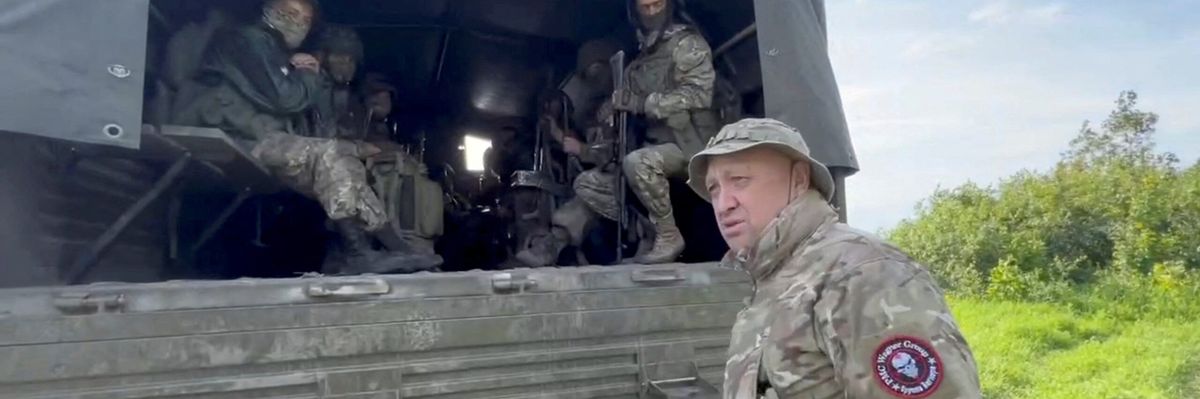
FILE PHOTO: Founder of Wagner private mercenary group Yevgeny Prigozhin speaks with servicemen during withdrawal of his forces from Bakhmut and handing over their positions to regular Russian troops, in the course of Russia-Ukraine conflict in an unidentified location, Russian-controlled Ukraine, in this still image taken from video released June 1, 2023. Press service of "Concord"/Handout via REUTERS ATTENTION EDITORS - THIS IMAGE WAS PROVIDED BY A THIRD PARTY. NO RESALES. NO ARCHIVES. MANDATORY CREDIT./File Photo
google cta
Analysis | Europe
Gaza tent city
Top photo credit: Palestinian Mohammed Abu Halima, 43, sits in front of his tent with his children in a camp for displaced Palestinians in Gaza City, Gaza, on December 11, 2025. Matrix Images / Mohammed Qita

Four major dynamics in Gaza War that will impact 2026

Middle East

Just ahead of the New Year, Israeli Prime Minister Benjamin Netanyahu is set to visit President Donald Trump in Florida today, no doubt with a wish list for 2026. Already there have been reports that he will ask Trump to help attack Iran’s nuclear program, again.

Meanwhile, despite the media narrative, the war in Gaza is not over, and more specifically, it has not ended in a clear victory for Netanyahu’s IDF forces. Nor has the New Year brought solace to the Palestinians — at least 71,000 have been killed since October 2023. But there have been a number of important dynamics and developments in 2025 that will affect not only Netanyahu’s “asks” but the future of security in Israel and the region.

keep readingShow less
Sokoto Nigeria
Top photo credit: Map of Nigeria (Shutterstock/Juan Alejandro Bernal)

Trump's Christmas Day strikes on Nigeria beg question: Why Sokoto?

Africa

For the first time since President Trump publicly excoriated Nigeria’s government for allegedly condoning a Christian genocide, Washington made good on its threat of military action on Christmas Day when U.S. forces conducted airstrikes against two alleged major positions of the Islamic State (IS-Sahel) in northwestern Sokoto state.

According to several sources familiar with the operation, the airstrike involved at least 16 GPS-guided munitions launched from the Navy destroyer, USS Paul Ignatius, stationed in the Gulf of Guinea. Debris from unexpended munition consistent with Tomahawk cruise missile components have been recovered in the village of Jabo, Sokoto state, as well nearly 600 miles away in Offa in Kwara state.

keep readingShow less
What use is a mine ban treaty if signers at war change their minds?
Top image credit: Voodison328 via shutterstock.com

What use is a mine ban treaty if signers at war change their minds?

Global Crises

Earlier this month in Geneva, delegates to the Antipersonnel Mine Ban Treaty’s 22nd Meeting of States Parties confronted the most severe crisis in the convention’s nearly three-decade history. That crisis was driven by an unprecedented convergence of coordinated withdrawals by five European states and Ukraine’s attempt to “suspend” its treaty obligations amid an ongoing armed conflict.

What unfolded was not only a test of the resilience of one of the world’s most successful humanitarian disarmament treaties, but also a critical moment for the broader system of international norms designed to protect civilians during and after war. Against a background of heightened tensions resulting from the war in Ukraine and unusual divisions among the traditional convention champions, the countries involved made decisions that will have long-term implications.

keep readingShow less
google cta
Want more of our stories on Google?
Click here to make us a Preferred Source.

LATEST

QIOSK

Newsletter

Subscribe now to our weekly round-up and don't miss a beat with your favorite RS contributors and reporters, as well as staff analysis, opinion, and news promoting a positive, non-partisan vision of U.S. foreign policy.