
Follow us on social

google cta
Signal-2023-06-07-133150_002

What kind of peace do we seek? At 60, JFK's speech never gets old

On Saturday it will be six decades since the 35th president made a call for not seeing the Soviet enemy as ‘evil.’ We have a lot to learn.

Analysis | Europe
google cta
google cta

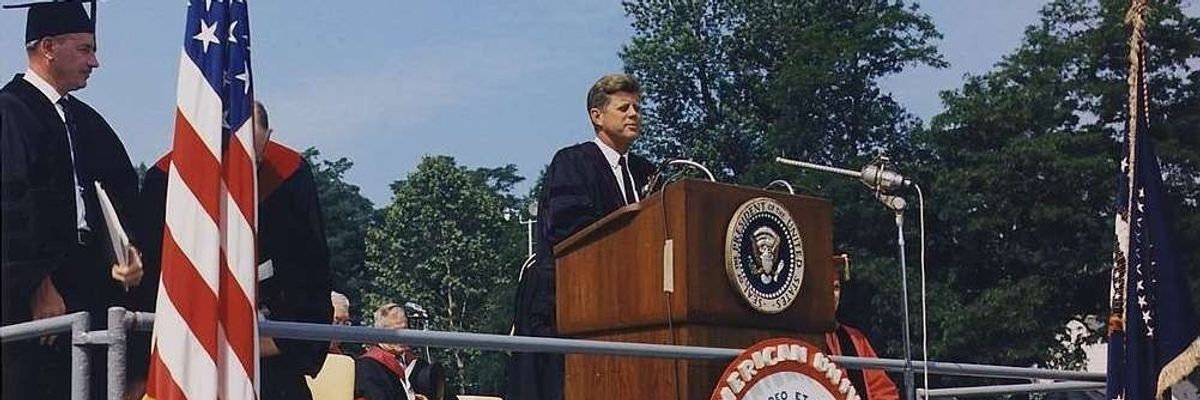
June 10th marks 60 years since American President John F. Kennedy delivered a searing critique of the Cold War and its mindset at a commencement address on the campus of American University in Washington, DC. 

In it, Kennedy expounded upon his vision of what peace might look like in the nuclear age. 

“What kind of peace do we seek?,” he asked.

"Not a Pax Americana enforced on the world by American weapons of war. Not the peace of the grave or the security of the slave. I am talking about genuine peace, the kind of peace that makes life on earth worth living, the kind that enables men and nations to grow and to hope and to build a better life for their children — not merely peace for Americans but peace for all men and women — not merely peace in our time but peace for all time."

For Kennedy, the specter of nuclear war, to which the United States and the U.S.S.R. came within a hair's breadth the previous October during the Cuban Missile Crisis, made the pursuit of peace with the Soviet adversary an imperative. Yet it was one that put the young president at odds, perhaps fatally so, with this own national security-military-intelligence establishment.

But at AU, Kennedy took his case for a sane, rational and above all ethical Cold War policy directly to the American people.

“I speak of peace,” said Kennedy, “as the necessary, rational end of rational men. I realize that the pursuit of peace is not as dramatic as the pursuit of war — and frequently the words of the pursuer fall on deaf ears. But we have no more urgent task.”

And Kennedy had, over the course of his presidency, and to the great consternation of the Pentagon and CIA, found a most unlikely partner in that pursuit, Soviet leader Nikita Khrushchev. Over the course of a series of U.S.-Soviet crises (the Bay of Pigs, the Vienna summit, and the Berlin Crisis) Kennedy and Khrushchev had developed a rapport which helped steer us away from apocalypse during the Cuban Missile Crisis. And in the  aftermath of that crisis, the two began working toward a Nuclear Test Ban Treaty.

Kennedy realized that progress was contingent upon seeing the other as we might wish we to be seen, in other words, upon empathy.

“No government or social system is so evil,” said Kennedy, “that its people must be considered as lacking in virtue.”

"So, let us not be blind to our differences but let us also direct attention to our common interests and to the means by which those differences can be resolved. And if we cannot end now our differences, at least we can help make the world safe for diversity. For, in the final analysis, our most basic common link is that we all inhabit this small planet. We all breathe the same air. We all cherish our children's future. And we are all mortal."

Such a way of thinking about the current Russian adversary is now notably absent in the corridors of power of Joe Biden’s Washington.

Indeed, in our view, Kennedy’s speech now stands as an important indictment of how far in the wrong direction recent Democratic administrations have traveled in the decades since Kennedy’s speech. While we are both on record condemning Putin’s invasion, we are mindful of the administration’s failure to pursue diplomatic avenues to both prevent and end the war. 

Today we stand perilously close to nuclear escalation as the administration ignores the red lines it set and succumbs to assorted hawks by agreeing to send F-16s to Ukraine. One can only hope President Kennedy’s message, delivered six decades ago this Saturday, somehow and in some way is understood by a new generation inside and outside Washington D.C., and has an impact on the course of war — and peace.


Dear RS readers: It has been an extraordinary year and our editing team has been working overtime to make sure that we are covering the current conflicts with quality, fresh analysis that doesn’t cleave to the mainstream orthodoxy or take official Washington and the commentariat at face value. Our staff reporters, experts, and outside writers offer top-notch, independent work, daily. Please consider making a tax-exempt, year-end contribution to Responsible Statecraftso that we can continue this quality coverage — which you will find nowhere else — into 2026. Happy Holidays!

President John F. Kennedy addresses American University Commencement, receives honorary degree, June 10, 1963, Washington DC. (public domain)
google cta
Analysis | Europe
Amanda Sloat
Top photo credit: Amanda Sloat, with Department of State, in 2015. (VOA photo/Wikimedia Commons)

Pranked Biden official exposes lie that Ukraine war was inevitable

Europe

When it comes to the Ukraine war, there have long been two realities. One is propagated by former Biden administration officials in speeches and media interviews, in which Russian President Vladimir Putin’s illegal invasion had nothing to do with NATO’s U.S.-led expansion into the now shattered country, there was nothing that could have been done to prevent what was an inevitable imperialist land-grab, and that negotiations once the war started to try to end the killing were not only impossible, but morally wrong.

Then there is the other, polar opposite reality that occasionally slips through when officials think few people are listening, and which was recently summed up by former Special Assistant to the President and Senior Director for Europe at the National Security Council Amanda Sloat, in an interview with Russian pranksters whom she believed were aides to Ukrainian President Volodymyr Zelensky.

keep readingShow less
US military generals admirals
Top photo credit: Senior military leaders look on as U.S. President Donald Trump (not pictured) speaks at Marine Corps Base Quantico, in Quantico, Virginia September 30, 2025. Andrew Harnik/Pool via REUTERS

Slash military commands & four-stars, but don't do it halfway

Military Industrial Complex

The White House published its 2025 National Security Strategy on December 4. Today there are reports that the Pentagon is determined to develop new combatant commands to replace the bloated unified command plan outlined in current law.

The plan hasn't been made public yet, but according to the Washington Post:

keep readingShow less
The military's dependence on our citizen soldiers is killing them
Top image credit: U.S. Soldiers assigned to Delta Company, 1st Battalion, 133rd Infantry Regiment, 2nd Brigade Combat Team, 34th Infantry Division, Iowa National Guard and Alpha Company, 96th Civil Affairs Battalion, conduct a civil engagement within the U.S. Central Command area of responsibility Oct. 12, 2025 (U.S. Army photo by Sgt. Zachary Ta)

The military's dependence on our citizen soldiers is killing them

Middle East

Two U.S. National Guard soldiers died in an ambush in Syria this past weekend.

Combined with overuse of our military for non-essential missions, ones unnecessary to our core interests, the overreliance of part-time servicemembers continues to have disastrous effects. President Trump, Secretary Hegseth, and Congress have an opportunity to put a stop to the preventable deaths of our citizen soldiers.

In 2004, in Iraq, in a matter of weeks, I lost three close comrades I served with back in the New York National Guard. In the following months more New York soldiers, men I served with, would die.

keep readingShow less
google cta
Want more of our stories on Google?
Click here to make us a Preferred Source.

LATEST

QIOSK

Newsletter

Subscribe now to our weekly round-up and don't miss a beat with your favorite RS contributors and reporters, as well as staff analysis, opinion, and news promoting a positive, non-partisan vision of U.S. foreign policy.