

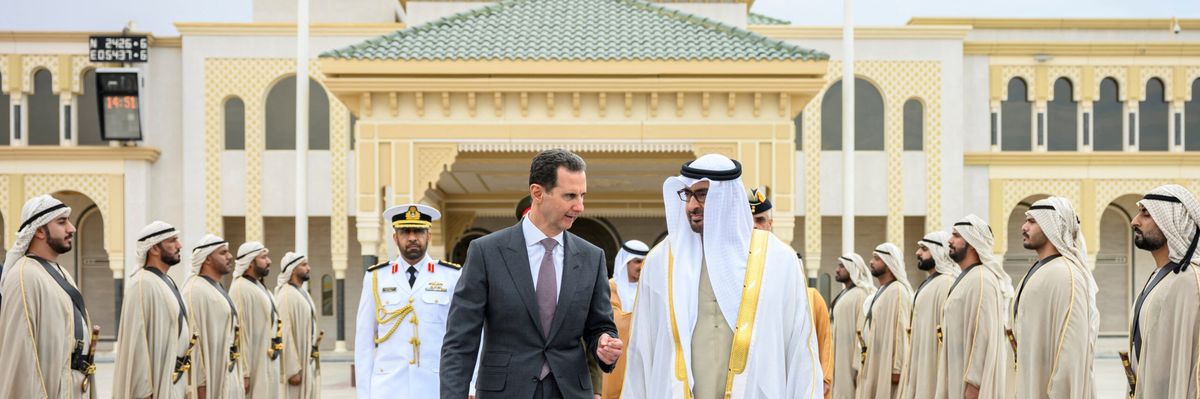
Most Middle East countries are now talking to Syria. Diplomacy and repairing regional relations have become the fashion — and high time. Two decades of war, uprisings, and toppling regimes have ravaged the region. The normalization effort is likely particularly welcome to the 16 million Syrians who have experienced the brutality and corruption of the regime, as well as the horrors of civil war and depredations of al-Qaida and ISIS. Today they face a life of penury and privation. The last thing they need is sanctions and isolation that condemn them to another decade of hopelessness and despair.
Rather than try to stop the Arab and Turkish diplomatic rapprochement with Syria, the U.S. should get on board.
Reasons the U.S. should join its Arab and Turkish allies
By coordinating efforts to gain concessions from Assad, Washington will exert greater leverage. A joint effort is more likely to produce greater concessions from Damascus than a piecemeal one. Now that Saudi Arabia has joined, the Arab effort has momentum. The Saudis have set forward a number of demands: that the Assad regime crack down on the Captagon drug trade, curtail the role of Iran in Syria, and welcome back Syrian refugees by offering greater security. These are all goals that the U.S. itself shares.
Coordination will help Washington regain its role as a leader in regional diplomacy; trying to stop normalization is a losing game. China recently emerged as a diplomatic power by brokering a Saudi-Iran reproachment. Russia is leading the way in peace negotiations between Ankara and Damascus.
Washington should not be left on the sidelines again but rather help tailor the peace between Syria and the Arab states. “If you’re going to engage with the regime, get something for that,” Assistant Secretary of State Barbara Leaf told Arab partners recently. If Washington joins in, it can better hold the parties to account, verify that Damascus’s commitments are met, and advance U.S. interests.
Failure to do so will only undermine America’s regional position, not to mention its position in Syria. None of the countries neighboring Syria want U.S. troops to remain there: not Iraq, not Turkey, and not the Syrian government itself, all of which claim to be preparing to raise the costs of the U.S. occupation. Last month, Iranian-backed Syrians attacked an American base in northeast Syria resulting in seven casualties including one death. U.S. troops retaliated, killing nine Syrians. These tit-for-tat strikes are likely to escalate.
Once it became clear that Assad would survive the civil war, regional powers faced little choice but to reconcile with him. The U.S. and Europe do not face similar pressures; they can continue to insist that U.N. resolution 2254, which calls for free and fair elections, be implemented. Neighboring states don’t have this luxury. Now that they are engaged with Damascus, the West’s policy to isolate the regime is already threadbare.
More important, Syria’s neighbors recognize that the devastating sanctions regime against Damascus hasn’t worked. It hasn’t driven Assad from power or changed his policies. Its major effect has been to hurt the most vulnerable Syrians, precisely those whom the West claims to be defending. Recognizing this failure, Saudi Arabia's foreign minister recently stated that consensus was building in the Arab world that “isolating Syria was not working” and that dialogue with Damascus was needed. Arab governments seized on the recent earthquake to put the bitterness of the civil war behind them and look for ways to help the Syrian people.
What About ISIS?
The U.S. has said that it must remain in Syria to fight ISIS, but the day when the Syrian government can assume responsibility for this task is approaching. Washington should begin preparing for that eventuality. The government has suppressed ISIS cells in its major cities and 60 percent of the country that it controls.
To be sure, ISIS is not defeated and continues to carry out hit-and-run attacks within government-controlled territory, particularly in the desert. But it is also carrying out attacks in the 30 percent of Syria that the U.S. polices. There is every indication that Syria’s military, which is rebuilding its forces, is increasingly effective against ISIS, much as Iraq’s forces are next door. It should be noted that most ISIS leaders killed by America have been tracked down in rebel-held Idlib, which is protected by Turkey, rather than in the government-controlled zone.
Syria’s military is starved for resources in no small part because U.S. forces captured most of Syria’s oil wells and uses the oil to pay for their local client, the Syrian Democratic Forces. By denying the Syrian government its oil, Washington ensures that Syrian security forces cannot fully take the fight to ISIS, which is then used to justify the continued U.S. occupation of the northeast.
ISIS survives in Syria largely because the country is divided into three zones, each ruled by a government at war with the others. This jurisdictional and military chaos favors the terrorist group, which can run between the legs of the three warring and impoverished statelets. So long as the government’s annual budget remains a paltry $3.5 billion — or one fifth its pre-war 2010 level — completely defeating ISIS will be difficult.
Can Arab engagement with Syria reduce Syria’s dependence on Iran?
“Some partner countries believe the best way to get at the Iran-oriented direction of Damascus is to get in there and engage and bring Syria back in a different direction,” Leaf argued. “I’m skeptical that it works that way.” Indeed, there is little doubt that the Assad government will remain wedded to both Iran and Hezbollah for military help. They saved the regime during the civil war.
But money and trade are powerful and can shape national policies.
We need look no further than the relationship between Saudi Arabia and China to see how money and trade can affect policy. Despite its virtually complete dependence on the U.S. for its national security, Riyadh has applied to join the Beijing-led Shanghai Cooperation Organization and is discussing trade in China’s currency. Beijing is the largest consumer of Saudi oil and its biggest trading partner. U.S. officials were stunned by the China-brokered deal between Iran and Saudi Arabia and may well be surprised by the impact that the Gulf states can have in Syria. The investment of even a few billion dollars would have a major impact on Syrians’ quality of life, and some Gulf lobbying of Damascus’s power centers might have an impact no less great than that which it has in Washington. To underline this point, Saudi papers last week reported that Damascus had already moved to crack down on the lucrative Captagon trade as a result of its talks in Saudi Arabia. Doubtless a gesture of goodwill to improve relations with Riyadh, the effect of engagement has been immediate with more far-reaching results pending.
Needless to say, Syrians are also culturally closer to Gulf Arabs than to Iranians. Over a million Syrians work and live in the Gulf. These connections, larded by even modest investments, can make a big difference.
The Kurds
America owes a debt to Syria’s two million Kurds for helping to destroy ISIS. But U.S. forces cannot remain in Syria forever, and when they leave, the quasi-independent state there is unlikely to survive. With no air force or legal standing, it will be overrun by its hostile neighbors. Just last week, a bipartisan coalition in the House forced a vote on bringing U.S. troops home. It may thus be better to foster a deal between Damascus and the Kurds than allow the region to collapse in panic and chaos, as happened in Afghanistan.
And there is a deal to be made between Damascus and the Kurds that promotes both their interests: Kurdish autonomy and Syrian sovereignty. Both see Turkey as their main threat; both need to cooperate in order to exploit the Kurdish region’s riches; both oppose radical Islamists and fear their return. Neither can rebuild alone. The Kurds need protection from Turkey and to sell their produce to Syria, and Damascus needs their water and oil. They have worked together in the past and can do so in the future.
Such a deal would also benefit the United States by depriving Turkey of its biggest complaint against Washington — that, by supporting the SDF, it is supporting Kurdish separatism — and thus restoring confidence between the two NATO allies.
Some policymakers insist that maintaining U.S. control of northeast Syria is useful because it helps Israel and hurts Iran — by impeding Iran from sending weapons to Syria and Hezbollah, and by ensuring that Syria remains a quagmire. But Israel has proven that it is more than capable of defending itself. Its excellent intelligence and frequent air strikes on Syria have been extremely effective at degrading Iran’s and Syria’s military capabilities.
By comparison, American troops in Syria have done little to weaken Iran’s presence or stop arms transfers that are flown into Syria. And, as demonstrated last week, U.S. troops there are vulnerable to attack.
Finally, Washington’s strategy of dividing Syria will only build greater animosity between the Kurds and their fellow Syrians with whom they will inevitably have to reconcile.
***
The normalization efforts between Syria and its neighbors are a positive development that Washington should join. By coordinating efforts with its Arab allies and Turkey, Washington can maximize the leverage it has accrued by its occupation and sanctions regime to gain concessions from Assad, reassert its leadership in regional diplomacy, and reduce Damascus’s dependence on Iran. Continued resistance to the normalization process will only undermine America's influence, set it against its Arab and Turkish allies, increase the risk to its troops, and harm more Syrians than it helps