

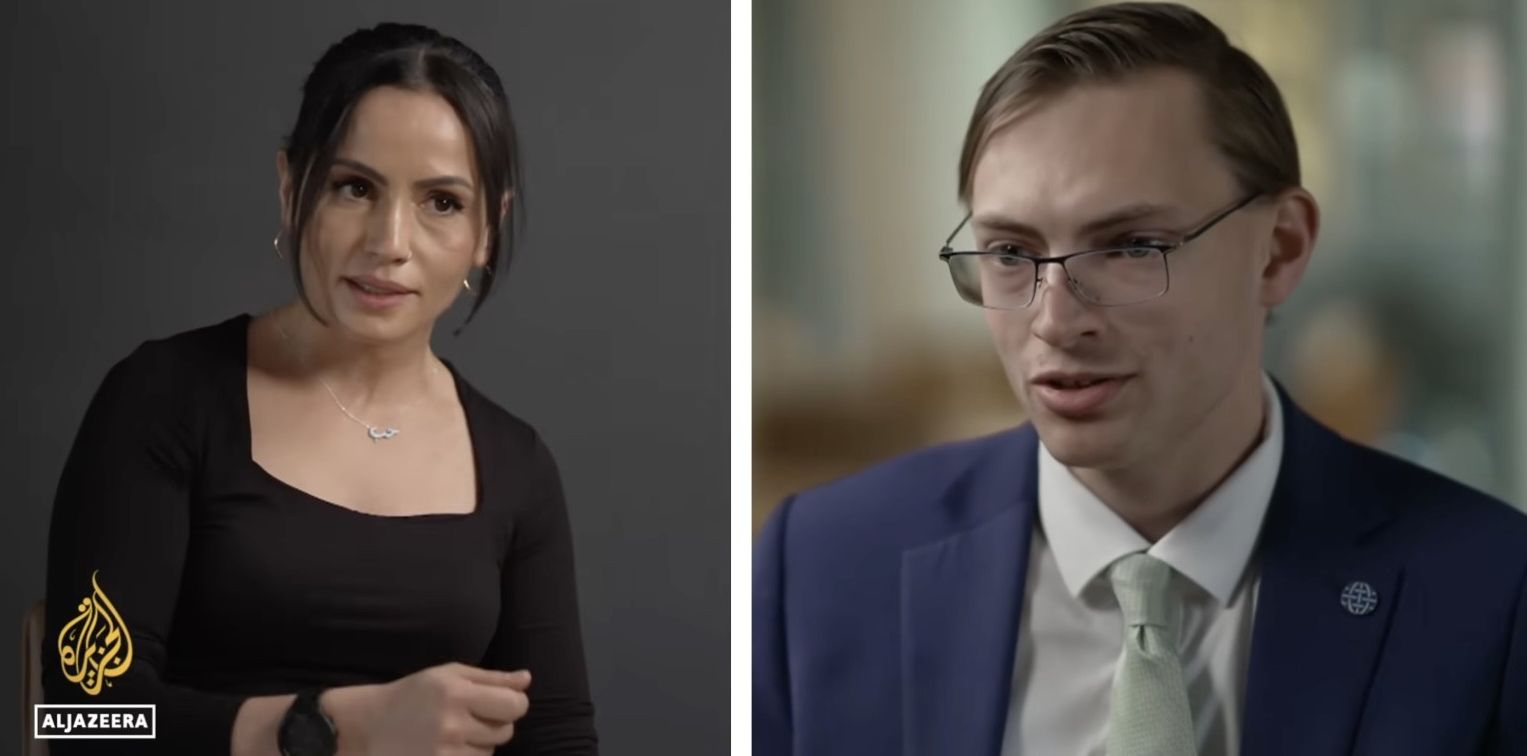
In a new Al Jazeera docuseries called the Business of War, the Atlantic Council’s Mark Massa was left speechless in response to a question from journalist Hind Hassan about the think tank’s funding from weapons manufacturers. Massa, whose think tank accepted at least $10 million from Pentagon contractors in the past five years, paused for a revealing ten full seconds before stumbling through a non-answer.
“There have been some other think tanks and other organizations that have done an analysis of the recommendations that have been given by the Atlantic Council, and they found that it tends to benefit those same weapons companies that are also providing a lot of money towards the Atlantic Council,” Hassan said, adding, “How do you respond to that?”
“Well, all I’ll say is that the Atlantic Council has a very strong intellectual independence policy for our researchers and the work that we, that we produce,” said Massa, who is a deputy director in the Scowcroft Center for Strategy and Security at the Atlantic Council.
Hassan pressed the question.
“How can you unravel from the interests of weapons companies when there’s money coming in from them? I’m just trying to understand what the reasoning is behind that.”
Then, the 10-second-long pause — one second for every million dollars that the Atlantic Council accepted from weapons companies over the past five years.
“I think you’re right that it's something that a lot of people have commented on, the relationship…the relationship between, you know, the interests, we see this, we see this, you know, we see this often,” Massa said, seeming to stammer. “But I would say that, you know, if you’re interested in learning more about the Atlantic Council’s intellectual independence policy, I can connect you with people at my company who can talk to you about that.”
Massa struggled to respond because it is a plainly obvious appearance of a conflict of interest. The top 50 foreign policy think tanks in the U.S. accepted at least $35 million from top Pentagon contractors in the past five years. The Atlantic Council took over $1.2 million from SAAB, $850,000 from General Atomics, and $750,000 from RTX (formerly known as Raytheon). The real figures are likely far higher, because there is no legal requirement for think tanks to disclose their funding sources.
No matter how good a think tank’s intellectual independence policy is, think tank experts are aware of who their donors are. Sure enough, oftentimes those donors include friendly household names such as Lockheed Martin and Northrop Grumman, companies that are less interested in pure academic research than they are in price-gouging the Pentagon and, for example, selling bombs being dropped in Gaza. As the executive director of a prominent DC think tank recently told me, “every donor has intent.”
Maybe what’s most revealing about the interview is that Massa mistakenly refers to the Atlantic Council as a “company” even though it is registered as a 501(c)(3) nonprofit organization. Companies are beholden to shareholders, and those shareholders are looking for a return on investment. Think tanks have investors, too, but the return on investment that weapons companies like Lockheed Martin and Northrop Grumman are looking for is not monetary, at least not immediately. Instead they are hoping for the think tank to produce reports sympathetic to their bottom line, which are in turn cited by inquiring lawmakers and Pentagon officials to justify procuring more F-16s and ICBMs. That is their return on investment.
You don’t have to look that far for evidence of that. Earlier in the same interview, Massa defended the U.S.’s right to use nuclear weapons to respond to cyberattacks, chemical weapons, and bioweapons:
“At the end of the day, if an adversary is inflicting strategic damage on the United States, it might not matter if that’s through large-scale use of nuclear weapons or through other high-consequences strategic attacks. There’s nothing magical about nuclear weapons,” he said.
Northrop Grumman, the prime contractor on the Sentinel ICBM program, has given at least $350,000 to the Atlantic Council since 2019.
Massa, like other fellows at the Atlantic Council, has advocated for more investment in nuclear weapons such as the Sentinel program. He co-published a piece at the Atlantic Council titled, “Don’t cut corners on US nuclear deterrence,” which argued that there is “simply no room to cut the number of ICBMs at this moment” and that investment in the Sentinel program “is necessary but not sufficient to maintain strategic deterrence.” The Sentinel program has sparked controversy due to the program’s soaring cost — recent estimates indicate it could cost up to $160 billion, more than double its initial $77 billion price tag — which goes unmentioned in Massa’s piece.
At the very least, the Atlantic Council is commendably transparent about its funding sources. Over a third of the major foreign policy think tanks do not reveal anything at all about their donors, and some think tanks are trending in the wrong direction. The Center for American Progress, for example, quietly took down its donor list earlier this month, citing concerns about the Trump administration’s “targeting leaders and institutions that have challenged the president’s actions.”
Kudos to Hassan for asking a question that most in Washington are afraid to. Until journalists and policymakers call this what it is — a conflict of interest — weapons contractors will keep getting the best return on investment in town.