

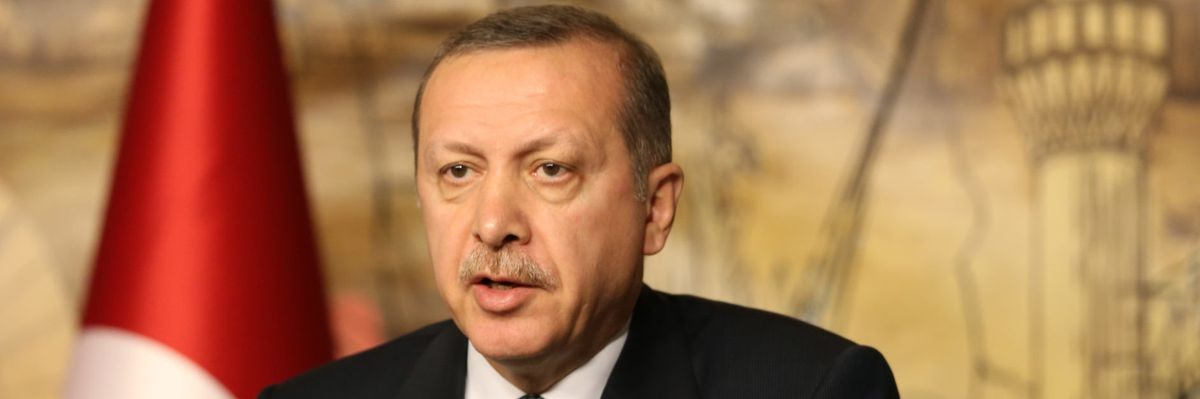
Is Turkey out of control? That seems to be the consensus of so many analyses now circulating in US and some European policy circles.
But the short answer is, no, it is not. Yet it may be understandable why the US, with its own narrow and self-centric obsession with the state of its “global leadership” might well believe it so.
In terms of being able to “control” Turkey, NATO, the EU, and even Russia and China may also be frustrated at their lack of control. Yet this state of affairs reflects a Turkey flexing its muscles as it explores the range of its own new and evolving self-determined identity and self-confidence in a complex part of the world.
The key to understanding is not looking at what we in the West want Turkey to be, but rather how Turkey sees its own place in the world. Today. What then are among the major factors now driving Ankara?
-Turkish Imperial Tradition: The Ottoman Empire over some seven centuries ruled longer over a greater geographical space than any other Muslim empire. The historical memory of Turkish rulers is steeped in thinking in broad geopolitical terms. (See. for example, Öttoman Rising” on Netflix.) It even had influence in India and Indonesia.There was really only a brief interlude of a narrowly defined modern Turkish nation state under the founder of the modern Turkish state, Mustafa Kemal Atatürk. But that kind of Turkish geopolitical thinking is now passé. So is all of this just Neo-Ottomanism? No, it’s much more than that.
-Contemporary Turkish geopolitical vision: President Erdogan’s former Foreign Minister Ahmet Davutoglu can be credited with the grand geopolitical vision at work in Turkey today. It can be summed as as saying that Turkey must be acknowledged as a European power, a Balkan power, a Mediterranean power, a Middle Eastern power, a North African and even limited African power, a Caucasian power, a Central Asian power, a Eurasian power, and especially a Muslim power. There are ample historical justifications for all these ambitious claims. And once this historically rooted vision has been imbibed, it is unlikely to be significantly reversed by any subsequent Turkish leader.
Turkey and Islam: The two great Islamic rivals in the Middle East today are not Iran and Saudi Arabia as pundits would have it, but rather Turkey and Saudi Arabia. Turkey is an overwhelmingly powerful geopolitical rival to Riyadh. It represents moderate mainstream Sunni Islam, with a sympathy for popular Islamic mysticism (Sufism)–qualities loathed by Riyadh. Although Erdogan has moved in increasingly harsh directions against domestic opponents since 2013, the country is still technically a democracy, and Erdogan has lost serious local elections. But the rulers of Saudi Arabia and most Arab state autocrats tremble at the thought of democracy in any form. Indeed, popular democratic Islamism is Riyadh’s createst nightmare. That is why they fear the Muslim Brotherhood, which, among contemporary Islamist movements, accepts democratic institutions, engages in elections, is still relatively moderate, and has not been involved in terrorism anywhere except in Palestine for decades. So the Brotherhood’s designation by many in the region a “terrorist organization” is ludicrous, even though credulous US politicians find it convenient to support this Egyptian-Saudi-Israel-promoted designation. The Saudis and Egyptians fear the Brotherhood’s acceptance and participation in democratic processes (it won an election in Egypt in 2012) until overthrown by a military coup.
Neither the US Pentagon nor the State Department, by the way, consider the Brotherhood to meet the criterion of a “terrorist organization.” Nor does Qatar, which is one reason the Saudis sought to overthrow the Qatari regime. The Gulf monarchs also all hate Qatar-based al-Jazeera satellite TV, which represents the nearest thing to free speech in the Arab world today. Qatar, like Ankara, does not wish to break ties with an important relatively modern and moderate Islamist organization whose future in politics will abide, within the law, for some time in multiple Muslim countries. Qatar, not incidentally, has been a major investor in Turkey and source of financial support, while Turkey has lent Qatar military support.
Muslim World Leadership: Turkey today seeks to carve out a major role for itself as a key, if not the key, Muslim voice in the world. This ambitious goal is not always well received by other rival Muslim states. But here we must ask: Who else can lay such claim as spokesman of Muslim interests? Riyadh? Saudi Arabia is a geopolitical joke whose influence has stemmed only from the power of its petrol purse to promote its intolerant Wahhabi form of Islam among poor Muslim countries, along with its possession of the Muslim Holy Places of Mecca and Madina. Otherwise, brutally put, Saudi Arabia lacks historical depth (except for a brief interlude as the birthplace of the Prophet Muhammad and his first, small Muslim state that quickly shifted north.) It has no serious indigenous culture, no intellectual tradition of depth, no science or technology, no innovation, under the negative influences of frozen clerical minds, a country still administered to a considerable degree by foreign expats, with no diverse economy apart from oil. Its Islamic vision is impoverished under an corrupted and decadent Royal Family whose Wahhabi form of Islam mainly rests on collation of everything that should be considered haram (religiously forbidden) in Islam, as well as promoting narrow exclusionary criteria about which Muslims should not be accepted as legitimate Muslims (takfir.) And it has a morbid fear of anything that smacks of more democratic process.
Egypt some half a century ago played an important geopolitical role in the Middle East but never survived being neutered in the Camp David accords and today is impoverished and visionless under harsh dictatorship. So what other state might command a voice in the Muslim world? Iran in one sense has the historical and cultural depth and diverse, self-contained economy, intellectual power and statehood tradition that will serve it well once ill conceived and crippling sanctions against it are removed. Indonesia could be a significant contender, but only down the road.
In short, there are few rivals to Turkey’s role as self-appointed spokesman for Muslim World interests. Egypt’s dominating pan-Arab leader in the 1960’s Gamal Abdul Nasser was asked why he adopted the pan-Arab cause. “Egypt adopted a role that was clearly in search of an actor,” he replied. In short, he was responding to the spirit of the times for which he had a grasp. The same might be said of Erdogan in Turkey today–a palpable need for some kind of leadership and vision in a Muslim world that seems otherwise largely mired in deep disarray.
That is one reason why Turkey does not consider abandonment of the fate of the Palestinians in the hasty recognition of Israel by Gulf rulers, to legitimately speak for one of the great modern issues of Muslim oppression. Most Muslims would agree.
Turkey and Iran: These two states, apart from Egypt, probably represent the two heavyweight states of the Middle East. Iran’s role has nowhere to go but up. Ankara and Tehran were serious Sunni-Shi’ite rivals several centuries ago, but despite a huge common border they have had no war in over a century. The Islamic republic does defend the rights of oppressed Shi’a in the region, but does not view itself as a “Shi’ite power” as such, but rather as a Muslim power. It has sought good relations with many Sunni groups including the Muslim Brotherhood. It is indeed currently hostile to the West–a situation for which both sides share equal blame and paranoia.
This standoff with the West will not last forever. But Iran, like Turkey, shares in much of the anti-colonial anti-western traditions of the Middle East. Like it or not, these traditions and impulses are still latent Morocco to China, down into Africa and Latin America. Turkey and Iran can be prickly neighbors with each other over a few tactical geopolitical rivalries, but it is unlikely these rivalries will get out of hand. And Iran, even more so than Turkey, is a Eurasian power, hence of great importance to Russia, China and to Beijing’s One Belt One Road ambitions–perhaps the centerpiece of world geopolitics over the next many decades.
Turkey as a European power: Turkey’s membership in NATO gives it a ringside seat in European geopolitical thinking. Ankara’s manipulation of the refugee issue also worries Europe. Turkey has now accepted nearly four million people into the country– nearly 64%of all refugees in the world. Europe has always been reluctant to accept Turkey into the EU–partly due to a cultural bias against Muslims–despite the some seven million Turks living in Germany today. Turkey’s purchase of the S-400 Russian-made anti-aircraft system profoundly upsets NATO. But NATO and the EU are stuck. Turkey is technically part of Europe; NATO is Ankara’s ticket to a seat at a major western strategic table. Turkey will wish to retain that seat. In the end Europe would rather keep a prickly and independent Turkey within European councils than kick it out–where it would lose even further leverage.
-Turkey as a Eurasian power: Turks are ethnically of Asiatic origin, a millennium ago migrating west from the Lake Baikal region. The Turkish language has more in common in terms of linguistic structure with Japanese than it does with Persian or Arabic (although unrelated to Japanese.) Various Turkish tribes migrated west over a thousand years, with the Ottomans finally arriving in Anatolia. But other Turkish peoples still remain spread across Eurasia: Uighurs, Uzbeks, Tatars, Kazakhs, Kyrgyz, Turkmen, Azerbaijanis–the languages relatively close. So Central Asia still figures significantly in Turkish historical memory and seeks closer ties with them.
Russian views: Russia historically feared pan-Turkism as a potentially separatist threat to the multi-ethnic Russian Empire which for centuries embraced all these Turkic peoples (except Uighurs in China.) Russia is still uncomfortable with Turkish ties and interests in Central Asia. But Turkey as a major middle power in the world is too important for Russia to ignore. Indeed, Moscow seeks to do all it can to maintain good ties with Turkey, despite strains. This resembles the European view of Turkey–too important a power to break contacts with, so Moscow reluctantly puts up with it–all the while pleased that Turkey is also a thorn in Europe’s side.
Turkey and China: China’s immensely ambitious One Belt One Road linking states across Eurasia to Europe is the most visionary project of this century, promising to reshape the global order. Turkey wants to be part of that–and Beijing concurs. Turkey can be a possible facilitator to the Chinese presence in Central Asia, but also a potential rival. Here questions of potential Muslim solidarity arise especially involving Muslim sensibilities, such as the Uighur issue. China will be compelled to deal with Islam in Central Asia–Turkey could help. There will be strains and some competition in Turkey’s relationship with China at times, but over the long run it will be durable due to the importance of each country to the other. As is the case with Russia, China and Turkey need each other as the New Silk Road project unfolds.
With all these ambitionsTurkey may be biting off more than it can truly handle, especially as its economy sags. But for the West, with nostalgia for the good old days when Turkey was a “staunch western ally” those days are gone forever. An understanding of the foundation and breadth of these Turkish ambitions is indispensable to managing relations with it in the years ahead as the US itself gradually continues to lose its dominating role over the course of international politics and is forced to acknowledge new regional powers.
This article has been republished with permission from Graham E. Fuller.