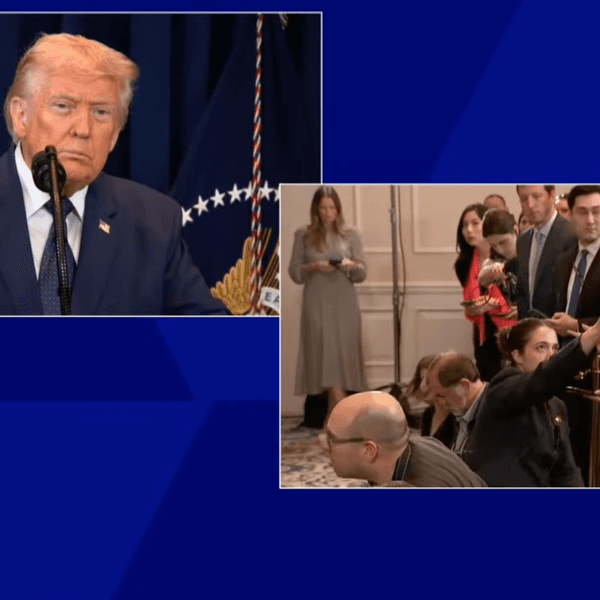
Over the weekend, President Donald Trump threatened to place new punitive tariffs on European allies until they acquiesce to his designs on Greenland, an escalation of his ongoing attempts to acquire the large Arctic island for the United States.
Critics loudly decried the move as devastating for the transatlantic relationship, echoing Denmark’s Prime Minister Mette Fredericksen’s earlier warning that a coercive U.S. seizure of the semi-autonomous Danish territory would mean the end of NATO.
The integrity of the 76-year-old alliance appears in the balance here, but the row over Greenland is a symptom, not the cause. Today, NATO faces a deep and existential challenge: a fundamental divide between the United States and the alliance’s European members over the type and extent of the threat posed by Russia. Ultimately, it is this fracture — and not the outcome of the current territorial dispute — that will be the alliance’s undoing.
The core of this transatlantic rupture is simple. While much of Europe is convinced that a future war with Russia is all but inevitable, some parts of Washington and key power centers in the Trump administration increasingly do not see Russia as a conventional military threat to the United States and do not believe that Moscow harbors imperialist intentions toward the rest of Europe.
Trump’s harsh rhetoric has seriously exacerbated this fracture, placed new strains on NATO, and accelerated the alliance’s weakening. However, transatlantic disagreements over the severity of the “Russia threat” emerged clearly during the Biden administration, most notably in the context of transatlantic debates about how best to support Ukraine.
Seeing the Russian invasion of Ukraine as an existential security concern, European leaders called from 2022 onwards for more U.S. military aid, expanded permissions for Ukrainian use of longer range missiles, and even direct U.S. involvement in the form of no-fly zones or air defense support. While declaring he would give Ukraine “whatever it takes” to win, President Joe Biden still preferred a more cautious and incremental approach, consistent with Washington’s assessment that the Russian attack on Ukraine, though serious, did not pose a threat to core U.S. interests or those of Europe. Regardless of his rhetoric, if Biden and his advisors truly perceived an existential threat to the United States, they would have sent ground forces to fight the war directly.
The Biden team did its best to suppress this intra-alliance divergence in threat perception, seeking to portray a united front, even as large parts of the U.S. national security bureaucracy shifted its focus away from Russia and toward China.
The Trump administration, on the other hand, has made alliance discord over Russia more public.
In February 2025, for example, less than a month into his second term, Trump held his first of many phone calls with Russian President Vladimir Putin where the two men discussed the “great benefit that [the two nations] will…have in working together.” The message was a stark contrast with the stance of European leaders who had little, if any, contact with the Russian president and sought above all to isolate him and his regime.
Under Trump, the transatlantic rift has continued to be most pronounced on the issue of Ukraine. Washington has pushed for a quick peace that forces few concessions on Moscow, believing that Russia poses little long-term threat to the United States or to Europe, no matter the outcome of the ongoing war. Europe, on the other hand, has consistently played the spoiler, fearful that anything less than a “strategic defeat” of Russia will only encourage Russian military aggression, next time with Europe in the crosshairs. Putting aside the question of which view is correct, the divide between the two camps has strained the alliance and worked against peace.
The intra-alliance split over how to respond to Russia is just as pronounced when it comes to Moscow’s hybrid campaign, including incidents of sabotage and drone and aircraft incursions into NATO airspace. European NATO allies have reacted with alarm to increasing Russian provocations. They have invoked NATO’s Article 4 several times and called for stronger responses to what they see as “phase 0” in a coming war between Russia and Europe.
Calls for U.S. and NATO forces to “close the skies” over Ukraine, to shoot down Russian fighter jets that enter NATO airspace, and other similar actions have been rejected by the Trump administration, however, as both too extreme and unnecessary. In fact, Trump’s response to the roughly two dozen drones that entered Polish airspace in September 2025 was little more than a shrug, as he left open the possibility that the incident might have been a mistake.
The Trump administration has signaled its lack of concern about any threat posed by Russia to U.S. and European interests in other ways as well. It has decided to remove the rotational U.S. military presence from Romania, long considered a frontline deployment key for deterring Russian aggression toward Europe. It has also begun to reduce military assistance to states along NATO’s border and to limit its involvement in NATO military exercises. U.S. disengagement from NATO over its different attitude toward Russia has thus already begun.
Rhetorically, the impending U.S. split from NATO seems even more obvious. Trump’s view of the Article 5 commitment is clearly narrower and more conditional than those of his predecessors. During his campaign, Trump famously suggested that he might only send U.S. forces to defend allies that adequately fund their own national defense.
More recently, when asked if he would back up NATO allies who acted against Russian aircraft that entered their airspace, Trump responded frankly: “it depends on the circumstance.” Though a break from past presidents, his aversion to fighting protracted wars (on display in this response) was a reason many Americans supported him in the first place.
If there were still doubts that divergent attitudes toward Russia were pushing NATO to the brink, Trump’s National Security Strategy, released in early December 2025, should put them to rest. For starters, the document did not identify Russia as a major threat to the United States or to Europe and discarded the great power competition framing that has been used in the past to guide U.S. policy toward Russia.
More significantly, the document referred to NATO as if the United States were already not a member, using European Union, Europe, and NATO almost interchangeably at times. Of course, in practice this is far from the reality, as the United States retains institutional control over NATO with an American general as SACEUR. But the strategy made the trajectory in U.S. foreign policy apparent, and that direction seems to be sharply away from NATO.
From this perspective, if Trump’s coercive effort to acquire Greenland does deal NATO a knock-out blow, it would only be the most proximate trigger and evidence of the growing chasm between America and its longtime allies — not the root cause of NATO’s implosion.
Moreover, even if the spat over Greenland is resolved without destroying the alliance, NATO’s future looks cloudy at best. Simply put, it seems improbable that a military alliance can endure when its members fundamentally disagree on the nature and extent of future threats, especially when that disagreement concerns Russia, the alliance’s primary antagonist. What does NATO planning look like, for instance, if much of Europe fears a Russian attack on the Baltics and the United States, the owner of most of NATO’s military assets, does not?
When warned by reporters from The New York Times that he might have to choose between acquiring Greenland and NATO’s longevity, Trump was unbothered, admitting only that “it may be a choice.” In reality, it seems that his decision has largely been made. Trump’s aggressive moves toward Greenland and punishments inflicted on historic allies suggest that his administration may already have accepted and baked NATO’s impending disintegration into its planning and policymaking.
Washington should not be so quick to toss its long-time European allies aside or turn them into enemies. U.S. and European security interests may be diverging, but having a strong partnership with Europe can provide the United States with other benefits, especially in the economic and technological domains. Recentering the transatlantic relationship around these pillars, and not pursuing imperialistic expansion at Europe’s expense, should be the Trump administration’s focus over the next three years.