

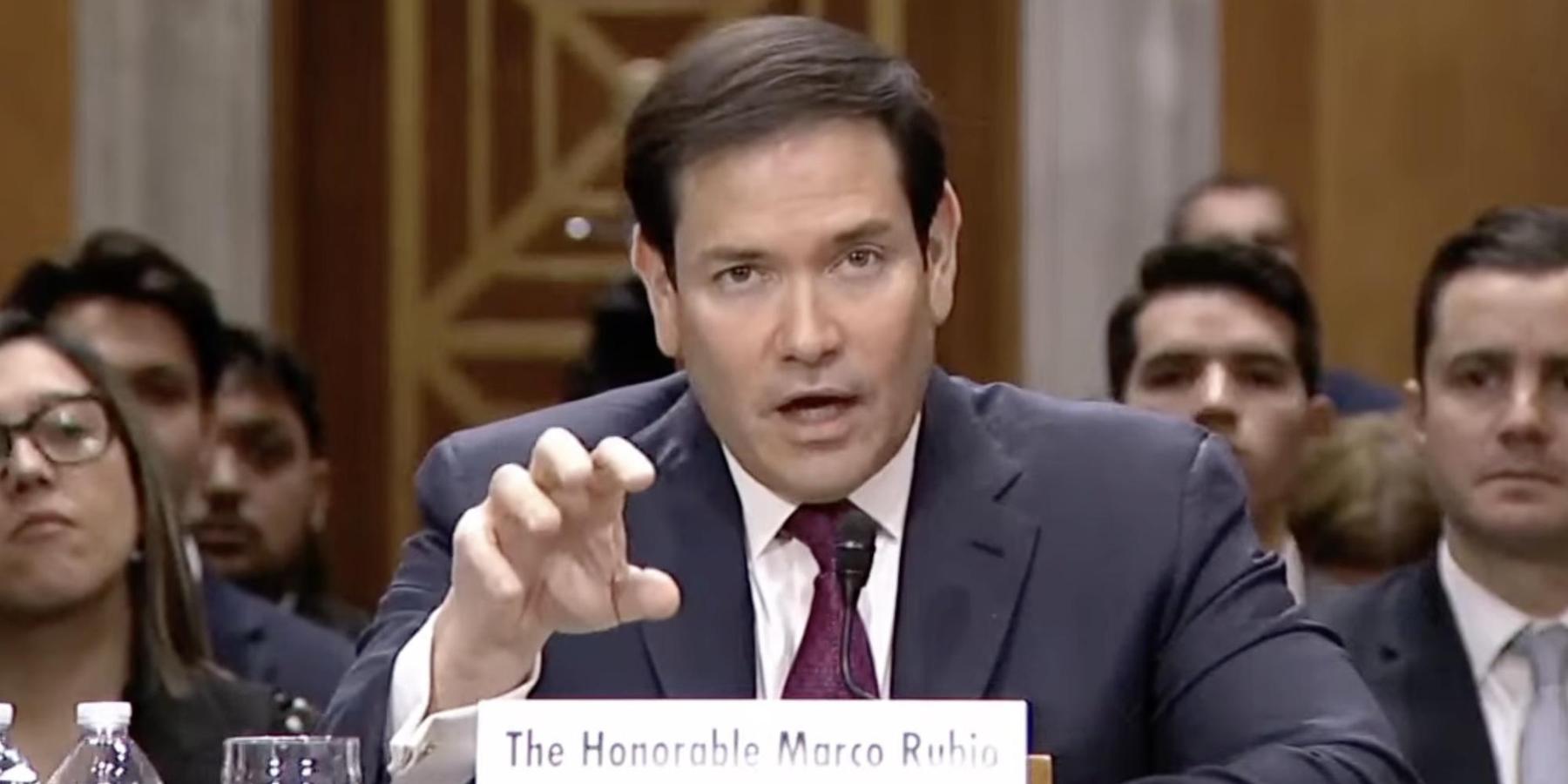
Secretary of State Marco Rubio told the Senate Foreign Relations Committee that he will not rule out further military force against Venezuela.
“The President never rules out his options as commander in chief to protect the national interest of the United States. I can tell you right now with full certainty, we are not postured to, nor do we intend or expect to have to take any military action in Venezuela at any time,” Rubio said.
“That said, if an Iranian drone factory pops up and threatens our forces in the region, the President retains the option to eliminate that,” he said, seemingly asserting Iran — which the U.S. is also increasingly hostile toward — could provoke further U.S. action there.
In prepared remarks to the Senate Foreign Relations Committee, Marco Rubio even asserted that that force could even be used to “ensure maximum cooperation if other methods fail" referring to the the interim leadership that the Trump administration put in charge after apprehending President Nicolas Maduro and taking him back to New York City on narcoterrorism charges.
“It is our hope that this will not prove necessary, but we will never shy away from our duty to the American people and our mission in this hemisphere,” the prepared remarks said.
Rubio reasserted the right to use more force in Venezuela, after Sen. Tammy Duckworth (D-Ill.) pressed him about Trump’s previous comments, that he “was not afraid of boots on the ground” there.
“Every President retains the right to defend the United States against an imminent threat… if there are Iranian drones deployed in Venezuela that could threaten the United States, we most certainly will address that, even if it’s located in Venezuela,” Rubio replied. “We hope we don’t get to that point. We don’t expect to get [there]… but [our adversaries get] a vote on that too.”
Rubio spent much of the rest of the hearing advocating for current U.S. policy in Venezuela. To date, that policy has included repeated strikes on alleged drug boats and a military buildup in the region, and, earlier this month, a military operation that removed Venezuela’s leader, Nicolas Maduro, from power. Now, the U.S.’ stated plans are to “run” Venezuela until a transition of power can take place there. Reuters reported yesterday that Washington has also been working to create a permanent CIA presence in the country.
Venezuela "was [in] an untenable situation [under Maduro], and it had to be addressed,” Rubio said. “And it was addressed,” by the U.S.
“We want to reach a phase of transition where we are left with a friendly, stable, prosperous Venezuela — and democratic, in which all elements of society are represented in free and fair elections,” Rubio said. "We're dealing with people who spent most of their lives living in a gangster paradise…So it's not going to be [a rapid political transition in Venezuela] from one day to the next…But I think we're making good and decent progress.”
Although committee members including Sens. James Risch (R-Idaho) and Rick Scott (R-Fla.), applauded the Trump administration's actions, others challenged them.
“The scope of the project that you are undertaking in Venezuela, is without precedent. You are taking their oil at gunpoint. You are holding and selling that oil, putting…the receipts in an offshore Middle Eastern account,” said Sen. Chris Murphy (D-Conn.). “A lot of us believe that [this project] is destined for failure!”
“If a foreign country bombed our air defense missiles, captured and removed our president and blockaded our country, would that be considered an act of war?” Sen. Rand Paul (R-Ky.) asked Rubio. “Of course it would be an act of war. I'm probably the most anti-war person in the Senate, and I would vote to declare war if someone invaded our country and took our president.”
To Paul’s point, Rubio contended the U.S. operation was in its national interest.
Other senators asserted that Congress must be properly consulted about U.S. policy toward Venezuela, and whether to go to war with it and other countries.
“In order to avoid our men and women in our armed forces, going into harm's way, doubting whether they have the support of the Congress — consultation, hearings and deliberations are required…Our framers entrusted the power of the declaration of war to [Congress], not to the executive,” Senator Chris Coons (D-Del.) charged. “Our democracy depends on consultation with Congress that is truthful and timely, and the confidence of our allies depends on them knowing where we're going next.”
“Today, an armada is steaming towards Iran,” he said, citing the growing U.S. military buildup near it. “Our president is on social media threatening Iran, and I hope I can count on you, Mr. Secretary, to consult with us and inform us before our next actions, whether against Nigeria, Colombia, Cuba, Iran or anywhere else.” (Rubio said that the U.S. does not currently plan to attack Iran, but that the ongoing U.S. military buildup there could defend against “what could be an Iranian threat to our personnel.”)
“Mr. Secretary, [we] don't need to be in another forever war," Sen. Duckworth said. “And that is the pathway that we are going towards…You’re not ruling out a military option.”