

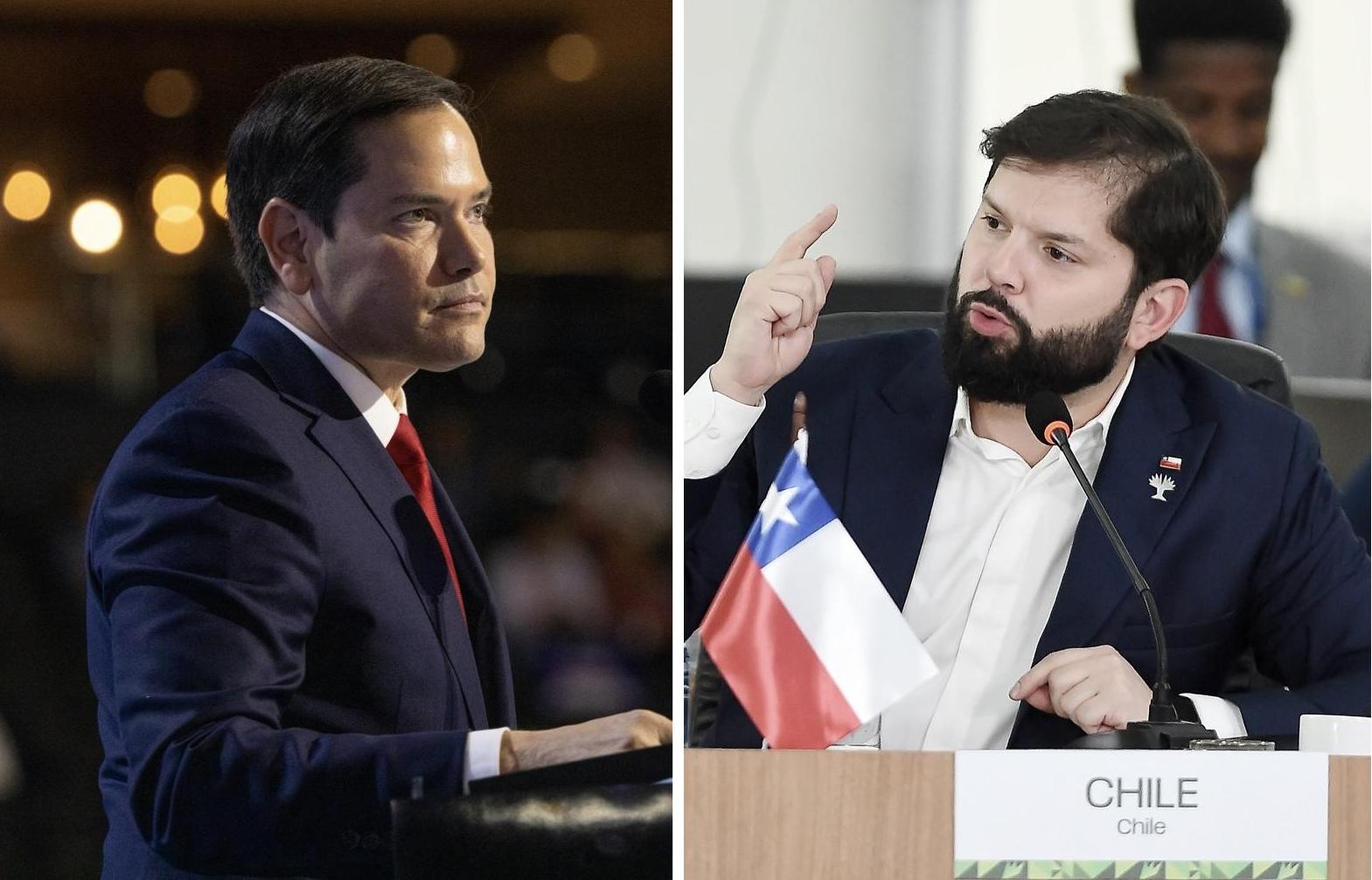
On February 20, the State Department announced it had revoked the visas of Chile’s minister of transport and telecommunications, the deputy minister of telecommunications, and the latter’s chief of staff, for purportedly “endangering regional security.”
The announcement, triggered by the fact that the Chilean government was considering authorizing the installation of a fiber optic submarine internet cable from Valparaiso to Hong Kong, threw U.S.-Chile relations into a tailspin.
The U.S. ambassador to Chile, Brandon Judd, was called to the Chilean foreign ministry to provide an explanation. Secretary of State Marco Rubio’s subsequent comment that the Chilean government headed by President Gabriel Boric has “tarnished” its legacy did not help matters. A few days later during a press conference, Judd charged that there had been “incursions in Chile’s telecommunications systems by malign foreign actors,” which elicited a strong response from the Chilean foreign minister, who objected to both the tone and the substance of the U.S. envoy’s statement.
Just another day of the “Donroe Doctrine” in action?
Canceling U.S. visas for government officials Washington dislikes is nothing new, though it could be argued that the Trump administration has taken this to new heights. What makes this exercise noteworthy are its unique circumstances, and the degree to which the Trump administration keeps pushing the limits of what is acceptable diplomatic behavior.
Extraordinarily, the sanctions imposed on the minister and other officials were not for the application of policies the U.S. objects to, or even for their approval, but for considering such policies in the first place. At the center of the whole affair is a $500 million project submitted to the Chilean government by a Chinese company, China Mobile, to install an 11,000-mile cable from Chile’s main port, Valparaiso, all the way across the Pacific to Hong Kong. Amazingly, this would be the first such cable connecting Asia with South America, although China is the continent’s number one trading partner. In contrast, there are some 30 such cables linking Asia to North America, and some 25 across the North Atlantic.
Presently, all e-communications from South America to Asia must go through the United States, making them both slower and more expensive. And Washington is intent on keeping it so, determined to hold on to its monopoly of such communications out of South America, on the flimsy pretext of the dangers to regional security derived from Chinese cables.
The intricacies of the Chilean bureaucracy are manifold, and there is some dispute about the number of hoops the authorization decree had jumped through by February 20, and how many were pending for it to become official. The paper trail even shows some backtracking on the part of the minister, after his initial approval.
The bottom line, however, is that the executive decree was still very much in the works and not yet official. Under such circumstances, to preemptively penalize an action that is still pending is not just undue interference in the domestic affairs of another nation. Rather, it seems designed to prevent not just policies Washington dislikes, but the mere consideration of them. What is the next step? Sanctioning a Latin American cabinet minister for proposing a particular measure at a cabinet meeting, or for discussing it with the president or his staff?
What makes the whole affair even more paradoxical is that, according to Chilean law, when a foreign company submits an investment proposal for its authorization, the government is obliged to give it proper consideration — if the government does not do so, it becomes exposed to legal action, both in local courts and before international tribunals. In this case, what the United States is objecting to is the very fact that Chilean government is considering such a proposal from a Chinese company — something the Chilean executive is obliged to do so by law — even if no final decision had yet been made.
And these U.S. measures strike at the very heart of a key component of the development strategy of what is arguably the region’s most advanced country and its attempt to make the big jump into becoming a fully developed nation. Chile’s success has largely been based on an open economy; an export-led development model, free trade (it has signed 30 free trade agreements with some 65 countries), and on targeting the Asia-Pacific — 60% of its exports go to Asia and 40% to China. Yet, over the past decade, the country has been hit by the middle-income trap and has found it difficult to regain the high growth rates of the 1990s and early 2000s.
Largely bereft of industry, Chile depends mostly on mining, agriculture and the service sector to keep its economy humming, with tourism enjoying a strong comeback. Exporting services, of course, depends heavily on digital connectivity. Chile itself is highly digitized, with the highest digital penetration in Latin America. It is ranked among the top 10 countries in terms of digital governance and among the top three in terms of average internet speed worldwide. With some first-rate engineering schools and universities, it has the manpower and technical skills this requires.
All of this makes Chile ideal for becoming South America’s digital hub, and China’s digital gateway into the region, with all the attending positive externalities and multiplier effects across the economy.
Thus, far from being a one-off, out-of-the-blue initiative on the part of China Mobile, the very idea of a fiber optic cable across the South Pacific, from Asia to South America, has been long in the making. As far back as January 2016, the Chilean government submitted to its Chinese counterpart a project to install a fiber optic cable from Valparaiso to Shanghai. This led to the signing of a Memorandum of Understanding on the subject, two pre-feasibility studies, and a follow-up by Chile’s new government in 2018.
Yet on a visit to Chile in April 2019, then-Secretary of State Mike Pompeo read Chile’s government the riot act, and the project was canceled.
By drawing a line in the sand, and telling Chile it cannot have a direct digital connection to Asia, the world’s most dynamic and fastest growing part of the world, the Trump administration is attempting to openly assert its dominance not just over countries in the Western Hemisphere like Honduras and Panama, but also over those countries in the Southern Cone where U.S. power has traditionally been exercised less overtly.
Rubio’s gratuitous derogatory comments towards Boric are both ironic and reflective of this contemptuous treatment of the region by the administration. On two of the most significant international issues of our time, the war in Ukraine and the crisis in Venezuela, Boric loyally sided with Washington throughout his four years in office, one of the very few left-wing leaders in Latin America and in the world to do so.
Yet, in the Chilean president’s last days in office, the Trump administration is throwing him under the bus. One is thus reminded of Henry Kissinger’s famous dictum, “it may be dangerous to be America’s enemy, but to be America’s friend is fatal.”
- Why Ecuador went straight to China for relief ›
- Trump shouldn't overplay his hand with Chile's new president ›