

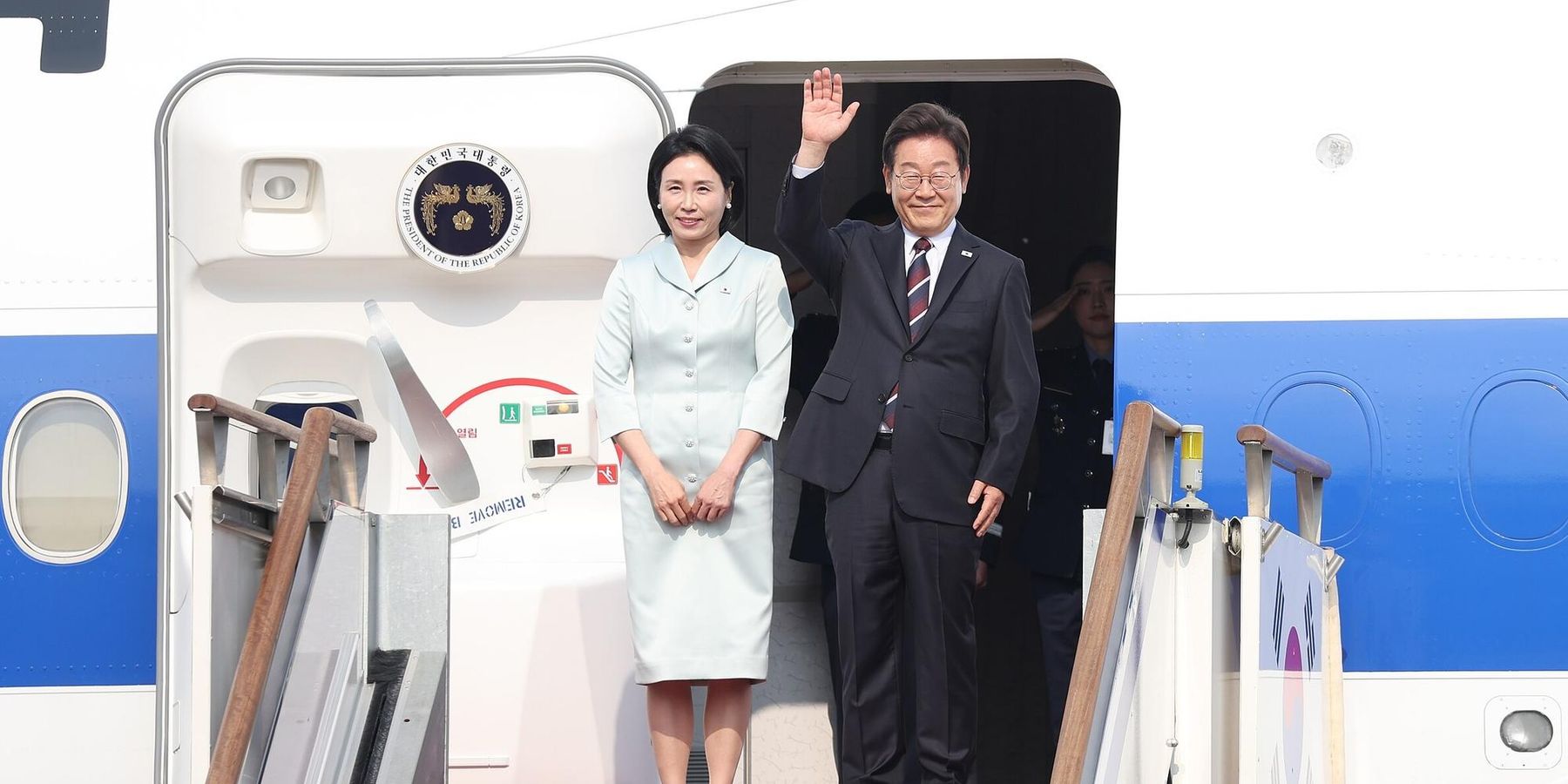
It has been half a year since the Lee Jae-myung administration took office in South Korea.
Domestically, the Republic of Korea (ROK) is still recovering from numerous problems left by former president Yoon Suk-yeol's brief imposition of martial law. However, there are also many diplomatic challenges that need to be addressed. The Lee administration faces arguably the most challenging external environment in years.
The global order is entering an era of great uncertainty as the U.S.–China rivalry intensifies on the one hand and multipolarization emerges on the other. Rather than looking for mutual accommodation with China and adapting to the shift toward multipolarity, the United States has focused on containing China’s rise and preserving strategic dominance in Asia.
The second Trump administration’s newly released National Security Strategy hints at the continuity of this trend, stressing the essential need for the United States to preserve “economic and technological preeminence” and “military overmatch” in Asia to outcompete and deter China.
This strategy of containment and great-power competition against China has required enormous resources and capabilities that the United States alone can hardly afford, as well as geographic proximity to China. The U.S. solution to overcome these structural limitations has been to seek the active participation of regional allies in the strategy.
As the National Security Strategy says, “Our allies must step up and spend — and more importantly do — much more for collective defense. America’s diplomatic efforts should focus on pressing our First Island Chain allies and partners to allow the U.S. military greater access to their ports and other facilities, to spend more on their own defense, and most importantly to invest in capabilities aimed at deterring aggression.” It also says that the United States will press its allies and partners to “use our combined economic power to help safeguard our prime position in the world economy.”
And indeed, South Korea is at the center of these demands. In recent years, South Korea has faced growing U.S. demands to elevate its alliance contributions. Regardless of who is in the White House, South Korea has repeatedly faced U.S. demands, for example, to pay more for the stationing of U.S. Forces Korea (USFK) and invest more resources in the United States to support the reshoring and rebuilding of American industries.
Washington has also continuously pressed South Korea to allow USFK greater “strategic flexibility” to operate outside Korea, thereby broadening USFK’s purpose from deterring North Korea to containing China. The new U.S. National Security Strategy’s strong emphasis on Taiwan and the need to further enhance U.S. military access within the first island chain suggests that Washington’s pressure on Seoul to expand the USFK’s strategic flexibility may well ramp up in the coming years.
South Korea has thus far stepped up its contributions to the alliance, given its security dependence on the United States. Nevertheless, an emerging dilemma for South Korea is that it is increasingly unclear whether the security benefits of the U.S. alliance will continue to outweigh the costs and risks of aligning with U.S. strategies to militarily contain China and exclude it from global supply chains — which could push South Korea to the frontline of great power confrontation, both geographically and strategically.
Surely, Trump’s approach to squeezing allies and partners is aggressive. But the reality is that under both Biden and Trump, South Korea has faced similar pressures to accommodate Washington’s strategies that are not compatible with South Korean national interests.
Ultimately, the United States is becoming a growing risk to South Korea's foreign policy. Going forward, South Korea will need to “de-risk” not only from China but also from the United States, by enhancing strategic autonomy and expanding multilateral cooperation with middle-power countries.
During the previous Yoon Suk-yeol administration, which ended in disgrace after the failure of Yoon’s attempted “self-coup,” South Korea was effectively trapped within a Cold War–like framework under the banners of “value-based alliance” and “strategic clarity.” For Yoon, strengthening ROK–U.S.–Japan military cooperation — a U.S.-brokered initiative aimed against China and North Korea — seemed to define the entirety of diplomacy. While not broken, ROK–China relations were in a state of paralysis.
In contrast, President Lee Jae-myung and his administration recognize the importance of strategic autonomy. Lee declared “pragmatic diplomacy centered on national interests” immediately upon taking office, giving ROK–China relations a chance at rehabilitation. The message was clear: while maintaining a close ROK–U.S. alliance, South Korea cannot pursue an anti-China foreign policy.
China remains South Korea's largest trading partner, and the supply chains for core industries such as semiconductors, batteries, and rare earths are tightly intertwined with China. Deterioration in ROK–China relations directly increases costs and risks for the South Korean economy. The Lee administration seeks to strengthen alliance cooperation on the premise of mutual benefit, while simultaneously managing relations with neighboring countries such as China and Russia.
However, the path to enhancing South Korea’s strategic autonomy is not as easy as it sounds. The United States wants South Korea to clearly distance itself from China, while China hopes South Korea does not become a “proxy” for the United States. The choices Seoul must make between these two great powers are narrowing.
At times like this, what is needed is a redefinition of the alliance. The ROK–U.S. alliance must evolve from a patron–client relationship into an equal partnership centered on mutual benefits and interests. If the United States seeks to treat South Korea as an accessory to its regional strategy, South Korea must secure its own strategic autonomy. For the alliance to become an equal partnership, South Korea must clearly articulate its own interests and be able to say “no” when necessary.
Particularly, as South Korea moves toward assuming the primary responsibility in ROK–U.S. combined deterrence against North Korea, adhering to the U.S. demand that “allies should do more for their own defense,” Seoul should make it clear to Washington that South Korea’s priority remains defending itself from North Korea, and it cannot be part of U.S. war planning against China over Taiwan. Allowing USFK deployments in a Taiwan contingency or committing ROK forces to defending Taiwan, which will exacerbate regional tensions and expose South Korea to threats of attacks from both North Korea and China, should be unacceptable for Seoul.
This is an era of global order restructuring, where even the United States prioritizes its own interests. The turbulence in ROK–U.S. relations should be seen as an opportunity to acknowledge the alliance’s value while critically examining which aspects of the alliance align with South Korea’s national interests and which do not. Going into 2026, the Lee administration's handling of ROK–U.S. relations stands on this testing ground.
In this context, the recent APEC summit held in Gyeongju, South Korea, left important takeaways for Seoul. It was not merely a diplomatic event but a stage testing the possibility of multilateral cooperation to “de-risk” from the zero-sum competition between the United States and China.
Many APEC participants are the so-called “middle powers” that rely on stable cooperation with both Washington and Beijing for their prosperity and share a keen interest in avoiding victimization amid the increasingly zero-sum U.S.-China rivalry. In 2026 and beyond, Seoul should invest significantly more diplomatic energy in bolstering engagement with like-minded middle powers to discuss ways to collectively encourage Washington and Beijing to stabilize their relations, as well as concrete initiatives to promote open and inclusive multilateral cooperation in Asia.
- Mr. President, don't push South Korea into your China-containment strategy ›
- South Korea isn't crazy about US-led anti-China bloc ›
- Paradoxically, 'Donroe Doctrine' could risk US interests | Responsible Statecraft ›
- Trump national security logic: rare earths and fossil fuels | Responsible Statecraft ›