

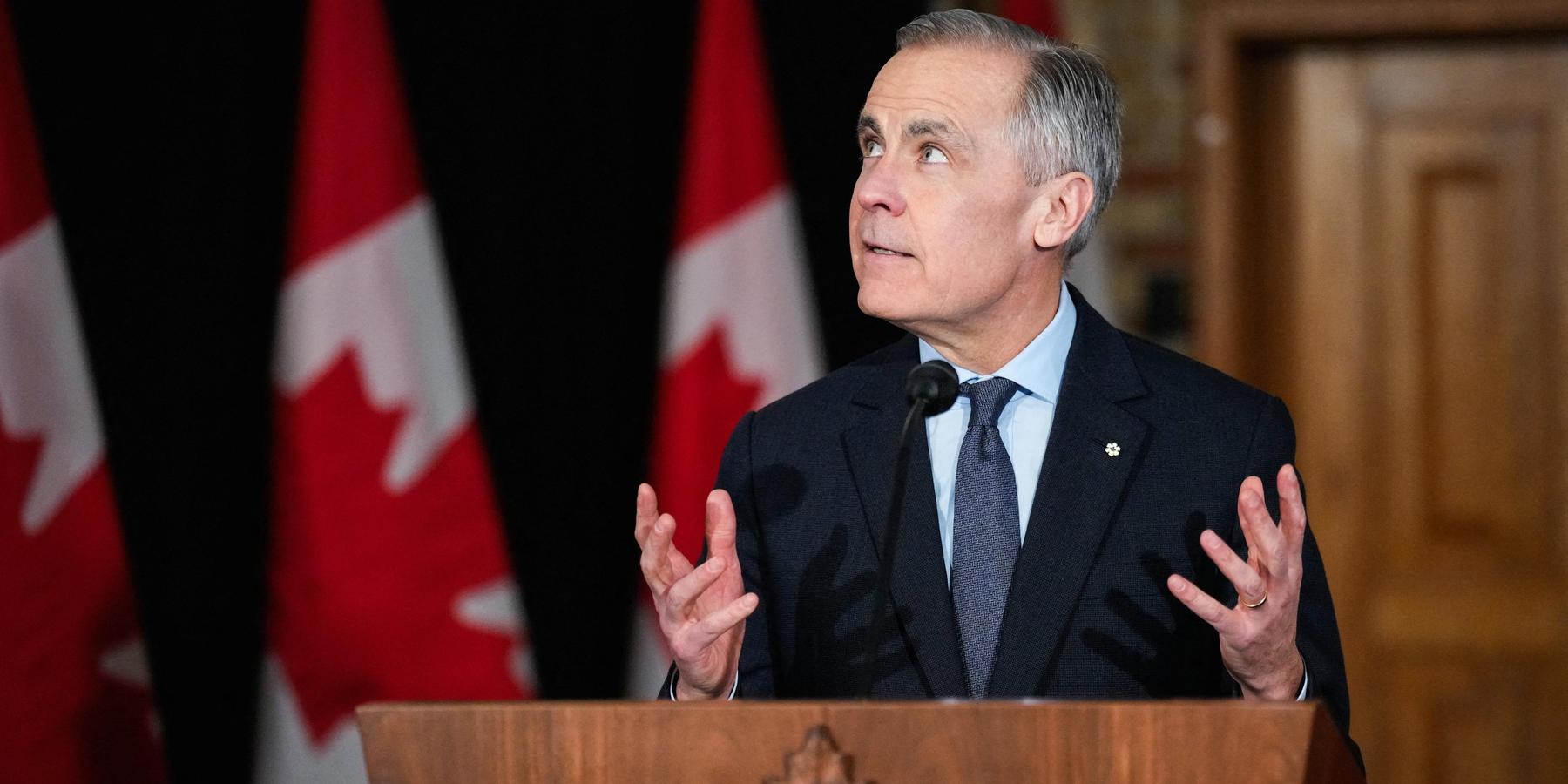
Canadian Prime Minister Mark Carney’s widely praised speech last week in Davos was most notable for its frankness in admitting the hypocrisy behind Western support for a selectively enforced “rules-based international order.” But it also pulled no punches in calling out the coercive measures that great powers — including the United States — are increasingly employing to advance their interests.
Suffice it to say, President Donald Trump did not take this criticism kindly and has since attacked Canada on social media, ridiculously alleging that China is “successfully and completely taking over” the country and threatening 100% tariffs on all Canadian exports to the United States. But the administration should be more careful in how it chooses to exercise its leverage before its threats begin to have diminishing returns.
Carney did not start this fight. With no provocation, Trump began his second term in office threatening to turn Canada into the 51st state. He also imposed ever-shifting tariffs on Canada in violation of the USMCA deal that he himself had negotiated — and that he had previously praised as the “fairest, most balanced, and beneficial trade agreement we have ever signed into law. It’s the best agreement we’ve ever made.” Worse, these were imposed on the wholly spurious charge that Canada was a major source of fentanyl imports, an accusation rejected by U.S. law enforcement agencies.
Canada has stuck its neck out for the United States on numerous occasions. It played the leading role in hiding and rescuing six American diplomats from Iran during the hostage crisis in 1980. Gander, Newfoundland nearly doubled its population when U.S. airspace closed on 9/11, with thousands of Americans being welcomed into Canadian homes. Canadian forces subsequently took on some of the fiercest fighting of the war in Afghanistan in Kandahar.
More recently, in 2018, Canada acceded to the first Trump administration’s request to arrest Huawei CFO Meng Wanzhou, despite the fact that the Canada-U.S. extradition treaty is not meant to cover third-country nationals accused of violating sanctions against a fourth country that only one of the two parties has in place. In retaliation, China kidnapped two Canadian citizens and relations between Ottawa and Beijing descended into a near decade-long deep freeze.
Then, in 2024, Canada imposed 100% tariffs on Chinese electric vehicles, preemptively aligning itself with the incoming American administration ahead of the 2026 USMCA review. Rather than welcome these moves, the Trump administration clearly interpreted them as a sign of weakness and responded by ratcheting up its rhetorical and economic pressure against Canada.
Trump likely views his bellicosity as a form of leverage, which may also explain why his administration has taken several meetings with Alberta separatists, as reported this week by the Financial Times. But effective leverage must combine costs with incentives and coercion with consent.
After Trump’s moves encouraged Carney’s government to take the modest step of resolving its tariff dispute with China, many were unwilling to take his threat to impose an across-the-board 100% tariff on Canada seriously. After all, Trump has repeatedly claimed that the U.S. doesn’t “need anything from Canada” and had initially welcomed Carney’s deal with Beijing.
More concerning for Canadians, however, is the fact that Trump is not alone in expressing these views.
Mirroring Vice President JD Vance’s now-infamous comments to Ukrainian President Volodymyr Zelensky in the Oval Office, Commerce Secretary Howard Lutnick and Treasury Secretary Scott Bessent have both suggested that Canada should simply “say thank you” rather than defend its interests and sovereignty. The online right-wing ecosystem has also pompously pushed the erroneous claim that Carney backed down from signing a free trade deal with China after Trump issued his tariff threats, when no such deal was in the works.
All this encourages Canadians to conclude that the problem will not disappear when Trump leaves office. While much of this may be political posturing ahead of the USMCA review, American leverage has been flaunted and overused rather than discreetly employed. This will invariably encourage Canada to diversify its trade partners — and Canadians to reevaluate the extent to which they see Americans as trustworthy.
The Trump administration may be able to use Europe’s security dependence on the United States as leverage in talks over Ukraine. But Canada’s leverage differs from that of its transatlantic allies: Washington will always view the defense of North America as a core national interest, and the economic and energy relationship between Canada and the United States is integrated to the point where weaponizing it would bring considerable costs for both sides.
If the administration is intent on using the USMCA review to hurt its neighbor rather than pursue joint gains, this will cause permanent damage to the Canada-U.S. bilateral relationship. In the long run, a Canada that is forced to pursue a more autonomous diplomacy and build up more independent sources of national power may be a more useful asset to the United States and might contribute more to continental security. But if even America’s best friend is forced to think twice before partnering with the U.S., then one can hardly characterize Trump’s approach as a form of 3D chess.