

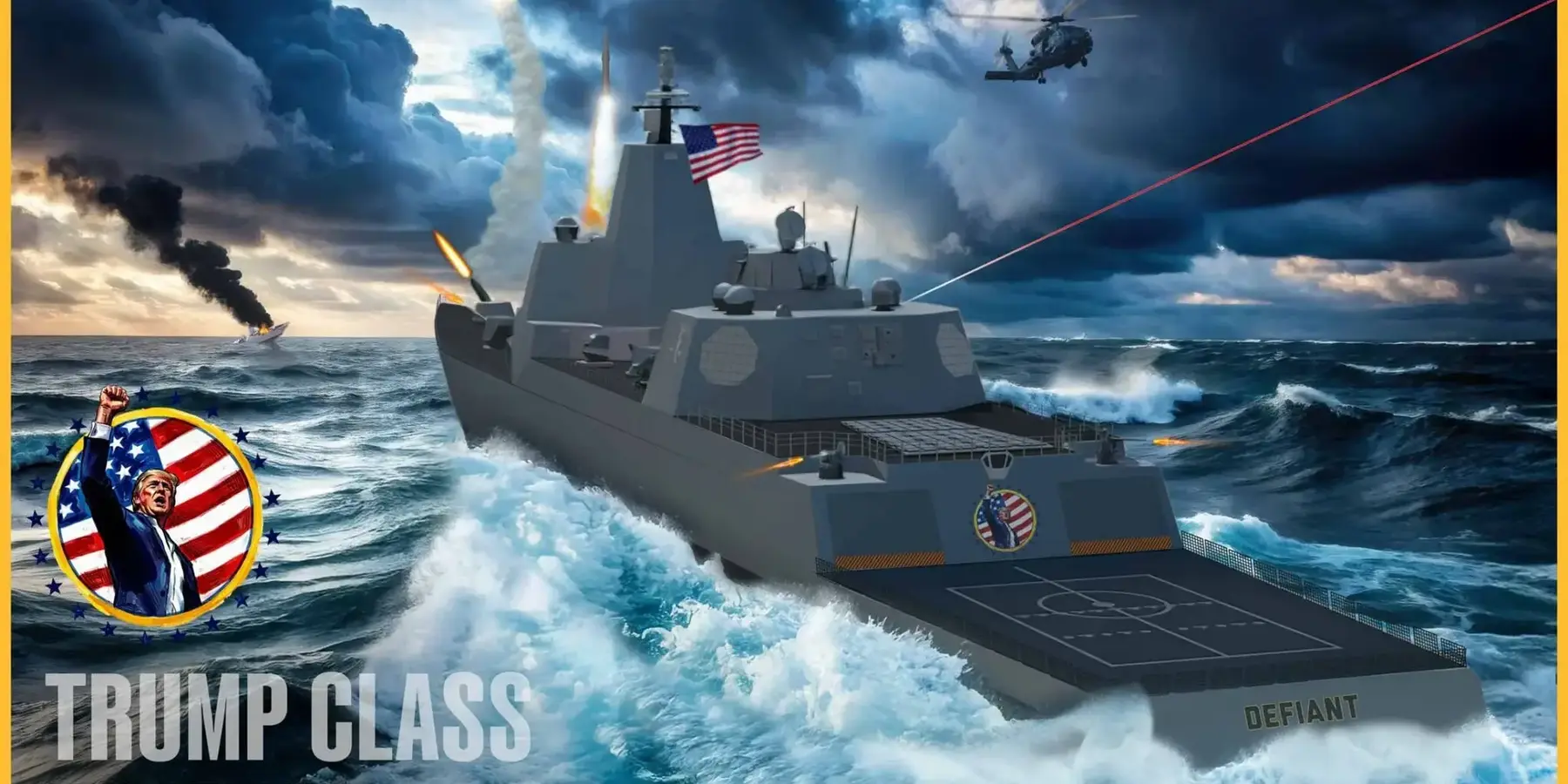
President Trump announced on December 22 that the Navy would build a new Trump-class of “battleships.” The new ships will dwarf existing surface combatant ships. The first of these planned ships, the expected USS Defiant, would be more than three times the size of an existing Arleigh Burke-class destroyer.
Predictably, a major selling point for the new ships is that they will be packed full of all the latest technology. These massive new battleships will be armed with the most sophisticated guns and missiles, to include hypersonics and eventually nuclear-tipped cruise missiles. The ships will also be festooned with lasers and will incorporate the latest AI technology.
If you think you have heard this story before, you would be right. This will be the fourth time this century that the national security establishment has attempted to build a new surface combatant ship for the Navy. For those of you who may not be keeping score, the previous three attempts have been horrendous failures.
Just to refresh everyone’s memory, the Navy already attempted to build a modern version of the battleship in the early 2000’s. That was the Zumwalt-class destroyer program. Navy leaders wanted to build 32 such ships that would be armed with a futuristic gun system to support Marine amphibious assaults. The gun could never be built in a cost effective way so it was cancelled. That left the ship without a clear mission and the entire program was stopped after only three ships had been built. Each of those ships still don’t have a clear mission and now exist as $8 billion anchors around the Navy’s neck.
Less than a month before the president announced this latest shipbuilding program, the Secretary of the Navy cancelled the Constellation-class frigate program after Navy leaders sunk nearly $9 billion into it and before a single hull had been commissioned. That announcement was shocking because the Constellation frigates were intended to be a low risk replacement for the earlier, failed Littoral Combat Ship program.
The Littoral Combat Ships were supposed to be the Navy’s workhorse ships that would hunt mines and submarines, fight other surface ships, and provide security for the rest of the fleet. They were originally to employ a complicated modular design that would see each ship have mission systems swapped out in port to give them the specialized capabilities for their next deployment. The scheme failed spectacularly when modules didn’t work and cost soared. The ships also proved to be quite fractious and suffered several embarrassing mechanical breakdowns. Several Littoral Combat Ships had to be rescued at sea and towed back to port.
The Littoral Combat Ship program was expected to help the Navy increase the size of the fleet because each ship was supposed to cost a mere $220 million when the program began in 2002. By the time Navy officials gave up on the program 15 years later, the cost of each hull had grown to over $600 million.
Over the course of three major shipbuilding failures, a reasonable person would expect that those involved in the process would have learned some lessons. The first lesson that should have been learned and properly applied this time around is that the desire to build the most futuristic ship imaginable is a fool’s errand.
The Zumwalt, Littoral Combat Ship, and the Constellation-class programs all failed because the designers got too cute. Rather than building rugged ships that are stripped down to the bare essentials, they continue to create fanciful designs chock-a-block full of every conceivable gadget.
There is an uncomfortable truth the leaders of the national security establishment need to learn. That is: every gadget you add to one of these systems is one more thing that can break. When designers lack discipline, as they obviously did while sketching out this latest future boondoggle, a simple mathematical truth asserts itself. Engineers will struggle just to get all of these components to work individually.
Then there will be a terrible system integration challenge to get all of these finicky components to work together. Even if those two challenges can be overcome, the poor crews of these ships will struggle mightily to keep all of these gadgets functional while at sea. The sheer number of problems will constantly threaten the crew’s capacity to stay one step ahead of the maintenance monster the designers are now creating for them.
I take no pleasure in predicting another shipbuilding disaster. My own son is a sailor in the U.S. Navy. He and his shipmates need effective equipment to do their jobs. When politicians in Washington implement policies that place political and economic interests above military effectiveness, acquisition disasters become inevitable.
You can take this one to the bank. The Navy will spend tens of billions of dollars over the course of the next decade on the Trump-class program. At best, the Navy will receive three troublesome ships that will cost more than $10 billion each before then entire scheme is abandoned. Of course, the people who are making these decisions today will have long since passed from the scene by the time that happens and so will not have to face the consequences of their actions. It will be my son and those who come after him who will have to do that.
- The US Navy just lit another $9 billion on fire ›
- Why US shipbuilding is the worst and more money won't save it ›