South Africa is struggling to unfurl its wings as a leading middle power and advance its relations with its fellow BRICS members while keeping out of the cross hairs of the U.S. president. This has been particularly hard considering that one member of the Global South grouping — Iran — is on Donald Trump’s current list of potential military targets.
South Africa joined BRICS in 2006. The organization is supposed to serve as an intergovernmental forum for member countries to connect on issues related to diplomacy, security, and economics. But the bloc has angered President Trump, who sees it as a threat to American leadership, particularly given China’s membership in the group.
Already frosty relations between Pretoria and Washington only got worse in the new year as South Africa found itself hosting Iran in long-planned naval exercises off its coast at the same time Trump was considering bombing Iran over its crackdown on protesters in January. From January 9 through 16, South Africa opened its waters to a number of BRICS countries to participate in these drills — christened Will for Peace 2026 — led by the Chinese. South Africa, Russia, the United Arab Emirates, Iran, and China were full participants, while Brazil, Egypt, Indonesia, and Ethiopia joined as observers.
What further complicates the discord is that South African President Cyril Ramaphosa reportedly never intended for Iran to join as a full participant. According to the New York Times, Ramaphosa ordered the country’s defense officials to limit Iran’s status in the drills to only being an observer. Despite these orders, Iran ended up fully engaging throughout the exercises, including the live fire portions. Ramaphosa responded by creating a Board of Inquiry to investigate the matter.
With BRICS’s membership recently growing — Iran and five others joined the group at the start of 2024 — these kinds of geopolitical miscues are more likely to happen, and when they do they’re guaranteed to agitate Washington.
In fact, this is the second incident within the past several months involving a purported miscommunication related to South Africa’s military relationship with Iran. In August 2025, South African General Rudzani Maphwanya reportedly visited Iran and pledged military and political support to the Iranians, which President Ramaphosa apparently didn’t approve either, calling the trip “ill-advised.” In response, the Democratic Alliance party — which is a part of the coalition government — called on General Maphwanya to be “court-martialled.”
Following the incident last month, the American embassy released a statement on X, saying that “Iran is a destabilizing actor and state sponsor of terror, and its inclusion in joint exercises — in any capacity — undermines maritime security and regional stability.”
The American embassy’s statement went on to say, “it is particularly unconscionable that South Africa welcomed Iranian security forces as they were shooting, jailing, and torturing Iranian citizens engaging in peaceful political activity South Africans fought so hard to gain for themselves. South Africa can’t lecture the world on ‘justice’ while cozying up to Iran.”
The State Department declined to provide Responsible Statecraft with a comment for this story.
The recent challenge in relations between the U.S. and South Africa follows a longer trend over the decades in which the governments of both countries have disagreed about a number of policy issues.
In an email to Responsible Statecraft, Ziyanda Stuurman, an advisor at the Africa Practice, said that “many of South Africa's politicians remember Ronald Reagan's policy of ‘constructive engagement’ with the Apartheid regime in the late 1980s as clearly as they remember grassroots pressure against and condemnation of the regime,” she said, adding that this is not the first time leaders from both countries have not seen eye to eye.
“In democratic post-Apartheid South Africa, several ANC-affiliated presidents have clashed with U.S. presidents from both sides of the aisle: Nelson Mandela heavily criticised the U.S.' involvement in Iraq in 2003; Thabo Mbeki and George W. Bush clashed several times between 2001 and 2008 over South Africa's response to the HIV/AIDS epidemic and Robert Mugabe's governance of Zimbabwe; and during his two terms in office, (South African President) Jacob Zuma was decidedly more interested in deepening ties with Russia and China between 2009 and 2018 and less so with Barack Obama and the White House.”
But Trump’s moves toward punishing South Africa seems to signal a particularly dark time for relations. In late November, the United States boycotted the South African-hosted G20 leaders’ summit following an explosion of tensions last year in which Trump accused the South African government — without any evidence — of failing to stop a genocide against the country’s white population.
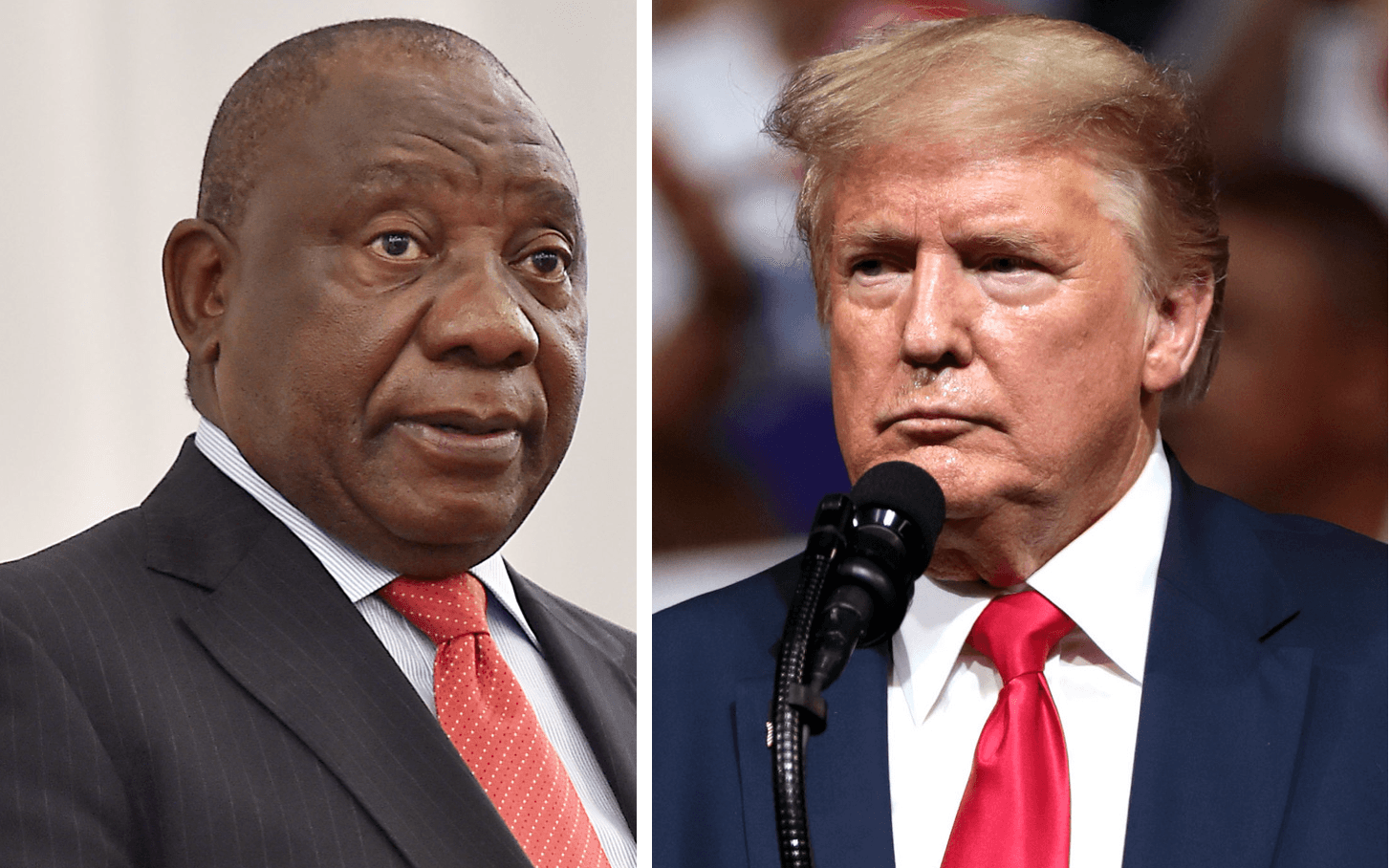
As part of that scuffle, Ramaphosa and Trump faced off in a dramatic incident at the Oval Office, where the two argued in front of the press about the South African government's role in violence against white South Africans. Trump has also disinvited South Africa from next year’s G20 summit, which will be hosted by the United States in south Florida, and has placed tariffs of 30% on the country.
South Africa’s role as a leading member of BRICS has particularly angered Trump, who sees the institution as an attempt by member countries to challenge American power and influence — particularly Russia, China, and, of course, Iran.
Stuurman says that “military and security cooperation between South Africa and its BRICS partners — all of them — is not unexpected or new. What is new is the optics, timing and geopolitical stakes of these exercises, which the South African National Defense Force (SANDF) chiefs have shown little to no appreciation of in recent years.”
Despite Trump’s best efforts, Washington’s ability to punish Pretoria has dissipated in recent years as South Africa has expanded global partnerships, both in terms of security and economics. In 2023, South Africa exported 7.5% of its goods to the United States, while exporting 11.3% to China. And that same year, a stunning 20.5% of its imports came from China, compared to 8.6% from the United States. Compare that to the year 2000, when South Africa exported 9.2% of its goods to the U.S. and only 1.3% to China, while importing 11.9% from the U.S. and just 3.7% from China.
With an increasingly diversified partnership base, South Africa will be unlikely to fold to Trump’s demands. If anything, it will likely make the country more prone to seeking alternatives in the face of an unreliable American partner. For South Africa, the key is to mend relations with Washington without sacrificing its role as a leading, and vocal, Global South middle power, forming connections with a number of countries that happen to be in Washington’s crosshairs.
 Screengrab via niacouncil.org
 Screengrab via niacouncil.org