

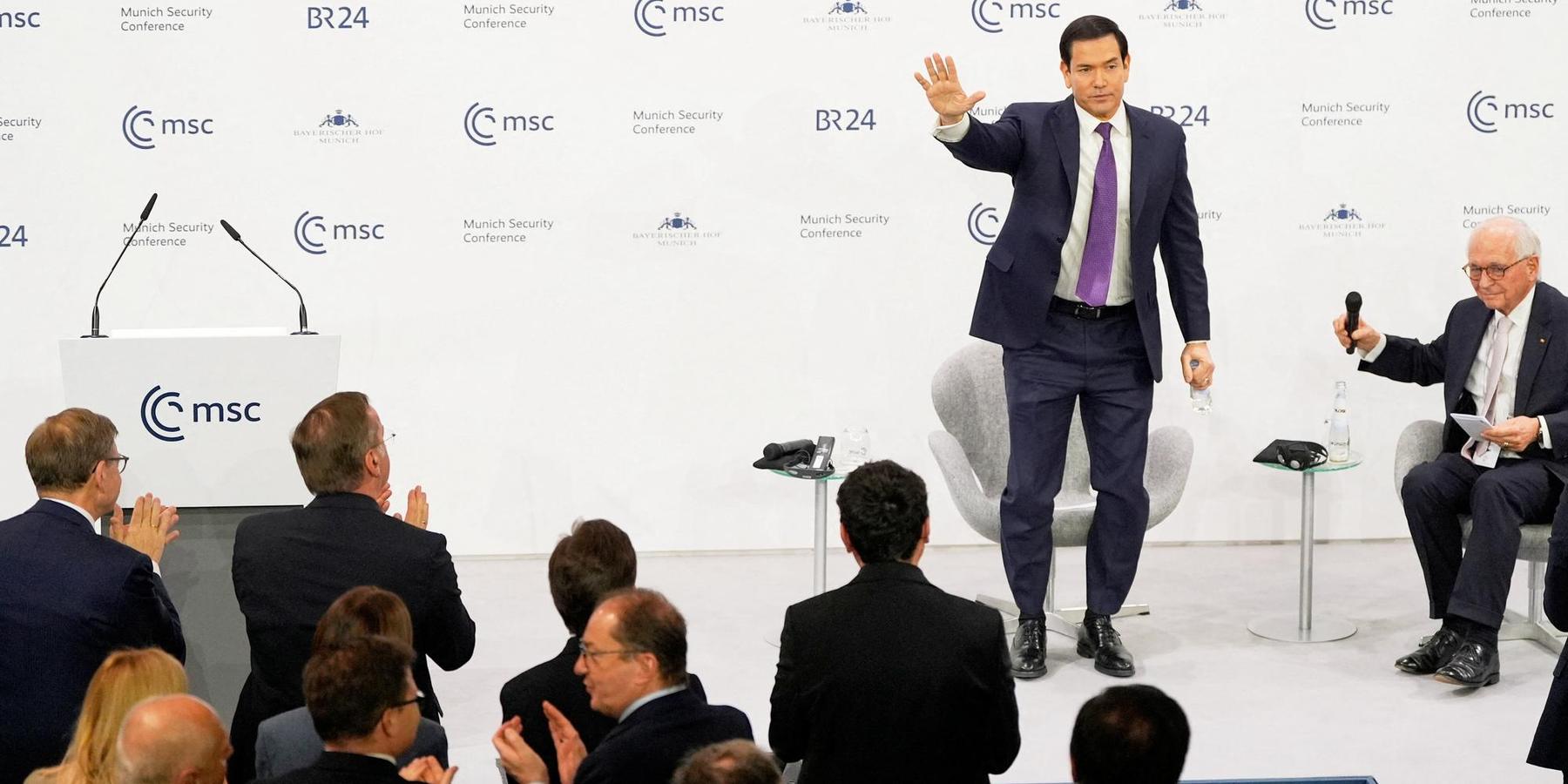
U.S. Secretary of State Marco Rubio arrived in the Munich Security Conference this weekend to sooth transatlantic anxieties. After Vice President J.D. Vance's criticisms of the old continent in 2025, the European dignitaries were looking for a more conventional American performance.
What they got was a peculiar mix of primacist nostalgia and civilizational foreboding, with an explicit desire to forge a path of restoration together.
"We are not looking for a rupture," the Secretary of State told his audience. "We want to revitalize an old friendship and renew the greatest civilization in human history," in a reference to the West.
Predictably, Rubio – a neoconservative favorite in a pre-Trump GOP – ensured that it was America’s job to lead. “The United States of America will once again take on the task of renewal and restoration, driven by a vision of a future as proud as it is sovereign, and as vital as our civilization’s past. And while we are prepared, if necessary, to do this alone, it is our preference — and it is our hope — to do it together with you, our friends in Europe.”
While the emphasis on common roots may have appealed to transatlantic elites, the secretary's rhetoric of civilizational renewal carries within it an implicit judgment: that Europe is on the trajectory of losing its essential character. His warnings about "mass migration that threatens the cohesion of our societies, the continuity of our culture, and the future of our people," drew a bright line under the administration’s earlier criticisms of "civilizational erasure" that European leaders, particularly on the right, are currently deploying in domestic debates.
Moving beyond these generalities, Rubio’s speech echoed the particular worldview of the Trump administration: he denounced the “climate cult” that hinders competitiveness, exhorted the Europeans to spend more on defense, and drew attention to the ineffectiveness of international organizations like the United Nations while extolling “American leadership” in attacking “narco-cartels” (in Venezuela) and “radical Shiite theocrats” in Iran.
None of that is particularly new: some, if not most, of these points were delivered by Vice President J.D.Vance last year and are reflected in the section on Europe in the new U.S. National Security Strategy. It was Rubio’s delivery, evoking Mary Poppins when she sang “a spoonful of sugar helps the medicine go down," that made the difference. This was largely a matter of tone and style, which spurred bouts of applause and laughter throughout the remarks, and a short standing ovation at the end.
On substance, what Rubio did not say was far more revealing than what he did, particularly concerning the war in Ukraine – defined by the European consensus as the existential security concern. He only mentioned Ukraine once during his speech — and that was to emphasize American leadership in getting Russia and Ukraine to the negotiating table.
There was no familiar “support Ukraine as long as it takes” rhetoric, no “democracy versus autocracy” framing. Some European hawks, like The Economist’s Shasank Joshi, have grown increasingly worried that the U.S. “no longer seems to see Russia as adversary or threat” – a view widely shared in the hawkish transatlantic establishment and the one Rubio’s speech certainly did nothing to dispel today.
Even more telling than what Rubio said, however, was what he did.
The night before his speech, he canceled a scheduled meeting with European leaders on Ukraine. The official explanation was a scheduling conflict. European officials interviewed by the Financial Times offered a blunter assessment: the move signaled that Washington is "losing interest in close cooperation with its allies to end the war." One called it "madness." Another noted that the meeting was meaningless without U.S. participation.
Actions, in this case, spoke louder than even the most soothing words. While Rubio’s conciliatory tone may soften the edges of the transatlantic friction, the inescapable reality is that President Donald Trump’s wish to end the war in Europe sharply conflicts with the preferences of key European leaders and Ukraine’s president Volodymyr Zelensky.
Trump continues to press Zelensky for territorial concessions, namely, a Ukrainian withdrawal from Donbass as a precondition for any negotiated settlement. He recently urged him to “move,” noted that “Russia wants to make a deal,” and warned him that “otherwise he’ll miss a great opportunity.”
This logic does not seem to be shared by Zelensky himself who seems to believe that his battleground situation is not desperate enough to make territorial concessions to Russia. This is a view reportedly not shared by some of his key advisers, and certainty nor by the overwhelming majority of the Ukrainian people who favor a negotiated end to the war — not out of trust for Russia, but because the alternative is the further destruction of Ukraine.
As to the European leaders, while the French President Emmanuel Macron is reaching out to Moscow for talks, the German Chancellor Friedrich Merz finds this outreach premature, preferring to doubling down on the same strategy (military aid to Ukraine, sanctions, no direct talks with Moscow) that has the war grinding on for four years, with neither Russian military defeat nor economic collapse anywhere in sight.
Munich Security Conference President Wolfgang Ischinger openly said what many European leaders imply: as long as the war in Ukraine is fought, Europe is safe. That is decidedly not the view of the Trump administration which, for all its flaws, has pivoted decidedly towards diplomacy.
Rubio spoke of renewing the “greatest civilization in human history.” But civilizations are renewed through actions, not speeches. And on that front, the future of Europe depends less on what Washington says in Munich than on whether Europeans are finally willing to move beyond their own transatlantic comfort zone and make the hard strategic choices — including genuine diplomatic engagement to end the war in Ukraine — that this moment demands.