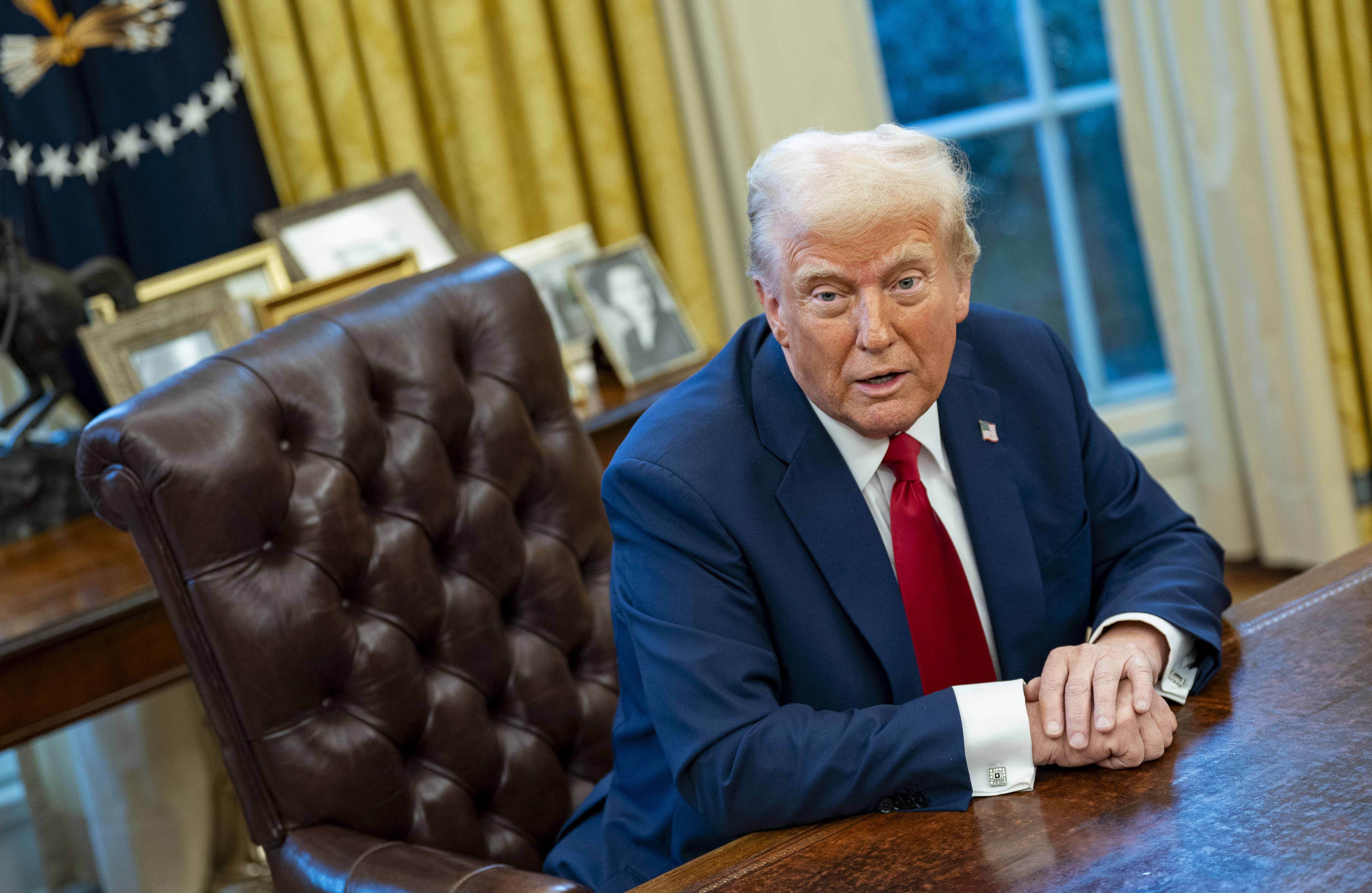
The Trump administration designated several branches of the Muslim Brotherhood as terrorist organizations in a move that will send shockwaves across the Middle East.
“The United States will use all available tools to deprive these Muslim Brotherhood chapters of the resources to engage in or support terrorism,” said Secretary of State Marco Rubio in a statement.
The decision comes just a month after President Trump instructed the State Department to consider issuing designations against Muslim Brotherhood branches in Jordan, Egypt and Lebanon. The policy appears tailored to slow down calls on the right to designate the entire Muslim Brotherhood as a terror group — a move that national security experts say would fuel extremism among moderate members of the group while diverting resources away from dealing with more violent groups, like al-Qaida or ISIS.
The move drew praise from hawkish analysts on the right. Mariam Wahba of the Foundation for Defense of Democracies called Trump’s decision “the most robust and consequential effort to tackle the growing threat posed by the world's largest and most potent Islamist organization.” The Institute for the Study of Global Antisemitism and Policy lauded the move and promised to “continue to brief policymakers” on its research about the organization and “on policy options for addressing the Muslim Brotherhood's long-term strategy.”
FDD and ISGAP played a crucial role in advancing the push to designate the Muslim Brotherhood, alongside officials and lobbyists representing Israel and the UAE, as RS reported last month.
The policy shift draws distinctions between different branches of the organization. The U.S. now considers the Lebanese Muslim Brotherhood a foreign terrorist organization, meaning that its backers can be criminally prosecuted if they provide “material support” to the group. (The administration has accused Lebanon’s Muslim Brotherhood of firing rockets at Israel in recent years.) Trump used a slightly less restrictive designation for the Egyptian and Jordanian Muslim Brotherhood affiliates, naming them as “specially designated global terrorists,” a move that cuts off their members from the global banking system.
The impact of the designation will largely come down to how aggressively the Trump administration enforces the policy. The Muslim Brotherhood refers to a loose umbrella of Islamist groups inspired by the teachings of Islamic scholar Hassan al-Banna, who founded the Egyptian Muslim Brotherhood in 1928. Muslim Brotherhood-affiliated groups have followed diverse paths in the ensuing century, with some forming moderate political parties, like in Tunisia, while others took up armed struggle, like Hamas. But many of them have maintained some form of contact with other Muslim Brotherhood groups — a fact that could now expose them to serious legal liability.
The decision will complicate U.S. relations with some of its allies in the Middle East, some of which are active supporters of the Muslim Brotherhood, including Qatar and Turkey. “For other governments where the brotherhood is tolerated, it would be a thorn in bilateral relations,” Nathan Brown, a professor of political science at George Washington University, told AP News.
Critics also say the move could bolster efforts by authoritarian governments to crack down on political opposition parties. Egypt banned its local Muslim Brotherhood branch after a military junta deposed the country’s democratically elected Islamist president in a bloody coup in 2013. Jordan, for its part, banned a Muslim Brotherhood-affiliated political party in 2025 after it won roughly a third of seats in the Jordanian House of Representatives in 2024. As Raed Jarrar of DAWN told RS last month, “it's a free gift that authoritarian regimes would use to stifle freedom of expression and political organizing in the Middle East and North Africa.”
- Was Jordan's Muslim Brotherhood ban a bid to please Israel, Saudi? ›
- Who's behind push to designate Muslim Brotherhood a terror group? ›
 Screengrab via niacouncil.org
 Screengrab via niacouncil.org