

The Gulf – where petrostates and psychodrama hold sway – is a critical field for jockeying in the global shift to multipolarity, and the Ukraine war is recasting what each player wants, and thinks it can get.
To wit: The Biden Administration wants to extend the Abraham Accords to include Saudi Arabia, so it can point to a key foreign-policy win before next year’s presidential election while moving Riyadh back inside the U.S.-Israel tent.
Saudi Arabia’s Mohammad Bin Salman (Crown Prince MBS) wants instead to distance Riyadh from Washington so he can lead non-aligned talks and take the credit for resolving Ukraine’s war with Russia — though, as an aside, he has demanded a nuclear enrichment plant and a fleet of F-35 fighter jets to consider Washington’s request in return.
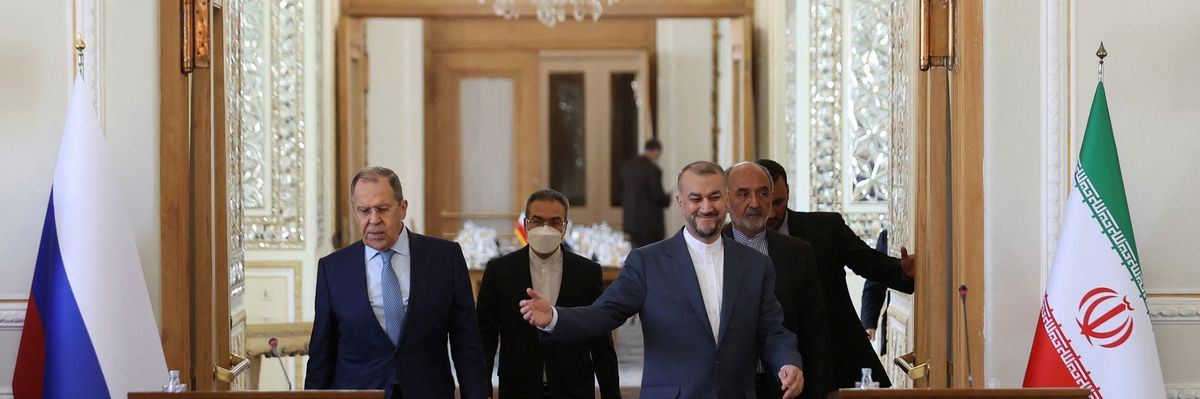
Iran, which came in from the cold after the past year’s “Women, Life Freedom” protests by signing a China-brokered normalization deal with Saudi Arabia, wants to stymie any Abraham Accords expansion beyond Bahrain and the United Arab Emirates and is working hard on becoming everyone’s best friend outside the West — read: Saudi Arabia, China, and Russia.
Israel wants to expand the Accords to include Riyadh, seeing it as a rare foreign policy opportunity to both balance Netanyahu’s domestic woes triggered by his controversial far-right government and to promote the anti-Iran U.S. alliance in the Gulf.
The Gulf’s oil and staggering wealth, its divide down the middle between Iran and pro-Western states, and its unwieldy balance of two global energy producers facing each other across the absurdly narrow and strategic Strait of Hormuz all make the region one of the highest-stakes playing fields in the world.
And the Ukraine war is shifting the goalposts. The Russians have arrived; China is quietly offering prizes, like nuclear plants, to regional actors; and the Gulf Cooperation Council states are flexing new muscle in the ongoing geo-strategic realignment.
Russian Moves
Russians are flooding the Gulf. They are buying up everything from lampshades to heavy equipment in Iran’s bazaars and avoiding sanctions by shipping them over land and across the Caspian Sea. Saudi Arabia is in talks with Russian weapons manufacturers sanctioned by the U.S. Meanwhile, the hotels in Abu Dhabi, Dubai, and down the Omani coast have seen a 200-percent jump in Russian bookings this year (376,000 guests a month in Abu Dhabi alone, triple last year’s average) despite the weakening ruble.
Both MBS and Mohammed bin Zayed Al Nahyan, the UAE’s Emir, have entered the field to negotiate a peace accord between Moscow and Kyiv. MBZ, as he is called, visited Russia in June presenting his mediation skills to President Putin, while MBS hosted a round of peace talks in Jeddah in early August, while voluntarily cutting oil output in July to boost prices, upsetting Washington (yet again) as the move will likely shore up Russian oil revenues.
U.S. Secretary of State Anthony Blinken’s attempt during his trip to Riyadh in July to promote the Abraham Accords and convince MBS not to move the goalposts, as well as to join the sanctions regime against Russia fell well short of success.
MBS, touting ties to both Ukraine and Russia, instead drew his own line in the turf, gathering 42 countries to his “peace” summit, including the U.S. and China while excluding Iran and Russia. Western critics dismissed it as a soapbox for MBS to parade his new-found role as peace broker (and Moscow blasted it as pointless). But, with China floating a revised 10-point peace formula at the meeting, it established the kingdom’s credentials as an emerging power offering new avenues for global conflict mediation, creating more daylight between Riyadh and Washington.Iran Reconstructed
With a new round of protests to mark the anniversary of the women’s demonstrations that began last September, the clerical leadership marks a year of surprising rehabilitation in the Gulf as well as wider afield.
Saudi Arabia and Iran have reestablished embassies in their respective capitals, offering a green light to warmer (and more substantive) relationships between Tehran and capitals up and down the Gulf’s western littoral. For Riyadh, Tehran’s warming relations with Moscow and its military support to Russia’s war effort have not posed major hurdles, as its own diplomatic proximity to Russia has grown.
Both states recognize that their relations with Moscow are pragmatic, if not entirely problem-free, and, as with much in their own ongoing detente, are more focused at the moment on compartmentalizing points of contention to build, rather than damage, goodwill.
Despite their respective reputational black marks for human rights, the two oil heavyweights were just warmly welcomed into the BRICS (along with the UAE). This signals the Global South’s growing clout and diversity, as well as a clear willingness to challenge established great power rules, prompting White House National’s Security Advisor Jake Sullivan seemingly to dismiss the BRICS after the meeting as geopolitically inconsequential.Israel and the U.S. seeking purchase
Although U.S. military engagement and financial commitments remain dominant in the Gulf, Washington is no longer leading the action, and is often caught up short these days by Beijing moving the goal posts behind its back. Following its diplomatic coup with the surprise Iran-Saudi normalization deal, China just last week offered to build a nuclear plant on the Saudi border with Qatar and the UAE without including the same conditions demanded by the U.S. to prevent enrichment and possible nuclear weaponization.
This comes hard on the heels of Blinken’s trip to Riyadh to promote the Abraham Accords, which he described as the “cornerstone” of the Biden administration’s Middle East policy on the basis that “Israel’s further integration into the region contributes to a more stable, a more secure and more prosperous region.”
But with tensions still rising between Netanyahu’s far-right government and the Palestinians, Riyadh is unconvinced that a public declaration of amity with Israel is politically wise or would contribute to stability in the Gulf, especially as trade, trust and diplomacy between the two countries have grown steadily without the fanfare of normalization. For MBS, the risks of joining the Accords include not only outraging the kingdom's own population and the wider Muslim community if it is seen as downgrading the Palestinian issue. But it could also stymie progress with Tehran, which would view such a move as Riyadh buckling to U.S. pressure and rejoining the anti-Iran camp. As the kingdom spreads its wings, it is clearly prioritizing Gulf neighborliness and détente over U.S. chumminess.
Where Washington has made progress, albeit without Israel’s support, is in backroom arrangements with Iran to tone down its nuclear enrichment in exchange for access to $6 billion of its frozen reserves held by South Korea.
Under the umbrella of a prisoner swap, which Washington hopes to finalize in two or three weeks, bank transfers have been prepared and Iran has quietly slowed its uranium enrichment to 60 percent and is in the process of diluting its stockpile. It’s the first breakthrough on the nuclear front since Donald Trump withdrew from the six-party JCPOA in 2018.
And, although it means negotiating with a sworn enemy — and only then through intermediaries, notably Oman and Qatar — it shows that Washington can maneuver adeptly even when the Gulf’s goal posts are shifting.
What’s less clear is whether the U.S. can be as flexible in expanding the Abraham Accords, with both China and Israel nipping at its heels, its hopes for a Libya-Israel rapprochement now dashed, and its erstwhile Team USA — aka the GCC states — heading off in different directions.
Though the Ukraine war is playing out in the European arena, its repercussions in the Gulf are striking. It has opened new horizons for Russia and China to engage meaningfully in the region’s security and energy, while giving new impetus to the region’s mid-level powers to pursue not only their own expanding agendas, but to find common cause in a Gulf-centered community that can sidestep the vicissitudes of Great Power competition.