

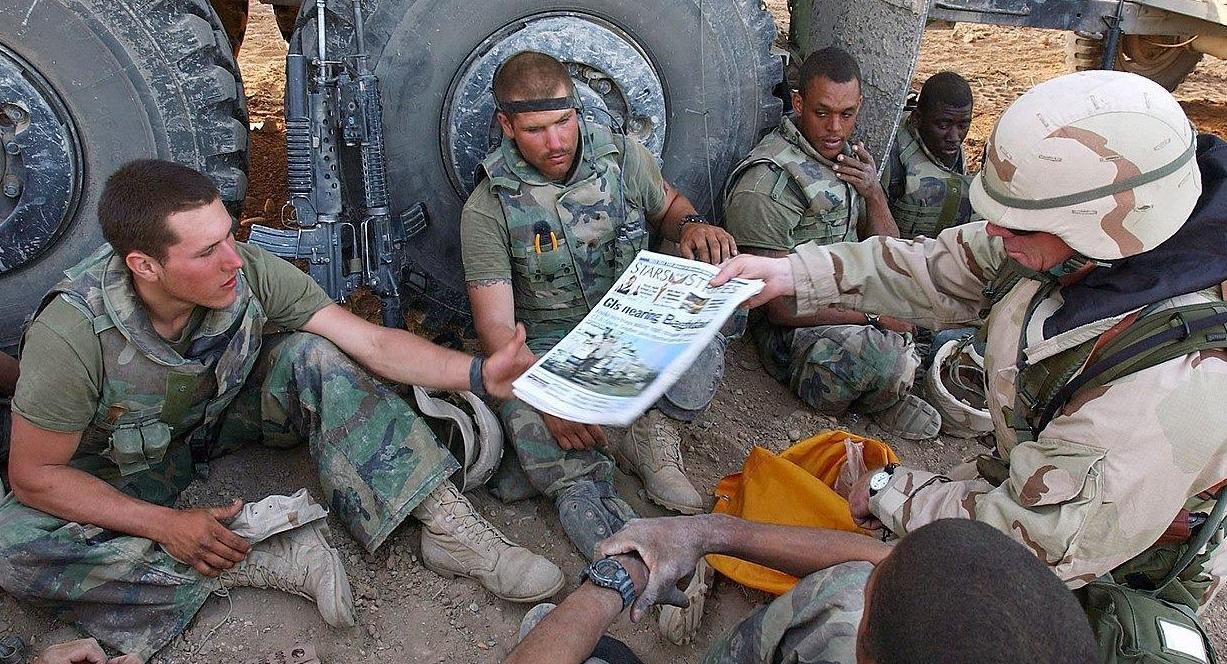
During Trump’s first administration, the Stars and Stripes newspaper had come perilously close to shuttering. In 2020, the Pentagon asked Congress to cut its funding, before ultimately ordering for the paper to be closed.
After a serious bipartisan pushback from lawmakers, Trump reversed course and the newspaper, which is authorized by Congress and the US Department of Defense, and has been a staple for American service members and their families since World War I, was spared.
But the future of the publication was again called into question earlier this month.
In a recent post on social media, Sean Parnell, the Pentagon’s top public affairs official and a close adviser to Defense Secretary Pete Hegseth, announced that the Pentagon would be taking over editorial content decision-making.
“The Department of War is returning Stars & Stripes to its original mission: reporting for our warfighters. We are bringing Stars & Stripes into the 21st century,” Parnell wrote in a post to X. “We will modernize its operations, refocus its content away from woke distractions that syphon morale, and adapt it to serve a new generation of service members.”
Also in the post, Parnell wrote that the newspaper would now “be custom tailored to our warfighter,” focusing on “warfighting, weapons systems, fitness, lethality, survivability, and ALL THINGS MILITARY.”
Unlike the threats of 2020, this proposed overhaul would allow operations of Stars and Stripes to continue, but at what cost?
Among the proposed changes, the Pentagon plans for only active-duty service members to produce all of Stars and Stripes’ reporting, and for 50% of the content on the Stars and Stripes website to “be composed of War Department-generated materials, including digital or print materials made by War Department writers and images captured by combat cameras.”
These changes appear to contradict with the historical editorial independence of Stars and Stripes. While the publication is part of the Pentagon’s Defense Media Activity and is authorized by the Department of Defense, it has long been an independent news source, under a congressional mandate that it be governed by First Amendment principles.
It is also only partially subsidized by the DoD, with most of its income brought in by subscriptions and advertising. The paper says it reaches an estimated 1.4 million readers a day across platforms.
Needless to say, the proposed overhaul would drastically affect the way that Stars and Stripes operates and risks being viewed as a PR machine delivery system for the Pentagon rather than vehicle for information written for and by military and civilians in the military community, wrote Jacqueline Smith, the ombudsman of Stars and Stripes, who challenged the change in a recent article in the publication:
Parnell’s statement was brief. The ramifications were spelled out, however, in a story on the Daily Wire in which unnamed “War Department officials” said stories will be written by active-duty service members and “Fifty percent of the website’s content will be composed of War Department-generated materials.” If half the content is composed by the Pentagon, how could anyone trust the other half to be impartial? Credibility will turn to dust. I believe that service members are smart. They do not need to be spoon-fed good news from the Department of Defense/War. Give them the full and fair picture and let them think for themselves. This is respecting those who serve.
Ben Holden, a professor at Northwestern University with experience in media law and free speech rights, told RS that Parnell’s proposal runs the risk of violating Directive 5122.11, which states, among other guidelines, that “there shall be a free flow of news and information to (the Stars and Stripes) readership without news management or censorship.” He said this drives right at the heart of the credibility issue as well.
“Institutions that try to control information often believe suppressing truth and transparency serves their interests,” Holden added. “Transparency builds trust. Over time, readers, whether civilians or soldiers, develop confidence in news and information that is honest, even if imperfect. Without credibility, you don’t have a publication.”
Not only this, but the newspaper has been critical in reporting on issues that affect service men and women here and in overseas deployments that may otherwise go unnoticed, said Kathy Kiely, the Lee Hills Chair in Free Press Studies at Missouri University and a board member of The Stars and Stripes National Museum and Library.
Without this crucial watchdog journalism, problems can go unreported, Kiely said, issues like insufficient military housing allowances or when the TRICARE health plan (which serves upwards of 9.6 million active duty members, retirees, families, and survivors) isn’t working correctly.
“If reporting is edited or censored by people who don’t want leadership bothered by inconvenient facts, then the troops won’t be served,” Kiely said. “All Americans deserve a watchdog press, but especially those who have signed up to defend the country.”
This has not been lost on the National Military Families Association, which penned a letter imploring the Pentagon not to take editorial control of the paper.
“That independence has enabled Stars and Stripes to report on unsafe conditions in privatized military housing, alleged abuse in Child Development Centers, changes in [Department of Defense Education Activity] schools, and other issues that rarely receive sustained attention from mainstream media,” wrote NMFA CEO Besa Pinchotti.
The announcement was decried by other military advocacy groups, press freedom advocates and policymakers alike. Even Stars and Stripes Editor-in-Chief Erik Slavin made clear his opposition and his commitment to balanced coverage in a message to the newspaper's editorial staff.
“The people who risk their lives in defense of the Constitution have earned the right to the press freedoms of the First Amendment,” Slavin wrote. “We will not compromise on serving them with accurate and balanced coverage, holding military officials to account when called for.”
The situation has elicited mixed reactions from veterans, many of whom read Stars and Stripes while in service. For some, including veteran and editor of Real Clear Defense John Waters, the proposal is a positive move toward reporting that will more accurately reflect what it’s like to serve.
By having active-duty service members produce all of Stars and Stripes’ content, it will result in content with a more authentic voice, as very few people “understand what it’s like to carry a weapon, go through boot camp or basic training, live on a military base, deploy, leave family behind, or prepare for combat in a combat zone.”
“While journalists can and do try to understand this world from an outside, observational perspective, it can only be fully understood by those who have lived it,” Waters said. “If more of those voices are brought into the publication, the department may achieve one of its goals: presenting a more authentic, true-to-life military voice.”
Other veterans worry that limiting the editorial independence of Stars and Stripes could actually distort the full military experience for readers. Veteran Thomas Brennan, editor of The Warhorse, said that the move could prevent the public from “understand[ing] the full range of issues service members face.”
“In my view, it is the role of public affairs to tell the military’s good stories,” Brennan said. “Journalists, on the other hand, should tell stories that include the exceptional, the bad, and the ugly. If Stars and Stripes only publishes positive coverage in the same manner as a press office, the two will become conflated, and that will further erode trust in the publication.”
Congress, which authorizes the newspaper’s budget, may be in a position to thwart the changes. Soon after the announcement, several members of the Senate Armed Services Committee — all Democrats — including Sens. Elizabeth Warren (D-Mass.), Mark Kelly (D-Ariz.), Richard Blumenthal (D-Conn.), and Tammy Duckworth (D-Ill.), said that efforts to usurp Stars and Stripes’ editorial independence amounted to an attack on the First Amendment.
“I certainly will push back,” said Blumenthal, a Marine Corps veteran, “because I think that the independence of Stars and Stripes is absolutely essential to the public knowing the truth about what’s happening in our military and also a measure of respect to our men and women who serve and sacrifice.”
- Hegseth: 'Defense' is out, 'killing people and breaking things' is in ›
- Report: Pentagon will likely fail audits through 2028 ›