

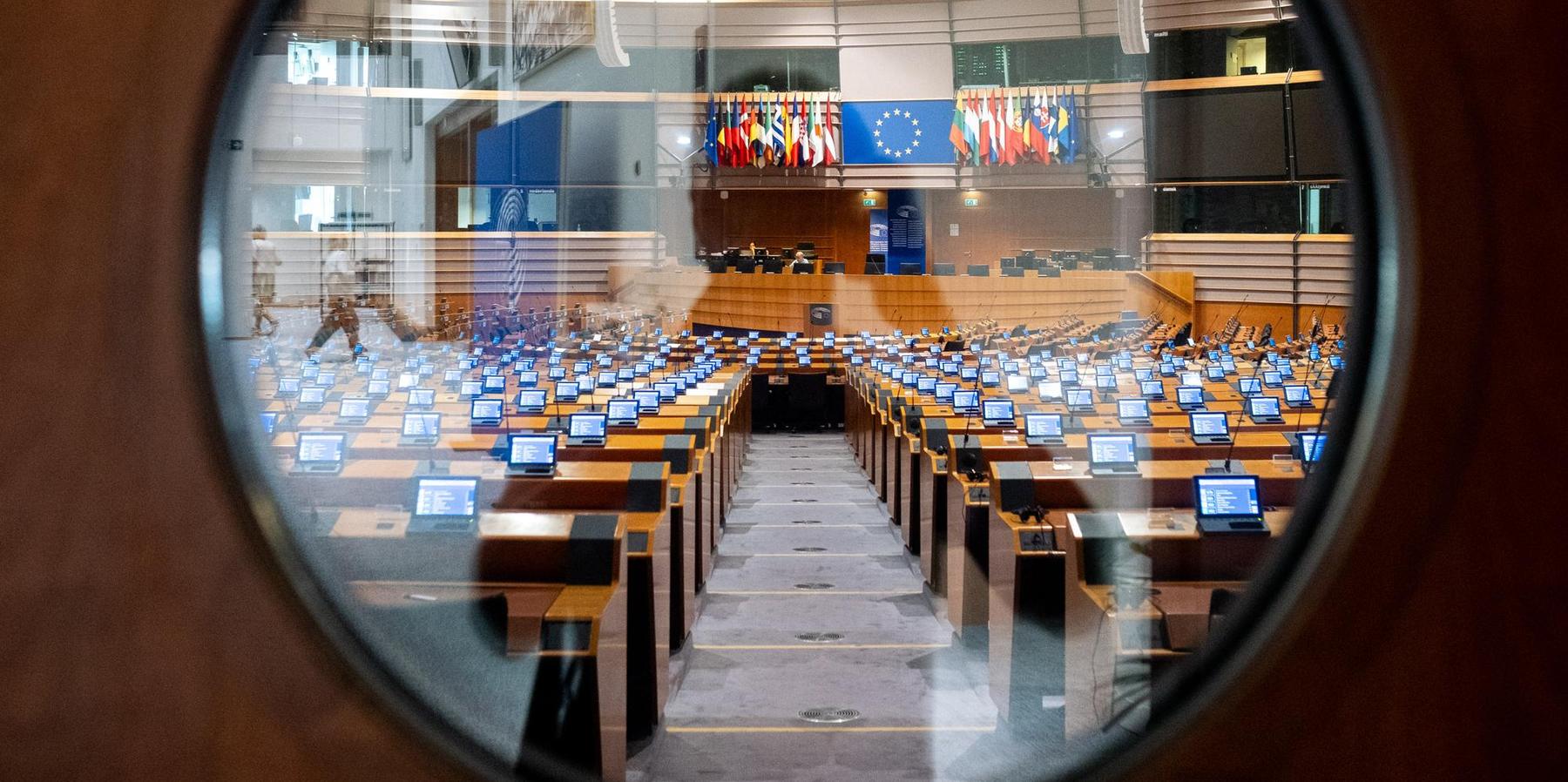
The European Parliament Thursday overwhelmingly adopted a resolution condemning the “brutal repression against protesters in Iran.”
While the final numbers look impressive — 562 MEPs voted for, 9 against and 57 abstained — scrutiny of voting patterns on individual amendments reveals a more nuanced picture, one of an emerging political realignment across ideological divides not dissimilar to recent developments in the U.S. Congress.
An amendment demanding de-escalation and condemning military threats against Iran was supported by a combination of the far-right and far-left blocs but opposed by the entire centrist bloc.
In addition to “condemning the repression” by the Iranian authorities of January’s street protests and urging Tehran to “cease all violence and engage in genuine dialogue,” an amendment tabled by the Italian Left MEP Danilo Della Valle (representing the anti-establishment Five Stars movement in Italy) “call(ed) for all EU institutions to fully respect the sovereignty and territorial integrity of the Islamic Republic of Iran, in accordance with the UN Charter and international law; strongly condemns any threat or use of military force against Iran, as well as any external attempt at destabilization or interference in Iran’s internal affairs.”
Apart from his own left faction, Della Valle’s amendment was supported by the right-wing Patriots for Europe (PfE), the third largest bloc in the chamber comprising such parties as the French National Rally, currently leading the polls in France, and the ruling parties of Hungary, the Czech Republic, and Italy. The Europe of Sovereign Nations (ESN), which is further to the right of the PfE and led by the Alternative for Germany (AfD), also voted in favor.
The mainstream blocs, including the center-right European People’s Party (EPP), the center-left Socialists & Democrats (S&D), and the liberal Renew Europe were joined by the right-wing European Conservatives and Reformists (ECR) in opposing the amendment, ensuring its defeat.
This split suggests the emergence of an American-style realignment in Europe, where ideological opposites find common cause in promoting foreign policy restraint, while the establishment center holds a more interventionist and hawkish stance. The left voted on anti-imperialist principles, opposing U.S. hegemony and military adventurism, while the right cited the inviolability of national sovereignty and concerns that a new Middle East war risked destabilizing the region and triggering new refugee flows into Europe.
The realignment is neither neat nor stable, however, but rather fluid and opportunistic. It coheres on a shared, sovereigntist non-intervention principle, but fractures when that principle conflicts with other ideological priorities.
Another amendment tabled by Della Valle that called for “EU institutions to exert diplomatic pressure on the United States and Israel to refrain from issuing or supporting military threats against Iran, and to commit to de-escalation, dialogue and full respect for international law,” revealed a different voting pattern. The Left, in that case, was by the center-left S&D, reflecting the stance of Spain’s government under Prime Minister Pedro Sanchez who was outspoken in his criticism of Israel’s military campaign in Gaza. The EPP and centrist liberal Renew Europe opposed the amendment, consistent with their staunch Atlanticist orientation and close ties with Israel.
They were joined by the conservative Patriots, whose consistent support for Israel, rooted in civilizational, anti-Islam politics, trumped their non-interventionist instincts.
The sovereigntist coalition, including the Left, ESN, and Patriots, was unexpectedly joined by S&D in backing an amendment tabled by the Belgian leftist Marc Botenga, that “reaffirms that the choice of Iran’s political leadership and institutional arrangements belongs solely to the Iranian people; underlines that it is not for the EU to endorse, promote or favor any particular opposition figure or candidate, nor to attempt to shape Iran's political future from abroad.”
This is a highly unusual coalition as S&D adheres rigidly to the “firewall,” a policy designed to isolate the Patriots and the ESN. All the more significant, then, that the S&D voted alongside both the far left and far right. It suggests that the old centrist consensus can fracture from within, driven by the pull of national government positions – in this case, Spain’s, the last major country in the EU governed by social democrats.
As seen from these examples, the EP’s Iran vote did not reveal a single, clean political rupture. Rather, it displayed a polity where the old left/right foreign policy spectrum no longer applies.
Instead, the variables that now determine the alliances are pro-Atlanticist vs. sovereigntist, interventionist vs. non-interventionist, and pro-Israel vs. critical of Israel (while the left is consistent in its criticisms of Israel, the far right is still willing to make exceptions for Israel from its generally non-interventionist stances.) Parties position themselves differently on each axis, which yields to a variety of coalitions of strange bedfellows.
One particularly insightful subset of data provided a snapshot of France's future presidential elections (to be held in 2027). Two of the likely contenders are MEPs:Jordan Bardella, the leader of both the Patriots in the European Parliament and the National Rally in France, who is currently leading in the polls, and Raphaël Glucksmann (Place Publique, S&D), a liberal-progressive hawk,.
On Iran, Bardella voted consistently for the sovereignty and non-interference amendments. His alignment with the far left on this issue was strategic, reflecting his "France First" sovereigntist stance. It signals a foreign policy designed to distance France from U.S.-led interventionism in the Middle East.
On the other end of the spectrum, Glucksmann broke ranks with his own S&D group by a) abstaining on the amendment reaffirming Iranian sovereignty in determining its own political system and leadership and b) by voting against the criticisms of Israel and calls for de-escalation.
This was a conscious signal to a hawkish electorate that he rejects the non-interventionist stance shared by the far left and far right. For Glucksmann, distinguishing himself from both is central to his presidential branding.
This fluid realignment has some parallels in the U.S. embodied by the progressive Democrat Ro Khanna and libertarian Republican Thomas Massie who have repeatedly formed coalitions in Congress to oppose foreign military interventions and advocate for a restrained foreign policy.
However, the replication of this model in Europe faces crucial limits. The U.S. system forges alliances within a two-party structure. The EU's multi-party system allows for more fluid, issue-specific coalitions, but also makes them less stable and predictable.
In the U.S., there are no informal or formal norms against Republicans and Democrats working together on specific initiatives. In Europe, for mainstream parties, especially on the center-left, reaching out to the far right, even on limited, narrow foreign policy issues, remains a powerful taboo. They can vote the same way on specific amendments, but never as a result of directly negotiating together.
Finally, the European Parliament, representing 27 member states, reflects national political competition in each of them — as the Bardella-Glucksmann example clearly shows. This adds a layer of complexity absent in the U.S., where congressional votes are less directly tied to individual presidential ambitions in the same way.
The EP’s vote on Iran did not produce a new EU foreign policy. But it did confirm the emergence of a "sovereigntist front" that can unite against the hawkish, interventionist establishment and even, occasionally, expose the cracks within that same centrist bloc in favor of non-intervention.
- EU's vaunted unity is disintegrating over Gaza crisis ›
- Europe whistles past the Venezuelan graveyard ›
- Could this be the election that brings Hungary's Orban down? | Responsible Statecraft ›